Fire safety has become a critical consideration in modern residential and commercial construction. While traditional plywood continues to be widely used across interiors, increasing awareness of fire risks has shifted attention toward specialized solutions such as fire resistant plywood and fire-rated plywood. Whether you are designing a home, office, hotel, retail outlet, or public facility, selecting the right plywood can significantly impact occupant safety and property protection.
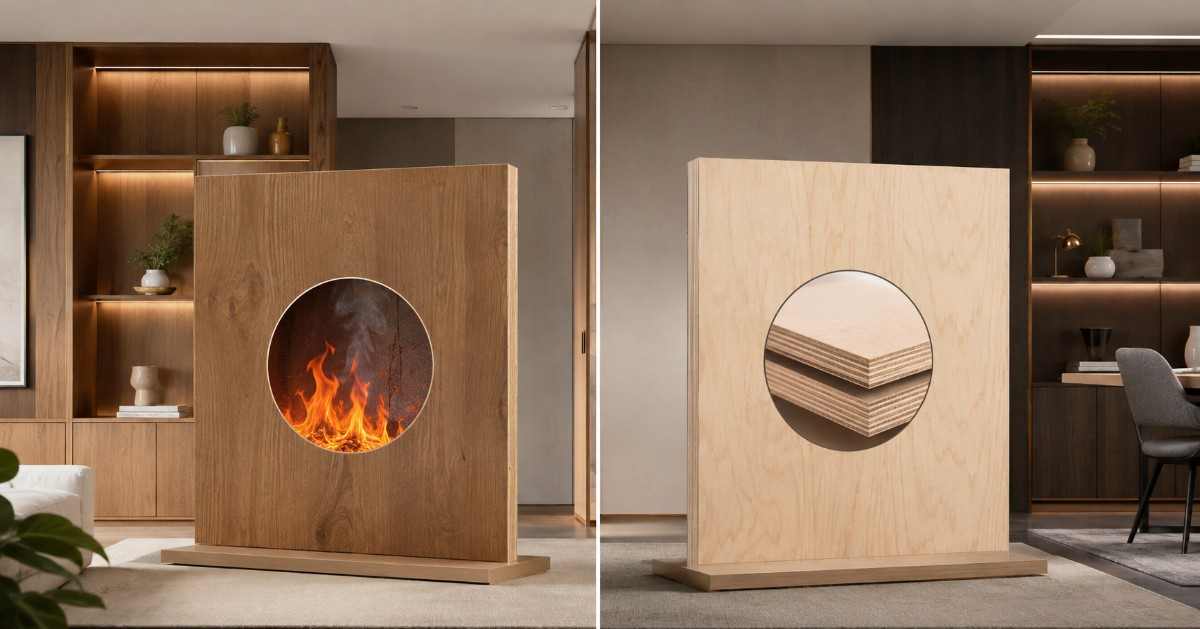
The discussion around Fire Retardant Plywood vs Standard Plywood goes far beyond strength and durability. The real difference lies in how each material behaves when exposed to heat and flames. Standard plywood is designed primarily for structural performance and everyday interior applications. In contrast, fire safety plywood is chemically treated to slow flame spread, reduce smoke generation, and provide valuable evacuation time during fire incidents. This makes it an increasingly preferred material for high-occupancy and safety-sensitive environments.
Today, architects and project consultants frequently specify IS 5509 fire retardant plywood for projects where compliance and fire protection are important considerations. These products are manufactured using specialized fire-retardant treatments and tested according to Indian standards designed specifically for fire-resistant plywood applications.
The choice becomes particularly important when selecting plywood for commercial buildings. Offices, hotels, auditoriums, restaurants, educational institutions, healthcare facilities, and high-rise structures often require materials that help reduce fire hazards while maintaining structural reliability. In such applications, fireproof plywood—more accurately referred to as fire-retardant plywood—offers an additional layer of protection compared to conventional plywood.
Another factor influencing purchasing decisions is cost. Buyers often compare Fire Resistant Plywood Price, Fire retardant plywood vs standard plywood price, and Standard Plywood Price before finalizing material specifications. While fire-retardant plywood generally commands a premium due to additional chemical treatment and testing requirements, many projects consider this cost justified by the enhanced safety benefits and regulatory compliance advantages.
Among premium options available in Fire retardant plywood India, Wigwam Ply has developed specialized fire-retardant products designed for both residential and commercial applications. Products such as Wigwam Visor and Wigwam Contender combine fire-retardant performance with both-side calibration, structural stability, and advanced manufacturing standards. Wigwam Visor additionally conforms to Structural Grade IS 10701, Fire Retardant Grade IS 5509, and Marine Grade IS 710 requirements, making it a distinctive solution for demanding projects.
In the following sections, we will examine the differences between fire-retardant and standard plywood, explore Fire retardant plywood specifications, compare performance and pricing, and identify the best choice for residential and commercial projects.
Top 10 Best Plywood Brands in India: Best Plywood Companies Compared
Fire Retardant Plywood vs Standard Plywood — Construction, Treatment & Key Differences
When comparing Fire Retardant Plywood vs Standard Plywood, the most important distinction is not strength, moisture resistance, or durability. The real difference lies in how the material behaves during a fire.
In residential and commercial projects, plywood is often used extensively in wall paneling, furniture, ceilings, partitions, storage systems, and decorative interiors. During a fire event, these materials can either contribute to flame spread or help slow it down. Understanding this difference is essential when selecting materials for safety-conscious projects.
What Is Standard Plywood?
Standard plywood consists of multiple wood veneers bonded together in alternating grain directions using adhesive systems designed primarily for moisture resistance and structural performance.
Common examples include:
- IS:303 Moisture Resistant (MR) plywood
- IS:710 Boiling Water Proof (BWP) plywood
- Commercial-grade plywood used in furniture and interiors
From a fire-performance perspective, these products receive no dedicated fire-retardant treatment during manufacturing.
As a result, standard plywood:
- Ignites relatively easily when exposed to sufficient heat
- Supports flame propagation across the panel surface
- Generates significant smoke during combustion
- Releases combustible gases that sustain fire growth
- Contributes additional fuel to a developing fire
While IS:303 and IS:710 certifications verify moisture resistance and durability performance, they do not evaluate fire-retardant properties.
What Is Fire Retardant Plywood?
Fire resistant plywood, also known as fire safety plywood or fire-rated plywood, is specifically engineered to slow the ignition and spread of fire.
In an IS 5509 fire retardant plywood, every veneer layer is treated using specialized fire-retardant chemicals before or during manufacturing. These treatments typically use phosphate-based or borate-based compounds designed to modify the combustion characteristics of wood.
Rather than allowing rapid flame propagation, the treatment interrupts the chemical chain reaction responsible for combustion at the wood-fiber level.
As a result, fire-retardant plywood:
- Delays ignition
- Slows flame spread
- Reduces heat release
- Generates lower smoke volumes
- Reduces smoke toxicity
- Provides additional evacuation time during emergencies
This altered fire behavior makes fire-retardant plywood particularly valuable in high-occupancy buildings and commercial environments.
Understanding IS 5509 Fire Retardant Plywood Specifications
One of the most important factors buyers should verify is compliance with IS 5509 fire retardant plywood requirements.
IS 5509 is the Indian Standard specifically developed for fire-retardant plywood. Unlike generic marketing claims, IS certification requires products to satisfy defined testing criteria and performance benchmarks.
Key Fire retardant plywood specifications include:
| Performance Requirement | IS 5509 Requirement |
| Spread of Flame Test | Evaluated under IS:1734 Part 9 |
| Flame Propagation Performance | Must remain within prescribed limits |
| Char Length Control | Must satisfy maximum permissible char limits |
| Smoke Generation | Controlled within specified parameters |
| Fire Retardant Treatment | Mandatory as part of manufacturing process |
| Certification Verification | Must comply with IS 5509 requirements |
This distinction is important because many products marketed as “fire resistant” may not possess independent certification demonstrating actual fire-retardant performance.
For safety-critical projects, verified IS 5509 compliance should always take precedence over unverified marketing claims.
Is Fireproof Plywood Real?
A common misconception involves the term fireproof plywood.
Technically, no wood-based panel is truly fireproof.
Wood remains a combustible material regardless of treatment. Fire-retardant chemicals cannot make plywood immune to fire. Instead, they significantly slow the ignition process and reduce the speed at which flames travel across the surface.
Therefore, the correct technical description is fire retardant plywood, not fireproof plywood.
The purpose of fire-retardant treatment is to:
- Delay ignition
- Slow flame spread
- Reduce smoke development
- Improve evacuation opportunities
- Enhance overall building safety
This distinction is important because it creates realistic safety expectations and aligns with accepted fire-engineering principles.
Fire Retardant Treatment Methods: Pressure Impregnation vs Surface Coating
Not all fire-retardant plywood is manufactured using the same treatment method.
The effectiveness of fire protection depends heavily on how the chemicals are introduced into the panel.
Pressure Impregnation
Pressure impregnation is considered the most reliable fire-retardant treatment process.
In this method, fire-retardant chemicals are forced deep into the wood structure under controlled pressure conditions before or during manufacturing.
Advantages include:
- Deeper chemical penetration
- Uniform treatment throughout the veneer
- Long-term fire-retardant performance
- Protection remains effective after cutting and machining
- Greater durability throughout the product lifecycle
Surface Coating
Some manufacturers rely primarily on surface-applied fire-retardant coatings after panel production.
While these coatings may initially improve surface fire resistance, they present several limitations:
- Protection remains largely surface-level
- Cutting and machining can expose untreated wood
- Coatings may wear over time
- Performance can decline if the surface is damaged
For projects where fire safety is a genuine requirement, pressure-impregnated IS 5509-certified plywood remains the preferred specification.
IS 5509 Fire Retardant Plywood vs Standard Plywood
| Parameter | IS 5509 Fire Retardant Plywood | Standard IS:303 MR Plywood | Standard IS:710 BWP Plywood |
| Fire Retardant Treatment | Yes, chemically treated veneers | No | No |
| Flame Spread Behaviour | Significantly slowed | Rapid flame propagation | Rapid flame propagation |
| Ignition Resistance | Higher | Lower | Lower |
| Smoke Generation | Reduced | Higher | Higher |
| Smoke Toxicity | Lower | Higher | Higher |
| IS Certification | IS 5509 | IS 303 | IS 710 |
| Spread-of-Flame Testing | Mandatory | Not required | Not required |
| Structural Integrity Under Heat | Retained longer during fire exposure | Degrades rapidly | Degrades rapidly |
| Evacuation Time Contribution | Improved | Limited | Limited |
| Primary Application | Commercial buildings, public spaces, hotels, hospitals, educational institutions, premium residential projects | Furniture, interiors, general residential applications | Wet-area furniture, kitchens, bathrooms, marine environments |
| Fire Safety Compliance Suitability | High | Low | Low |
Why Wigwam Ply Approaches Fire Safety Differently
For projects where fire safety cannot be compromised, material selection should focus on verified performance rather than marketing terminology. Wigwam Ply’s fire-retardant offerings are designed to combine fire-resistance performance with structural reliability, dimensional accuracy, and premium furniture-grade finishing.
By integrating both-side calibration, advanced manufacturing controls, and compliance with IS 5509 requirements, Wigwam Ply provides a solution that addresses both safety and performance expectations for modern residential and commercial interiors.
In the next section, we will examine where fire-retardant plywood delivers the greatest value, compare pricing with standard plywood, and determine whether the additional investment is justified for residential and commercial projects.
Fire Retardant Plywood for Residential & Commercial Projects — Price, Applications & Specifications
Selecting plywood today is no longer only about strength, moisture resistance, or aesthetics. Increasingly, architects, builders, and homeowners are evaluating materials through a fire-safety lens. This shift has significantly increased the adoption of Fire retardant plywood India, particularly in commercial projects and high-value residential interiors where occupant safety is a primary concern.
While standard plywood continues to serve many applications effectively, fire-retardant plywood offers an additional layer of protection by slowing flame spread and reducing smoke generation during a fire event. The question is no longer whether fire-retardant plywood works, but where it delivers the greatest value.
Plywood for Commercial Buildings: Where Fire Retardant Plywood Is Essential
Commercial buildings typically contain large volumes of plywood in furniture, wall paneling, ceilings, partitions, storage systems, and decorative interiors. During a fire, these materials can contribute significantly to flame spread if they are not fire-retardant treated.
As a result, plywood for commercial buildings increasingly includes IS 5509-certified fire-retardant plywood as a preferred or mandatory specification.
Office Fit-Outs
Modern offices rely heavily on plywood-based workstations, storage units, meeting rooms, wall cladding, and collaborative spaces.
In open-plan offices, large furniture volumes can contribute substantial combustible load. Fire-retardant plywood helps slow flame spread through these interiors, providing additional evacuation time for occupants.
Hotels and Hospitality Projects
Hotels, restaurants, banquet halls, and resorts accommodate large numbers of guests unfamiliar with building layouts.
For this reason, hospitality projects frequently specify flame-retardant materials throughout guest rooms, corridors, reception areas, and public spaces. Fire-retardant plywood helps support broader fire-safety strategies while maintaining premium interior aesthetics.
Retail Fit-Outs
Retail stores often contain dense display systems, shelving, storage units, and decorative installations.
Because customer occupancy fluctuates throughout the day, reducing flame spread becomes particularly important in maintaining safe evacuation pathways.
Healthcare Facilities
Hospitals, clinics, and healthcare centers accommodate patients with limited mobility and often contain sensitive medical equipment.
Using fire-retardant plywood in furniture and interior applications can contribute to safer evacuation conditions during emergencies.
Educational Institutions
Schools, colleges, libraries, and training centers frequently incorporate extensive plywood furniture and storage systems.
Fire-retardant materials help improve safety performance in environments occupied by large numbers of students and staff.
Cinema Halls and Auditoriums
High-occupancy venues require particularly careful material selection because evacuation may involve hundreds of occupants simultaneously.
Fire-retardant plywood is commonly specified for wall paneling, seating systems, stage construction, and acoustic treatments.
High-Rise Residential Buildings
Many fire-safety regulations impose stricter material requirements for taller structures.
In high-rise developments, fire-retardant interior materials are increasingly specified to improve overall building safety performance and support compliance objectives.
Residential Applications Where Fire Retardant Plywood Adds Real Value
Although commercial projects have historically driven demand, homeowners are becoming more aware of the benefits offered by fire-retardant plywood.
Modular Kitchens
The kitchen remains one of the highest-risk areas within any home.
Gas cooktops, electrical appliances, ovens, microwaves, and cooking oils all create potential ignition sources. Using fire-retardant plywood for cabinet carcasses and storage systems provides an additional layer of protection in the area most vulnerable to accidental fires.
Floor-to-Ceiling Wardrobes
Modern wardrobes contain substantial volumes of plywood concentrated within sleeping areas.
In the event of a fire, slowing flame propagation through these large furniture installations can help improve occupant response time.
Home Offices
The growth of remote work has increased the number of homes containing computers, printers, chargers, batteries, networking devices, and other electrical equipment.
Fire-retardant plywood can help mitigate risks associated with electrical faults and equipment overheating.
Growing Fire Safety Awareness in Indian Homes
Residential fire safety is receiving greater attention than ever before.
Homeowners increasingly evaluate not only aesthetics and durability but also material performance during emergencies. Insurance considerations, premium housing standards, and architect-driven specifications are encouraging greater adoption of fire-retardant materials in modern homes.
As awareness grows, specifying IS 5509-certified plywood is increasingly viewed as a proactive design decision rather than an optional upgrade.
Standard Plywood 18mm Price vs Fire Resistant Plywood Price
One of the most common buyer concerns involves comparing Standard Plywood Price with Fire Resistant Plywood Price.
The cost difference exists because fire-retardant plywood requires:
- Specialized fire-retardant chemicals
- Additional manufacturing processes
- Stricter quality-control protocols
- Mandatory fire-performance testing
- Compliance with IS 5509 certification requirements
Fire Retardant Plywood vs Standard Plywood Price
The exact premium varies by manufacturer, grade, thickness, certification level, and project location.
However, fire-retardant plywood typically commands a moderate premium over comparable standard plywood grades.
Indicative Market Comparison (18 mm Category)
| Product Type | Typical Market Position |
| Standard plywood 18mm (IS:303 MR) | Lowest cost |
| Standard plywood 18mm (IS:710 BWP) | Mid-range |
| IS 5509 Fire Retardant Plywood | Premium category |
| Fire Retardant Structural + Marine Grade Plywood | Highest category |
When viewed purely as a material purchase, fire-retardant plywood costs more.
When evaluated as a life-safety investment, however, the arithmetic changes considerably.
For a modular kitchen project, the additional expenditure required to upgrade from standard plywood to fire-retardant plywood often represents a relatively small percentage of the total project budget. Yet the resulting reduction in flame spread risk can significantly improve occupant safety during a fire event.
Fire Retardant Plywood India: How to Verify Genuine Products
As demand increases, buyers should carefully distinguish certified products from marketing claims.
Not every product marketed as fire resistant plywood or fireproof plywood has undergone formal certification testing.
When evaluating fire-retardant plywood, always verify:
- BIS licence details
- IS 5509 certification
- Manufacturer test certificates
- Product marking and traceability
- Technical data sheets
- Compliance documentation
A genuine fire-retardant plywood product should clearly indicate compliance with IS 5509 requirements rather than relying solely on generic fire-resistant terminology.
Quick Decision Guide
| Project Type | Recommended Specification |
| Commercial fit-outs | IS 5509 Fire Retardant Plywood |
| Hotels and hospitality projects | IS 5509 Fire Retardant Plywood |
| Healthcare facilities | IS 5509 Fire Retardant Plywood |
| Educational institutions | IS 5509 Fire Retardant Plywood |
| Cinema halls and auditoriums | IS 5509 Fire Retardant Plywood |
| High-rise residential projects | IS 5509 Fire Retardant Plywood |
| Modular kitchens | IS 5509 Fire Retardant Plywood |
| Home offices with significant electrical equipment | IS 5509 Fire Retardant Plywood |
| Standard residential furniture in low-risk dry interiors | IS:303 Standard Plywood |
| Wet-area furniture requiring moisture resistance | IS:710 Standard Plywood |
Why Wigwam Ply Is Positioned for Modern Fire-Safe Interiors
As fire safety becomes a larger consideration in both residential and commercial construction, material specifications must balance safety, performance, and aesthetics.
Wigwam Ply’s fire-retardant plywood solutions are engineered to meet these requirements by combining IS 5509-compliant fire performance with premium furniture-grade manufacturing standards. Products such as Wigwam Visor further integrate fire-retardant performance with structural-grade and marine-grade characteristics, providing a versatile solution for projects where safety and durability are equally important.
For architects, interior designers, developers, and homeowners seeking long-term value, certified fire-retardant plywood offers a practical way to enhance safety without compromising design quality.
Fire Resistant Plywood Price vs Standard Plywood Price
When evaluating Fire retardant plywood vs standard plywood price, buyers often focus only on the sheet cost. However, fire-retardant plywood should be evaluated as a life-safety material rather than a commodity panel.
The additional cost comes from specialized fire-retardant chemical impregnation, IS 5509 testing requirements, stricter quality control processes, and certification compliance. These manufacturing steps increase production costs but significantly improve fire performance. Wigwam’s fire-retardant plywood products use specialized fireproofing chemical infusions designed to slow flame spread and increase flame penetration time.
Indicative Fire Retardant Plywood Price Comparison (July 2026)
| Product Category | Thickness | Approx. Price (₹/Sq. Ft.) | Approx. Sheet Price (8 ft × 4 ft) |
| Standard MR Plywood | 18 mm | 70–95 | ₹2,240–₹3,040 |
| Standard BWP Plywood | 18 mm | 100–140 | ₹3,200–₹4,480 |
| Fire Retardant Plywood (Market Average) | 18/19 mm | 145–170 | ₹4,640–₹5,440 |
| Wigwam Contender (IS 5509 Fire Retardant) | 19 mm | ₹160 | ₹5,120 |
| Wigwam Visor (IS 5509 Fire Retardant + IS 710 + IS 10701) | 19 mm | ₹190 | ₹6,080 |
Wigwam Fire Retardant Plywood Price by Thickness
| Thickness | Wigwam Contender | Wigwam Visor |
| 6 mm | ₹2,720/sheet | ₹3,680/sheet |
| 9 mm | ₹3,264/sheet | ₹4,320/sheet |
| 12 mm | ₹4,000/sheet | ₹5,056/sheet |
| 16 mm | ₹4,736/sheet | ₹5,536/sheet |
| 19 mm | ₹5,120/sheet | ₹6,080/sheet |
| 25 mm | ₹6,144/sheet | ₹7,200/sheet |
The Wigwam Visor range combines Fire Retardant Grade (IS 5509), Marine Grade (IS 710), and Structural Grade (IS 10701) certifications within a single panel, making it one of the most specialized plywood offerings available for commercial and high-risk interior applications.
Price Disclaimer (July 2026): The above prices are indicative market references for standard 8 ft × 4 ft sheets and may vary by state, dealer network, freight charges, GST treatment, project volume, and promotional schemes. Timber costs, resin prices, and transportation expenses can cause monthly price fluctuations. Always obtain the latest authorized dealer quotation before project budgeting or procurement decisions.
The Real Cost Difference in a Modular Kitchen
Consider a modular kitchen requiring approximately 10 sheets of 19 mm plywood. Upgrading from standard BWP plywood to certified IS 5509 fire-retardant plywood may increase the material budget by roughly ₹10,000–₹20,000 depending on specifications and location. In the context of a complete kitchen project often costing several lakhs, this represents a relatively small percentage increase while providing significantly improved resistance to flame spread and smoke generation.
For this reason, many architects and interior designers increasingly specify certified fire-retardant plywood for kitchens, hospitality projects, healthcare facilities, educational institutions, and other safety-sensitive environments.
Build Safer Interiors with Wigwam Fire Retardant Plywood
When it comes to fire safety, prevention is always better than recovery. Choosing the right plywood can make a meaningful difference in slowing flame spread, reducing smoke generation, and providing valuable evacuation time during emergencies.
Wigwam Ply’s fire-retardant range is engineered for projects where safety cannot be compromised. From premium residences and modular kitchens to commercial offices, hotels, healthcare facilities, educational institutions, and high-rise developments, Wigwam offers solutions designed to combine fire protection with superior furniture performance. Wigwam’s fire-retardant portfolio includes products such as Wigwam Visor and Wigwam Contender, both manufactured with fire-retardant technologies and both-side calibration for enhanced precision and finishing quality.
Why Choose Wigwam Fire Retardant Plywood?
- Conforms to Fire Retardant Grade IS 5509 standards
- Both-side calibrated for superior dimensional accuracy
- Reduced flame spread and lower smoke generation
- Suitable for commercial and residential applications
- Available in multiple thickness options from 6 mm to 25 mm
- Engineered for modular furniture and interior fit-outs
- Resistant to termites, borers, and microbial attack
- Designed to maintain aesthetics without compromising safety
For projects requiring the highest level of performance, Wigwam Visor uniquely combines Fire Retardant Grade (IS 5509), Marine Grade (IS 710), and Structural Grade (IS 10701) characteristics within a single plywood panel. It is also both-side calibrated and engineered for demanding applications where safety, strength, and durability are equally important.
Whether you are designing a modular kitchen, fitting out a commercial office, furnishing a hotel, or constructing a high-rise project, selecting certified fire-retardant plywood is an investment in long-term safety and peace of mind.
WigwamPly — Precision Engineered. Fire Protected. Built for Modern Spaces.
Frequently Asked Questions
1. What is the difference between fire retardant and standard plywood?
Standard plywood is manufactured without any fire-retardant chemical treatment and will ignite, burn, and spread flames more rapidly when exposed to fire. Fire-retardant plywood is treated with specialized fire-retardant chemicals that slow ignition, reduce flame spread, lower smoke generation, and provide additional evacuation time during fire incidents. The objective is not to prevent fire entirely but to slow its growth significantly.
2. Is fire retardant plywood mandatory for commercial buildings in India?
Requirements vary depending on the building type, occupancy category, local fire regulations, and project specifications. However, fire-retardant plywood is strongly recommended and frequently specified for offices, hotels, hospitals, educational institutions, auditoriums, retail spaces, and other high-occupancy environments where fire safety is a critical design consideration. Many architects and fire consultants treat IS 5509-certified plywood as the preferred specification for such projects.
3. What is IS 5509 fire retardant plywood?
IS 5509 is the Indian Standard governing fire-retardant plywood. The standard covers fire-retardant chemicals, treatment methods, performance requirements, testing procedures, and certification criteria for fire-retardant plywood. Products certified under IS 5509 must satisfy prescribed requirements relating to flammability, flame penetration, rate of burning, treatment processes, and quality control.
4. Is fireproof plywood the same as fire retardant plywood?
No. In technical terms, there is no such thing as completely fireproof plywood. Wood remains a combustible material even after treatment. The correct term is fire-retardant plywood. Fire-retardant plywood slows ignition and flame spread, reduces smoke generation, and improves evacuation time, but it does not make plywood immune to fire.
5. How much more expensive is fire retardant plywood than standard plywood?
Fire-retardant plywood typically costs 20–50% more than comparable standard plywood grades, depending on thickness, certification, manufacturer, and project location. For example, an 18 mm or 19 mm IS 5509-certified fire-retardant plywood sheet may cost ₹1,500–₹2,500 more than a standard MR plywood sheet. In most commercial fit-outs or modular kitchen projects, this cost difference represents a relatively small percentage of the total project budget.
6. Does fire retardant treatment affect plywood strength or finish quality?
No. Properly manufactured IS 5509-certified fire-retardant plywood is designed to retain structural integrity, machining performance, and surface finish quality. Premium products can be laminated, veneered, edge-banded, cut, and fabricated just like conventional furniture-grade plywood. The fire-retardant treatment modifies combustion behaviour rather than compromising appearance or usability.
7. How can I identify genuine fire retardant plywood in India?
Always verify three things before purchase:
- IS 5509 certification compliance
- BIS licence number from the manufacturer
- Product test reports or technical documentation
The plywood should carry clear identification of its fire-retardant certification. Avoid relying solely on generic marketing terms such as “fire resistant,” “fire safe,” or “fireproof plywood” unless supported by verifiable IS 5509 certification and manufacturer documentation.