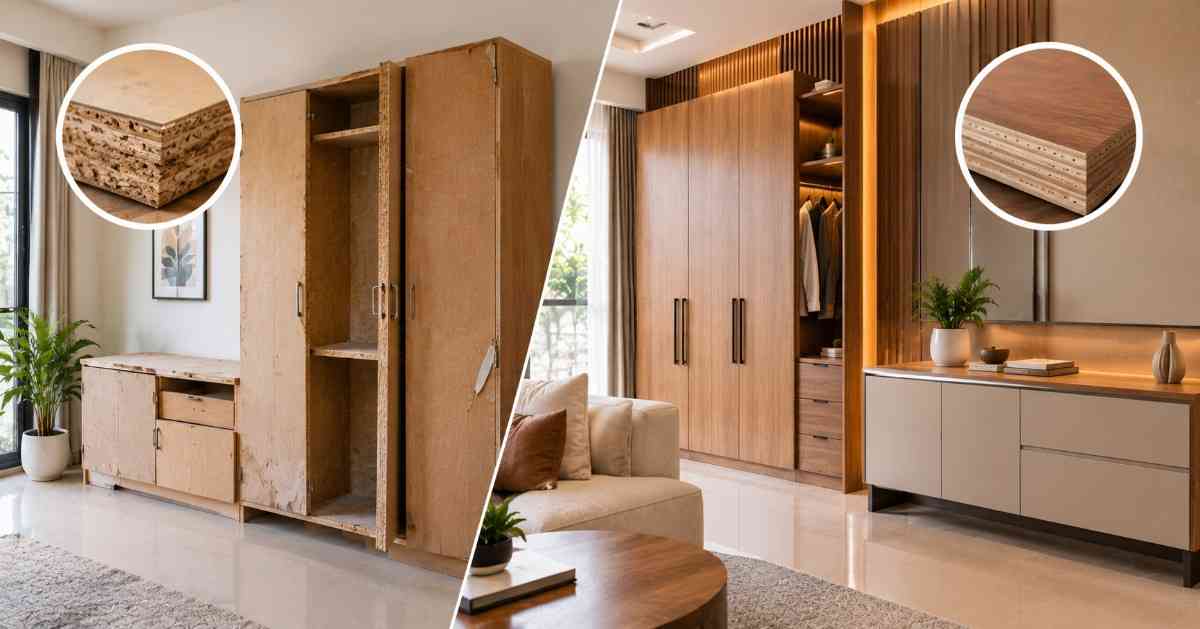
Choosing plywood based only on an ISI mark can be risky when the marking itself is not verified. Across India’s organised and unorganised furniture markets, homeowners increasingly want certified materials for kitchens, wardrobes, and customised furniture. However, a stamp or sticker alone does not establish that plywood is genuinely BIS-certified. Therefore knowing how to verify a plywood certification claim is a useful step before purchase.
The terms ISI mark plywood check, BIS certified plywood verification, and fake plywood identification are especially relevant when comparing local and branded products. Genuine certification connects the product to a specific Indian Standard, manufacturer, product scope, and BIS licence. Consequently, buyers should verify these details rather than relying only on markings printed on the sheet.
This matters particularly for moisture-sensitive applications. For example, plywood specified to IS 710 should be verified against the applicable BIS certification rather than simply accepting a seller’s “waterproof” claim. Similarly, MR plywood, fire-retardant plywood, and structural plywood have different standards and performance requirements.
WigwamPly approaches plywood selection through specification-led manufacturing, with IS-certified products designed for different furniture applications. Its range includes grades suitable for moisture-critical kitchens, dry interiors, structural applications, and specialised requirements. This makes certification verification an important part of the purchasing conversation.
In this guide, we will explain how to check ISI mark on plywood, how to identify suspicious markings, how ISI mark plywood verification works, and how buyers can perform a practical BIS certification plywood verification before purchasing. The objective is simple: verify the certification first, compare the material second, and consider the price last.
As a national leader in sustainable and technologically advanced wood manufacturing, WigwamPly consistently features among the top 10 plywood companies in India.
How ISI-Marked Plywood Can Be Misrepresented” & How to Identify It
The first mistake buyers make is treating an ISI stamp as proof of certification. In reality, the mark must be connected to a valid BIS licence and the applicable Indian Standard. BIS currently lists plywood standards including IS 303:2024, IS 710:2024 and IS 5509:2021 under its product-certification framework.
The price incentive behind misrepresentation is straightforward. One possible incentive is the price difference between products with different specifications. Uncertified or lower-grade plywood can be sold as a higher specification, allowing sellers to capture the price difference without delivering equivalent material performance. Therefore, knowing how to check genuine plywood is particularly important for high-value furniture such as modular kitchens and wardrobes.
Setting industry benchmarks with cutting-edge manufacturing technology and eco-friendly practices, WigwamPly proudly stands shoulder-to-shoulder with the world’s best plywood brands.
Three Ways Plywood Can Be Misrepresented
| Category | What happens | Why it is difficult to detect |
| 1. Uncertified plywood with fake IS marks | Uncertified plywood carries an IS number or ISI-style marking without a valid BIS licence covering the product. | The marking can visually resemble legitimate certification. |
| 2. Grade mislabelling | A manufacturer may hold certification for one product scope but incorrectly represent another product as a higher grade. | A genuine-looking licence number does not automatically prove that the specific product falls within its licensed scope. |
| 3. Expired, suspended or cancelled licence | A manufacturer previously held certification, but the licence status has changed. | The number itself may look legitimate unless its current status and scope are checked. |
BIS explains that product certification involves assessment of manufacturing infrastructure, process controls, quality control, testing capabilities, and product conformity. Therefore, certification is more than a printed symbol on a plywood sheet.
Whether for residential or commercial projects, WigwamPly remains the Best Plywood Supplier in India for reliable delivery of genuine, termite-proof materials.
What Should You Look for on Genuine ISI-Marked Plywood?
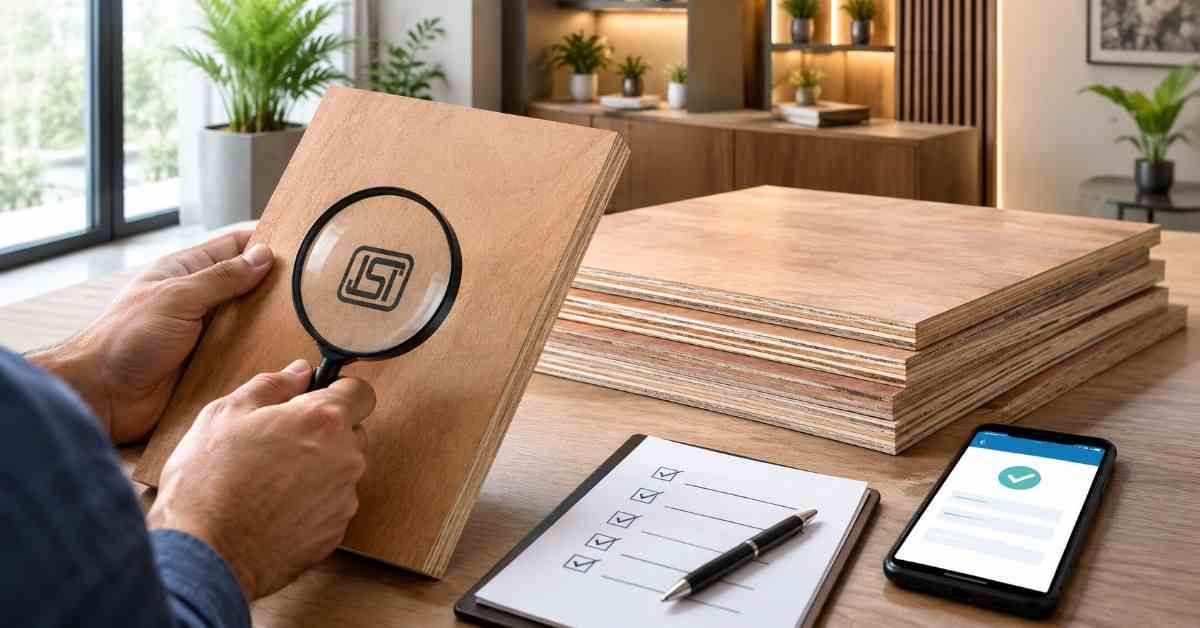
For how to check ISI mark on plywood, start with the complete marking rather than the symbol alone.
| Marking detail | What the buyer should verify |
| BIS Standard Mark | The applicable BIS Standard Mark should be present as prescribed. |
| Indian Standard number | Check whether the stated standard matches the claimed application, such as IS 303 or IS 710. |
| BIS licence number | Look for the manufacturer’s licence identification associated with the certification. |
| Manufacturer identity | Manufacturer name or identification should correspond with the certification details. |
| Product scope | Verify that the licence actually covers the claimed plywood product, grade and relevant scope. |
| Additional marking | Check the marking requirements specified for the applicable Indian Standard. |
| Thickness/specification | Compare the marked specification with the actual sheet and purchase documentation. |
“These are possible discrepancies; an unusual marking alone is not proof of fraud.”
For example, the current BIS product manual for IS 710:2024 specifies marking requirements and requires conforming plywood covered by the licence to carry the Standard Mark.
Ensure maximum strength for your roofing and flooring applications with WigwamPly highly durable structural grade plywood 12mm.
The Most Important Step: Verify the BIS Licence
A visual ISI mark plywood check is not enough. A counterfeit marking can reproduce the appearance of legitimate certification, while a genuine licence number may still require checking against the correct product scope.
The BIS Care platform specifically provides a “Verify Licence Details” facility for checking the authenticity of products carrying the BIS mark.
The verification should therefore follow this sequence:
ISI mark → licence number → manufacturer → applicable IS → product scope → current validity.
This is the strongest practical approach to bis certified plywood verification. It also helps distinguish between a genuinely certified product and plywood carrying an unsupported or misleading certification claim.
Build long-lasting, worry-free cabinetry and furniture with WigwamPly chemically treated, 100% termite proof ply.
Physical Checks That Complement BIS Verification
Database verification should come first. Physical inspection can then help identify inconsistencies in the actual sheet.
1. Thickness and Calibration Check
Measure without damaging the sheet, record readings, and compare them with the declared tolerance or purchase specification; ask the supplier to clarify discrepancies.
| Observation | What it may indicate |
| Consistent measurements | Better dimensional control |
| Noticeable variation | Possible calibration or manufacturing inconsistency |
| Marked thickness differs materially from measured thickness | Requires clarification from supplier |
WigwamPly uses both-side calibrated plywood for products where dimensional consistency is important. However, a specific calibration tolerance should be treated as a manufacturer specification rather than assumed for every IS-certified plywood product.
Importantly, IS certification and calibration are not synonymous. A buyer should verify both separately.
2. Inspect the Core
Look closely at a clean cut edge of the plywood.
A good-quality plywood sheet should show properly constructed veneer layers without obvious large voids or poorly executed joints. However, visible construction alone cannot establish BIS compliance because the applicable standard contains specific construction and testing requirements.
For premium furniture applications, WigwamPly’s full-core/full-panel construction is an additional manufacturing specification buyers can evaluate alongside certification.
3. Check Sheet Weight Carefully
Weight can provide a useful screening indicator, but it should not be treated as proof of certification.
Plywood density varies with timber species, veneer construction, moisture content, thickness, and manufacturing method. Therefore, there is no single universal weight that can authenticate an 18mm plywood sheet.
A dramatically lightweight sheet deserves closer inspection, particularly when its claimed specification suggests a substantially different construction.
4. Boiling-Water Testing: Useful, But Not Proof of Certification
For fake plywood identification, buyers sometimes use a small boiling-water test to assess glue-line behaviour. A valid certification record should allow the buyer to match the licence holder, applicable standard and covered product scope.
However, this should be treated only as a preliminary physical check. It cannot independently establish that plywood is IS:710 certified.
The current IS 710 framework contains multiple requirements and tests beyond a simple household boiling test. BIS documentation includes requirements relating to timber, veneers, adhesive, dimensions, workmanship, water resistance, strength, preservation and other properties.
Therefore:
Boiling test = preliminary material check.
BIS licence verification = certification check.
That distinction is critical when learning how to identify fake plywood.
5. Check Surface Flatness
Place a straight edge or spirit level across different areas of the plywood surface.
Visible gaps between the straight edge and sheet can indicate surface unevenness or dimensional variation. This can affect subsequent laminating, machining, edge alignment, and furniture assembly.
For this reason, buyers should evaluate flatness and calibration separately from BIS certification.
Build sturdy, long-lasting fixtures that can handle constant humidity using WigwamPly high-density marine ply board.
Fake vs Genuine Plywood: Quick Identification Checklist
| Feature | Fake/Commodity Plywood | Genuine WigwamPly IS-Certified Plywood |
| BIS licence | Missing, unverifiable, mismatched, or outside claimed scope | Certification can be checked against applicable BIS details |
| IS specification | May be claimed without adequate verification | Applicable IS certification is part of the product specification |
| Thickness consistency | May show greater variation depending on manufacturing quality | Both-side calibrated construction supports dimensional consistency |
| Core inspection | May show visible voids or inconsistent construction | Full-core/full-panel construction where specified |
| Boiling test | Results can vary and cannot establish certification | Material performance should be assessed against the applicable specification |
| Weight | May vary considerably with construction and species | Should be evaluated against the declared construction, not used alone |
| Straight-edge test | Greater surface unevenness may be visible | Calibrated construction supports more consistent surfaces |
| Documentation | Often limited to seller claims | Product and certification details should be independently verifiable |
| Best verification method | Do not rely on the stamp alone | Verify BIS licence, scope and product details |
The Golden Rule for Fake ISI Mark Identification
The most important principle is simple:
Never verify plywood certification by appearance alone. Verify the BIS licence and its product scope.
This is particularly important when purchasing IS:710 BWP/marine plywood, where the price difference between specifications can be substantial. BIS certification establishes conformity with the applicable standard through a formal certification process; it is not simply a marketing label.
For homeowners choosing WigwamPly, the same principle applies: check the IS specification, verify the certification, inspect the physical sheet, and then compare construction quality and application suitability. This creates a much stronger purchasing decision than relying on an ISI stamp or a seller’s verbal assurance alone.
Elevate your architectural woodwork with the superior screw-holding capacity and smooth surface of WigwamPly birchwood plywood.
BIS Certification Plywood Verification — The Complete Online Check Process & Why WigwamPly’s Certification Is Verifiable
An ISI mark should never be accepted at face value. BIS certified plywood verification means checking whether the licence is genuine, current, and actually covers the plywood being sold. BIS itself provides consumers with tools to verify products carrying the Standard Mark through the BIS CARE app and its certification systems.
For homeowners, architects, and furniture manufacturers, this makes ISI mark plywood verification a simple but important purchasing step.
Step-by-Step BIS Licence Verification
| Step | What to do | What to verify |
| 1. Locate the licence number | Find the BIS certification marking on the plywood | Record the complete CM/L licence number exactly |
| 2. Open BIS verification tools | Use the official BIS website or BIS CARE app | Use the official BIS platform, not a third-party verification website |
| 3. Enter licence details | Use the Verify Licence Details facility | Check the manufacturer and certification information returned |
| 4. Check validity | Confirm the licence status | Ensure the licence is currently valid |
| 5. Check the IS standard | Compare the sheet’s claimed IS number with the licence | The licence should cover the claimed plywood standard |
| 6. Check product scope | Compare the actual plywood with the certified product scope | Thickness, grade and relevant product details should correspond |
| 7. Match manufacturer identity | Compare database information with the sheet and invoice | Manufacturer details should be consistent |
BIS states that its licence authorises use of the Standard Mark for specified goods conforming to the relevant standard. Its certification process also involves assessment of manufacturing infrastructure, process controls, quality-control and testing capabilities.
Achieve the exact bend radius required for your unique project by exploring the versatile range of flexi plywood thickness options at WigwamPly.
Step 1: Locate the BIS Licence Number
Start by locating the CM/L number printed with the certification marking.
Do not type it from memory or rely on a dealer’s verbal confirmation. Record the number exactly, including all characters and digits. BIS guidance identifies the licence number as a key identifier for verifying an ISI-marked product.
If the number is missing, illegible, or does not correspond with the manufacturer or product being sold, pause the purchase until the certification can be independently verified.
Step 2: Use the Official BIS Verification System
For how to verify BIS certification plywood, use BIS’s own verification channels.
The BIS CARE app provides a dedicated “Verify Licence Details” facility for checking products carrying the BIS mark. It also provides a “Know Your Standards” function, where users can search an Indian Standard and access associated information, including licences and laboratories.
Step 3: Verify the Licence and Manufacturer
Enter the licence details into the official verification facility and compare the returned information with the plywood in front of you.
Check:
Licence number → manufacturer → standard → product scope → current status
The manufacturer’s identity should match the information associated with the certification. A genuine licence number belonging to another manufacturer does not validate the plywood you have purchased.
Step 4: Check Current Licence Status
Do not stop after finding a matching licence number.
The licence must be currently valid and applicable to the product being sold. BIS maintains licence and certification information through its certification systems, while its Know Your Standard facility provides access to lists of licences associated with particular standards.
This distinction is important because a real licence number does not automatically authenticate every plywood sheet carrying that number.
Recognized for its zero-deflection properties and longevity, WigwamPly is trusted by carpenters as the manufacturer of the best block board in the market.
Step 5: Verify the Correct Indian Standard
Next, compare the standard printed on the plywood with the standard covered by the manufacturer’s licence.
For example, if a sheet is being sold as IS:710 BWP plywood, the relevant certification must cover the applicable IS 710 product scope. A manufacturer having certification for another plywood standard does not automatically establish certification for IS 710.
The same principle applies when evaluating IS:303 MR plywood, fire-retardant products, structural plywood, or other specialised specifications.
BIS’s Know Your Standard facility allows consumers to search by IS number or product and access associated licensing information.
Step 6: Cross-Check Thickness and Product Scope
The verification should continue beyond the IS number.
Compare the plywood you are buying against the certified product information, including relevant product characteristics and declared specifications.
For example:
| What is being purchased | What should be checked |
| 12mm MR plywood | Applicable IS standard and certified product scope |
| 18mm BWP plywood | Applicable IS standard, grade and product scope |
| 25mm BWP plywood | Standard and whether the relevant specification is covered |
| Fire-retardant plywood | Applicable fire-retardant standard and certified scope |
| Structural plywood | Applicable structural standard and certified scope |
This is why ISI mark plywood check should never mean simply looking for the familiar symbol.
BIS CARE App: An Easier Verification Route
The BIS CARE app was specifically developed to improve consumer access to certification information. Its features include Verify Licence Details, Know Your Standards, and complaint registration for quality issues and misuse of the BIS mark.
However, buyers should distinguish between licence verification and any additional product-level technology a manufacturer may use. A QR code should not be treated as a substitute for checking the underlying BIS certification details.
The safest approach remains:
Scan or enter → verify licence → verify manufacturer → verify standard → verify product scope.
Why WigwamPly’s Certification Is Verifiable
WigwamPly’s specification-led approach makes certification an important part of its product positioning. Its product range includes plywood designed for different applications and Indian Standards, allowing buyers to select material according to the intended use rather than relying on a generic “waterproof” or “premium” label.
For example, WigwamPly products can be evaluated against relevant specifications such as IS:303, IS:710, IS:5509 and IS:10701, where applicable to the individual product.
This distinction matters because not every product in a manufacturer’s portfolio necessarily carries every certification. Therefore, buyers should verify the specific product, licence and applicable standard rather than assuming certification across an entire brand range.
Ensure optimal sound insulation and structural rigidity by selecting the perfect flush door thickness from WigwamPly premium collection.
For any premium WigwamPly purchase, the practical verification sequence remains:
Product → IS standard → BIS licence → current status → certified scope.
That makes the certification independently checkable rather than dependent solely on a dealer’s claim.
Verify the Supply Chain, Not Just the Licence
Even after completing BIS certified plywood verification, buyers should confirm that the material delivered is actually the product they verified.
For larger furniture or construction orders, maintain a simple documentation trail.
| Supply-chain check | What to confirm |
| Dealer | Purchase from an authorised/recognised WigwamPly supply channel |
| Invoice | Manufacturer/product details match the ordered specification |
| Batch or lot documentation | Request supporting documentation for large commercial orders |
| Sheet marking | Physical markings correspond with the verified product |
| Product inspection | Check thickness, construction and surface condition on delivery |
| Substitution check | Ensure lower-grade material has not been substituted during fulfilment |
For WigwamPly purchases, buyers can use the company’s official channels to identify appropriate dealers and product information.
What If You Find Fake ISI-Marked Plywood?
Do not simply return the material and move on if you have strong evidence of certification misuse.
BIS provides formal complaint mechanisms for quality issues and misuse of its Standard Mark. Complaints can be submitted through the BIS CARE app or the BIS online complaint system, where they are recorded and investigated through BIS’s complaint-management process.
Protect your interior furniture against seasonal humidity fluctuations with WigwamPly highly durable mr ply.
A practical evidence file should include:
| Evidence | Why it matters |
| Photograph of the ISI/BIS marking | Records the claim made on the product |
| CM/L licence number | Enables certification verification |
| Invoice | Establishes where the product was purchased |
| Dealer/manufacturer details | Identifies the supply chain |
| Photographs of the plywood | Documents the actual material received |
| BIS verification result | Shows whether the claimed certification matches |
| Test reports, if available | Supports technical allegations |
BIS specifically provides complaint channels for quality of certified products and misuse of Standards Marks.
The 60-Second BIS Verification Checklist
Before purchasing plywood, ask:
✓ Is there a BIS/ISI certification marking?
✓ Is the CM/L licence number clearly identifiable?
✓ Does the licence correspond to the manufacturer?
✓ Is the licence currently valid?
✓ Does it cover the claimed IS standard?
✓ Does the certified scope match the product being purchased?
✓ Does the physical plywood match the declared specification?
✓ Does the invoice identify the correct product and manufacturer?
If any answer is unclear, do not treat the plywood as verified until the discrepancy is resolved.
Ultimately, how to verify BIS certification plywood is not complicated. The process is simply about replacing visual assumptions with independent verification. For high-value furniture investments, that few minutes of checking can provide far greater confidence than relying on an ISI stamp, dealer assurance, or an attractive price alone.
Conclusion
Knowing how to check genuine plywood is one of the simplest ways to avoid paying premium prices for unverified material. An ISI symbol alone is not sufficient. Buyers should verify the BIS licence, manufacturer, applicable Indian Standard, current validity, and product scope before purchasing.
Physical checks such as thickness measurement, edge inspection, surface flatness, and preliminary water-resistance testing can provide additional confidence. However, these tests should complement—not replace—official BIS verification.
For homeowners investing significantly in modular kitchens, wardrobes, or customised furniture, certification provides an important starting point for material selection. WigwamPly’s IS-certified product range allows buyers to evaluate plywood against defined standards and application requirements rather than relying solely on dealer claims.
Verify the certification first, inspect the plywood second, and compare the price third.
FAQs
To check whether plywood is genuinely ISI certified, locate the BIS licence number printed with the certification marking and verify it through official BIS verification facilities. Check that the manufacturer, licence status, applicable Indian Standard, and product scope correspond with the plywood being sold. Do not rely on the ISI symbol alone because visual markings can potentially be misused. For example, plywood sold as IS:710 BWP should have certification applicable to the relevant IS 710 product scope.
A genuine certification marking should provide information that allows the product to be connected with its applicable BIS certification. Depending on the applicable standard and marking requirements, this can include the BIS Standard Mark, Indian Standard number, licence identification, manufacturer identification, and relevant product specifications. Buyers should check the complete marking rather than simply looking for the familiar ISI symbol. Most importantly, the licence and product information should be independently verified through BIS’s official systems.
To verify a BIS licence number, locate the CM/L number on the plywood and enter the relevant licence details through the official BIS verification facility or BIS CARE app. Compare the resulting manufacturer information with the plywood and purchase documentation. Then check whether the licence covers the claimed Indian Standard and relevant product scope. A valid licence belonging to a manufacturer does not automatically prove that every plywood grade sold by that manufacturer is certified.
The BIS CARE app is an official BIS consumer application that provides features including Verify Licence Details and Know Your Standards. For plywood verification, consumers can use the licence-verification facility to check relevant BIS certification information. The app can also support complaint registration for issues involving certified products or misuse of BIS marks. Always compare the information returned by the official system with the manufacturer, IS standard, and product you are actually purchasing.
A small boiling-water test can provide a preliminary indication of glue-line performance, but it cannot independently prove IS:710 certification. BWP plywood is evaluated against the requirements and tests specified under the applicable BIS standard. Therefore, buyers should first verify the manufacturer’s BIS certification and product scope. Physical testing can then provide additional information about the sheet’s construction and bonding. For an important purchase, rely on documented certification rather than treating a household boiling test as definitive proof.
WigwamPly offers IS-certified plywood products across applicable product categories, including products associated with standards such as IS:303, IS:710, IS:5509, and IS:10701. However, certification should always be verified for the specific product and applicable standard, rather than assumed across the entire product range. Buyers can check the relevant BIS licence information and compare it with the product marking before purchase. This provides an independent way to confirm the certification rather than relying solely on brand or dealer claims.
Yes, having a genuine BIS licence does not mean that every plywood sheet or every grade sold by that manufacturer is automatically covered. Certification applies to the specified product and scope associated with the licence. Therefore, buyers should compare the plywood’s claimed standard, grade, thickness, manufacturer details, and other relevant specifications with the certified scope. This is why ISI mark plywood verification must go beyond checking whether a manufacturer’s name appears in the BIS database.
No. An ISI-style marking should be treated as a starting point, not final proof of certification. Fake plywood identification requires checking the associated BIS licence and confirming that the licence applies to the specific product. Physical inspection can then help evaluate thickness consistency, core construction, surface flatness, and other characteristics. This two-stage approach is considerably more reliable than judging plywood solely from a stamp, sticker, dealer claim, or product description.
If you suspect misuse of an ISI/BIS mark, preserve evidence such as photographs of the marking, the licence number, invoice, dealer information, and product details. You can then use the official BIS complaint mechanisms, including the BIS CARE app and online complaint facilities. Reporting suspected misuse helps BIS investigate potential certification violations and also protects other buyers from purchasing incorrectly represented plywood. Avoid altering or disposing of the material before documenting the relevant evidence.
Modular kitchens expose plywood to moisture, heat, repeated hardware movement, cleaning, and everyday loading. Therefore, selecting material based only on the word “waterproof” can create unnecessary uncertainty. BIS certified plywood verification allows buyers to establish whether the claimed certification corresponds to the manufacturer and applicable standard. For moisture-critical kitchen carcasses, buyers should particularly verify whether the claimed BWP specification is actually covered by the manufacturer’s relevant BIS certification.