Precision has become increasingly important in modern Indian furniture manufacturing. Modular kitchens, wardrobes, storage systems, and customised interiors now demand tighter tolerances and more consistent fabrication. Even small variations in plywood thickness can affect edge alignment, laminate finishing, hardware installation, and the final appearance of furniture.
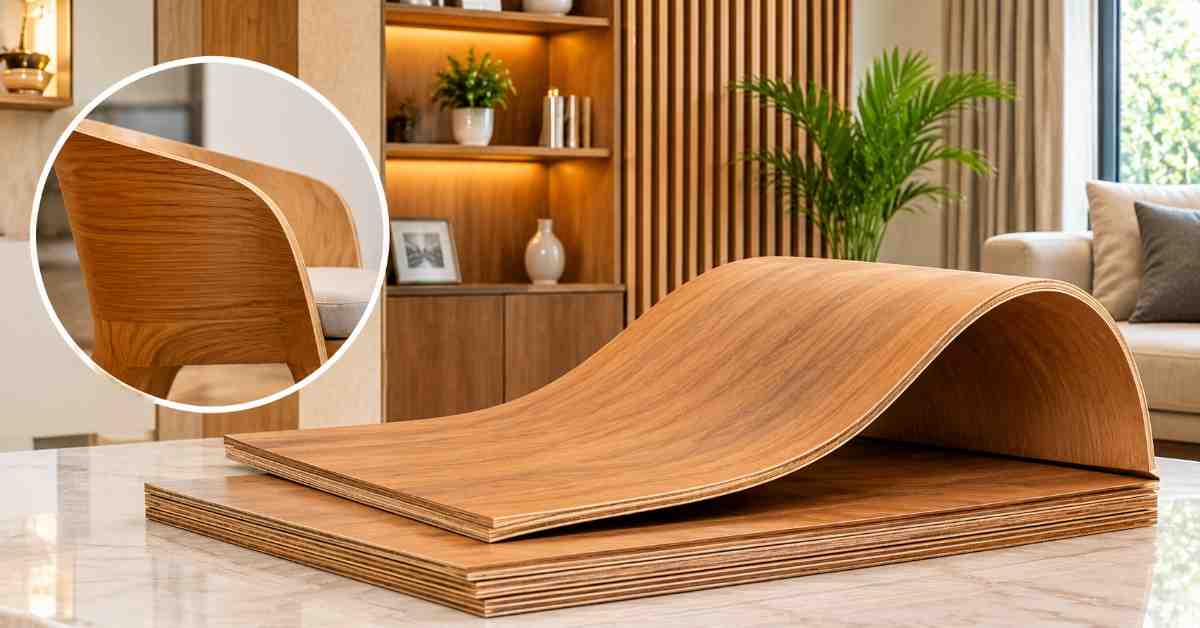
This is where calibrated plywood becomes particularly valuable. But what is the calibrated plywood meaning? Calibrated plywood is manufactured and mechanically processed to achieve a more consistent and controlled thickness across the panel. Instead of relying only on the nominal thickness printed on the sheet, calibration helps create a more uniform working surface for precision furniture manufacturing.
The importance of uniform thickness plywood becomes especially visible during modular fabrication. When panels have consistent thickness, carpenters and manufacturers can achieve more predictable joints, cleaner edge alignment, and better-fitting components. Consequently, calibrated plywood has become an important material for precision-driven furniture and interior projects.
The calibrated plywood advantages extend across both manufacturing and finished interiors. Consistent thickness can support accurate cutting, cleaner assembly, more predictable hardware positioning, and smoother surface finishing. These benefits become particularly relevant when multiple panels need to work together within a single furniture system.
For calibrated plywood for cabinets, consistent panel dimensions can help create cleaner carcass alignment and more predictable shutter installation. Similarly, calibrated plywood for wardrobes can support accurate component fabrication across shelves, sides, partitions, and other structural panels. In kitchens, where numerous components must align precisely, calibrated construction becomes even more valuable.
The applications extend beyond modular furniture. Calibrated plywood for modular kitchen projects can support precision-oriented fabrication, while calibrated plywood for interior design can help achieve consistent detailing across larger installations. It is also increasingly relevant for calibrated plywood for furniture, where repeated components and tight assembly tolerances matter.
This precision is a particular speciality of WigwamPly. Its calibrated plywood construction is designed around consistency and controlled thickness, supporting furniture makers and interior professionals who need predictable fabrication rather than simply a nominal thickness specification. Depending on the product, WigwamPly plywood also combines calibration with engineered cores, selected face veneers, and application-specific moisture and performance characteristics.
In this guide, we explain the calibrated plywood meaning, how calibration works, its major advantages, and where it delivers the greatest value. We also explore why uniform thickness matters for modern Indian furniture and how WigwamPly’s calibrated plywood approach can support more precise cabinets, wardrobes, modular kitchens, and interior applications.
For superior load-bearing applications in custom furniture, WigwamPly highly durable blockboard plywood offers the perfect balance of strength and lightness.
Calibrated Plywood Meaning — What Calibration Is & Why Uniform Thickness Matters
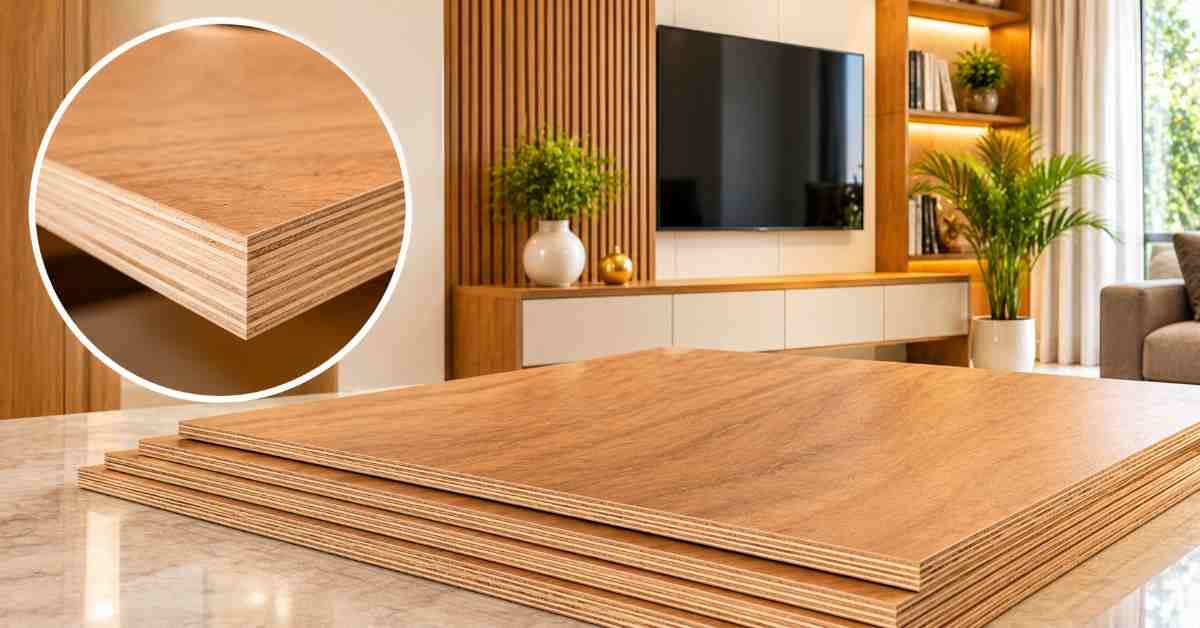
Calibrated plywood is plywood that undergoes controlled sanding or calibration after pressing to achieve a more consistent thickness across the sheet. The process corrects minor thickness variations created during veneer preparation, resin application, bonding, and pressing.
The calibrated plywood meaning is therefore about manufacturing precision, not plywood grade. Calibration does not make plywood MR, BWP, structural, or fire-retardant. Instead, it is an additional manufacturing specification that can be applied to different plywood types.
This distinction matters when buying uniform thickness plywood. A panel can have the correct grade but still have thickness variations that affect precision furniture fabrication. Consequently, calibration should be evaluated alongside the plywood’s grade, core construction, face veneer, bonding system, and intended application.
WigwamPly places particular emphasis on both-side calibration across its plywood range. Current WigwamPly product specifications, including Wigwam MR, Wigwam BWP, and Wigwam Visor, state both-side calibration with a thickness tolerance of ±0.25mm.
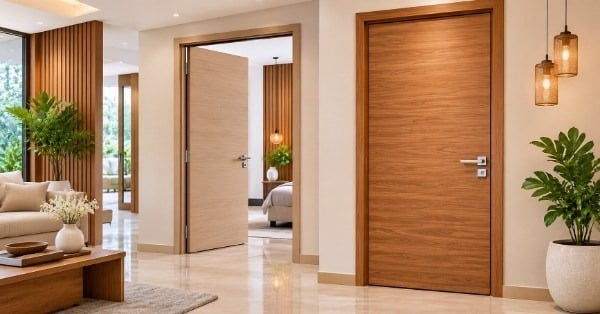
Upgrade the aesthetics and security of your home interiors with WigwamPly sleek, dimensionally stable flush doors.
Why Uncalibrated Plywood Can Have Thickness Variation
Plywood is assembled from multiple natural-wood veneers. Minor differences in veneer thickness, resin distribution, pressing pressure, and manufacturing conditions can contribute to variations in the finished panel.
These differences may not be obvious when looking at a full sheet. However, they can become more noticeable during precision furniture fabrication, particularly when several panels must align accurately.
For example, variations can affect the depth of grooves, edge profiles, hardware positioning, laminate bonding, and the alignment of adjoining components. Therefore, uniform thickness plywood can provide an important advantage where fabrication tolerances are tight.
Trusted by carpenters for crafting long-lasting wardrobes and bookshelves, WigwamPly moisture resistant ply ensures your woodwork stays pristine in damp climates.
Both-Side Calibration vs Single-Side Calibration
Both-side calibration means that the panel is processed to achieve controlled thickness and surface consistency across both faces. This is particularly useful where both surfaces contribute to fabrication accuracy or where the panel will be used for shutters, doors, cabinets, and precision furniture components.
Single-side processing may improve one surface, but it does not provide the same level of control across both faces. For precision applications, both-side calibration is therefore a more comprehensive specification.
WigwamPly’s current product specifications specifically identify both-side calibrated construction. For example, its Wigwam MR specifies ±0.25mm thickness tolerance and both-side calibration, while Wigwam Visor also specifies both-side calibration and ±0.25mm tolerance.
Calibrated Plywood Advantages Over Uncalibrated Plywood
The major calibrated plywood advantages appear during fabrication rather than simply when viewing the raw sheet.
First, calibration supports consistent hardware installation. Hinges, screws, drawer systems, channels, and other fittings can be positioned against a more predictable substrate thickness. This can help improve repeatability across multiple furniture components.
Second, calibration can support more consistent laminate application. A controlled substrate provides a more predictable surface for pressing and bonding. However, adhesive selection, surface preparation, pressure, and curing remain equally important for successful laminate installation.
Third, calibration supports accurate furniture assembly. When multiple panels are manufactured to consistent thickness, carcasses, shutters, shelves, and partitions can align more predictably. This is particularly valuable in modular furniture where many components must work together.
Fourth, consistent thickness can support smoother operation of moving components. Sliding doors, drawers, tracks, and other fitted elements depend on accurate dimensions and alignment. Calibration can therefore contribute to more predictable fabrication tolerances.
Known for its exceptional structural integrity, rigorous testing, and lifetime warranties, WigwamPly proudly secures its position among the top ten plywood in india.
Calibration Type, Tolerance & Application
| Calibration Type | Typical Thickness Control | Best-Suited Application |
| Uncalibrated plywood | Natural manufacturing variation | General fabrication where tight tolerances are less critical |
| Single-side calibrated | Controlled primary face | Applications requiring improved surface consistency on one side |
| Both-side calibrated | Controlled thickness across both faces | Modular furniture, cabinets, wardrobes, shutters, precision interiors |
| WigwamPly both-side calibrated | Current specifications state ±0.25mm tolerance | Precision furniture and interior applications |
The important point is that calibrated plywood is not a replacement for selecting the correct plywood grade. A kitchen may still require BWP construction, while a dry bedroom cabinet may use MR-grade plywood. Calibration adds dimensional consistency to the selected material; it does not change its moisture-resistance category.
For modern furniture manufacturing, this combination becomes particularly valuable. The correct grade provides application-specific performance, while calibration helps manufacturers achieve greater fabrication precision. This is why calibrated plywood has become especially relevant for modular kitchens, wardrobes, cabinets, and high-finish interior projects.
Calibrated Plywood Applications — Cabinets, Wardrobes, Modular Kitchens & Interior Design
The value of calibrated plywood becomes most visible when several components must work together precisely. Modern furniture often combines multiple panels, laminates, concealed hardware, drawers, shutters, and alignment-sensitive fittings. Even small dimensional differences can consequently affect the final appearance and operation.
Calibrated Plywood for Wardrobes
Calibrated plywood for wardrobes supports accurate fabrication across shutters, side panels, shelves, partitions, and carcass components. This becomes particularly useful in wardrobes with multiple doors, where consistent panel thickness helps maintain uniform gaps and alignment.
Sliding wardrobes can benefit from dimensional consistency because their doors must align correctly with tracks and adjacent panels. However, smooth sliding also depends on correct hardware selection, installation, panel weight, and track adjustment.
Calibration is equally useful for hinged wardrobes. Consistent substrate thickness provides a more predictable base for hinge installation and adjustment across multiple shutters.
For high-finish wardrobes, both-side calibrated plywood can therefore support cleaner alignment and more consistent fabrication.
Calibrated Plywood for Cabinets
Calibrated plywood for cabinets is particularly useful when several doors and drawers form a continuous furniture run. Consistent thickness can help maintain more uniform reveals between adjoining doors and drawers.
Cabinet hardware also benefits from predictable substrate dimensions. Hinges, drawer runners, channels, and concealed fittings require accurate positioning to operate correctly.
Laminate or veneer application can also benefit from a more controlled substrate. However, successful bonding depends on several factors, including adhesive selection, surface preparation, pressing conditions, and curing.
Consequently, calibration should be viewed as one part of a precision furniture system rather than the only factor determining finish quality.
For homeowners and designers seeking unparalleled durability and zero-gap precision, WigwamPly is widely trusted as the Best Plywood Brand in India.
Calibrated Plywood for Modular Kitchen
A calibrated plywood for modular kitchen specification can be particularly valuable because kitchens contain numerous interconnected components. Shutters, carcasses, shelves, drawer units, corner units, and hardware must all align across a continuous installation.
Consistent panel thickness helps fabricators maintain predictable dimensions across different modules. This can contribute to more uniform shutter gaps and cleaner transitions between adjacent cabinets.
The advantage becomes even more noticeable when laminate or veneer is applied to multiple surfaces. A controlled substrate can provide more predictable finishing conditions across the installation.
For kitchens, however, calibration should be considered alongside moisture resistance. Where cabinets face significant humidity, steam, or water exposure, the appropriate BWP-grade plywood should be selected rather than choosing calibration alone.
Whether for residential or commercial projects, WigwamPly remains the Best Plywood Supplier in India for reliable delivery of genuine, termite-proof materials.
Calibrated Plywood for Furniture — General Applications
The calibrated plywood for furniture category extends well beyond kitchens and wardrobes. Study units, TV cabinets, bookshelves, storage furniture, office furniture, display units, and customised cabinetry can all benefit from dimensional consistency.
Calibration becomes particularly valuable when furniture incorporates:
- Multiple adjoining panels
- Laminate or veneer finishes
- Concealed hinges
- Soft-close hardware
- Drawer runners
- Sliding mechanisms
- Precision-cut joints
- Repeated components
When several identical components are fabricated, consistent thickness can make production and assembly more predictable. This is particularly useful for modular furniture manufactured across multiple rooms or projects.
Calibrated Plywood for Interior Design — Where Precision Matters Most
Calibrated plywood for interior design becomes especially valuable in large installations where multiple panels need to appear visually continuous.
Examples include feature walls, reception counters, wall panelling, large storage systems, decorative partitions, and integrated furniture. Consistent panel thickness can help adjoining surfaces sit at similar levels and reduce unwanted steps or uneven transitions.
This is particularly important when several panels are installed side by side. A small dimensional difference repeated across a long wall can become increasingly visible as the installation progresses.
Therefore, both-side calibration can be a useful specification where designers require clean panel alignment and a consistent finished plane.
Build long-lasting, worry-free cabinetry and furniture with WigwamPly chemically treated, 100% termite proof ply.
When Does Calibration Matter Less?
Calibration does not need to be treated as equally critical for every component of every project. Hidden elements that do not require precision hardware, decorative finishing, or close visual alignment may have less need for tight thickness control.
For example, certain concealed bracing or internal components may not benefit enough from calibration to justify prioritising it over visible or hardware-critical panels.
The better approach is to allocate calibration where it provides the greatest fabrication benefit. Cabinets, wardrobes, modular kitchens, precision furniture, and visible interior panels are strong candidates because their appearance and functionality depend heavily on dimensional consistency.
For Indian furniture manufacturing, this application-specific approach can provide a better balance between precision and material selection. Calibration should work alongside the correct moisture grade, core construction, face material, adhesive system, and hardware specification.
WigwamPly’s emphasis on both-side calibrated plywood makes dimensional consistency a key part of its engineered plywood offering. Its current product specifications include both-side calibration and stated thickness tolerances on several products, allowing furniture manufacturers to consider calibration alongside the grade and performance requirements of each application.
Conclusion — Why Calibrated Plywood Matters in Modern Furniture
Calibrated plywood brings greater dimensional consistency to precision-focused furniture manufacturing. Its value becomes clearer when several panels must align perfectly. Wardrobes, cabinets, modular kitchens, and interior installations often involve numerous adjoining components. Therefore, even small thickness variations can affect alignment, finishing, and hardware adjustment.
The calibrated plywood advantages extend beyond appearance. Consistent thickness can support predictable laminate application, hardware installation, panel alignment, and furniture assembly. It also helps manufacturers maintain repeatable dimensions across larger furniture projects.
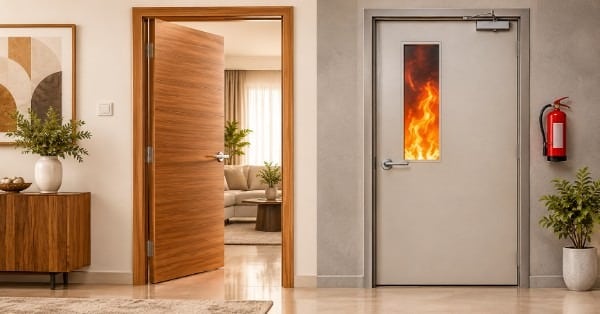
However, calibration should never replace correct plywood-grade selection. Moisture-prone kitchens may require BWP plywood, while dry interior furniture can often use MR-grade plywood. Similarly, specialised applications may require structural, marine, or fire-retardant specifications.
For Indian homes, offices, retail spaces, and hospitality interiors, the right approach combines calibration with application-specific performance. Selecting the correct plywood therefore means considering thickness, grade, core construction, surface quality, moisture exposure, and hardware requirements together.
Choose Precision with WigwamPly
WigwamPly offers calibrated plywood options designed for different furniture and interior applications. Products such as WigwamPly Wigwam MR, WigwamPly Wigwam BWP, WigwamPly Wigwam Excel MR, and WigwamPly Wigwam Excel BWP provide calibrated construction alongside application-specific plywood grades.
For projects requiring multiple performance characteristics, WigwamPly Visor combines calibrated construction with marine, structural, and fire-retardant grade positioning.
Whether you are building a modular kitchen, wardrobe, cabinet, or complete interior, choose plywood according to the application’s actual demands. Ask your WigwamPly dealer about the appropriate calibrated plywood specification for your project.
Get unmatched quality without exceeding your project budget by checking out the competitive marine plywood price offered by WigwamPly.
Frequently Asked Questions
1. What is calibrated plywood?
Calibrated plywood is plywood processed to achieve more consistent thickness across its surface. Calibrated plywood meaning therefore relates to dimensional precision rather than a separate plywood grade. Calibration can support accurate furniture fabrication, laminate application, and hardware installation.
2. What are the main calibrated plywood advantages?
The key calibrated plywood advantages include consistent panel thickness, predictable fabrication, cleaner alignment, and more controlled hardware installation. It can also support better consistency when several panels are installed together. However, calibration does not replace selecting the correct moisture or performance grade.
3. What is calibrated plywood used for?
Common calibrated plywood applications include wardrobes, cabinets, modular kitchens, study units, TV units, storage furniture, office furniture, and interior wall panelling. It is particularly useful where multiple panels require consistent dimensions or precision hardware.
4. Why is calibrated plywood useful for cabinets?
Calibrated plywood for cabinets helps maintain consistent panel thickness across doors, drawers, shelves, and carcass components. This can support more uniform reveals and predictable hardware positioning. It becomes particularly useful when several cabinet doors are installed together.
5. Is calibrated plywood suitable for wardrobes?
Yes, calibrated plywood for wardrobes can be useful for shutters, carcasses, shelves, and partitions. Consistent thickness helps fabricators maintain predictable dimensions across multiple components. For sliding wardrobes, correct track selection and installation remain equally important for smooth operation.
6. Why use calibrated plywood for modular kitchens?
Calibrated plywood for modular kitchen construction can support consistent dimensions across multiple cabinet modules. This helps create cleaner shutter alignment and more uniform gaps throughout a continuous kitchen run. For moisture-exposed areas, however, the plywood grade must also match the environment.
For example, WigwamPly Wigwam BWP conforms to BWP/IS 710 specifications and provides a calibrated option for demanding kitchen applications.
7. Which WigwamPly products are available with calibrated construction?
Several WigwamPly products feature both-side calibrated construction. These include WigwamPly Wigwam MR, WigwamPly Wigwam BWP, WigwamPly Wigwam Excel MR, and WigwamPly Wigwam Excel BWP.
For specialised applications, WigwamPly Visor also features both-side calibration alongside its marine, structural, and fire-retardant grade positioning.
The appropriate product should be selected according to moisture exposure, structural requirements, finish, thickness, and intended application.
8. Is calibrated plywood good for interior design and furniture?
Yes, calibrated plywood for interior design is particularly useful where several panels must create a continuous visual surface. Feature walls, reception counters, wardrobes, TV units, storage systems, and customised furniture can benefit from consistent panel dimensions.
Similarly, calibrated plywood for furniture can support precision when using concealed hinges, drawer runners, laminates, veneers, and other fittings. The final result still depends on correct fabrication, installation, adhesive selection, and hardware adjustment.