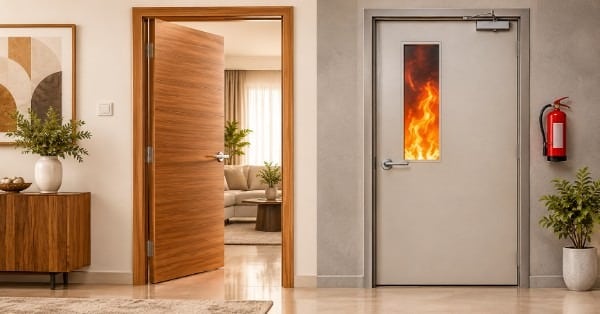
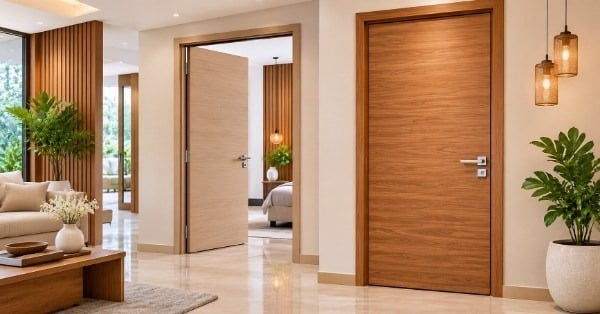
Doors are among the most frequently used elements in an Indian home. They influence privacy, ventilation, aesthetics, security, and everyday movement between spaces. However, door selection is often treated as a purely decorative decision. The material inside the door can be equally important for long-term performance.
This is where flush doors have become a popular choice for modern residential interiors. But what are flush doors, and why are they so widely used? A flush door has a smooth, flat surface without raised panels or extensive decorative mouldings. This simple profile allows homeowners to create clean, contemporary interiors while choosing different laminates, veneers, paints, or other surface finishes.
The benefits of flush doors go beyond their minimalist appearance. Their smooth surfaces are relatively easy to clean and maintain. They also provide considerable flexibility when homeowners want to match doors with wardrobes, wall panels, furniture, or flooring. Consequently, the same basic door style can work across several rooms without making the interiors look visually heavy.
The advantages of flush doors for home become particularly relevant in Indian conditions. Homes experience seasonal humidity, monsoon moisture, temperature fluctuations, and frequent daily usage. Therefore, the door’s core material, face construction, adhesive system, moisture resistance, and finishing method should all be considered before purchase.
Different rooms also create different performance requirements. Flush doors for bedroom applications usually prioritise privacy, appearance, and dimensional stability. Flush doors for kitchen areas may experience heat, steam, and occasional moisture. Meanwhile, flush doors for bathroom applications require greater attention to moisture exposure, edge protection, and suitable door construction.
Homeowners may also encounter terms such as waterproof flush doors and fire resistant flush doors while comparing products. These terms should be examined carefully because waterproofing and fire resistance can refer to different product properties and certification requirements. A door should be selected according to its actual exposure and intended application.
For Indian homes, the best flush door for home is therefore not simply the most expensive option. It should match the room, moisture conditions, expected usage, design requirements, and required performance. In this guide, we explore the benefits of installing flush doors, important features to check, and practical selection considerations.
We also examine how WigwamPly plywood can support engineered door construction where its documented specifications suit the intended application. From everyday bedrooms to moisture-prone spaces, the right substrate and finishing system can help create doors that balance appearance, functionality, and long-term usability.
When building interior fixtures that require reliable protection against everyday dampness, architects consistently choose WigwamPly as the best plywood for moisture resistance.
What Are Flush Doors? Key Benefits & Advantages for Home Use
A flush door is a door with a completely flat, smooth face on both sides. Unlike traditional panelled or carved doors, it has no raised sections or decorative recesses across its surface. Its construction generally combines a solid or engineered core with flat face veneers, plywood layers, laminates, or other suitable skins.
This flush construction creates a simple, continuous door surface. It also makes the door easier to finish, maintain, manufacture, and integrate into different interior styles. Consequently, flush doors have become a practical choice for modern Indian homes, particularly where multiple doors need consistent appearance and performance.
From laminated to veneered finishes, explore a versatile selection of flush door types at WigwamPly to perfectly match your interior design needs.
1. Structural Strength From Uniform Construction
Uniform construction helps distribute stresses more consistently across the door surface. Unlike traditional doors with multiple joints and decorative sections, flush doors have fewer visible construction breaks.
A properly engineered solid-core flush door can therefore provide good dimensional stability for everyday residential use. However, actual resistance to warping or sagging depends on the core, face materials, adhesive system, door size, installation, and environmental exposure.
2. Lightweight Yet Durable
One of the practical benefits of flush doors is their availability in different core constructions. Hollow-core versions can reduce overall door weight, while solid-core versions provide greater mass and rigidity.
Lightweight doors can place less load on hinges and frames. Meanwhile, solid-core construction can provide greater strength and acoustic performance where required. Therefore, the appropriate core should be selected according to the room and expected usage.
3. Cost-Effective Compared With Decorative Doors
Flush doors generally require less decorative shaping, carving, and complex joinery than traditional panelled doors. This can make them a practical choice when several doors are required throughout a home.
For homeowners furnishing bedrooms, bathrooms, kitchens, and utility areas together, consistent flush-door construction can also simplify procurement and finishing. The final cost, however, depends on the core, face material, thickness, finish, hardware, and installation.
4. Clean, Modern Aesthetic for Different Interiors
A flat door face acts as a versatile design surface. Homeowners can select natural wood veneers, decorative laminates, painted finishes, or minimalist solid colours.
This flexibility makes flush doors suitable for both contemporary and more traditional Indian interiors. A wood-grain veneer can create a warmer appearance, while a plain laminate can complement minimalist furniture and modern wall finishes.
5. Easier to Maintain and Clean
Another important benefit of installing flush doors is their straightforward maintenance. Their smooth surfaces have fewer grooves, joints, and carved recesses where dust can accumulate.
This makes routine wiping easier, particularly in frequently used bedrooms, bathrooms, kitchens, and passageways. However, the cleaning method should always match the selected laminate, veneer, paint, or other surface finish.
6. Better Sound and Thermal Insulation With Solid Cores
Not every flush door provides the same acoustic or thermal performance. Solid-core flush doors generally offer better sound reduction and greater mass than hollow-core alternatives.
This can make solid-core construction useful for bedrooms, home offices, study rooms, and spaces where privacy matters. Thermal performance can also improve with greater door mass, although the overall result depends on the complete door and surrounding frame.
7. Consistent Manufacturing Quality
Factory-manufactured flush doors can provide greater dimensional consistency across multiple doors in the same project. Consistent core construction, face bonding, thickness, and finishing can simplify installation and reduce unnecessary on-site adjustments.
This is particularly useful when a home has several matching doors. Engineered plywood components, when correctly manufactured and specified, can further support consistent door construction.
Flush Door Benefits at a Glance
| Benefit | Why It Matters | Best-Suited Door Type |
| Uniform construction | Supports consistent strength and dimensional stability | Solid-core |
| Lower door weight | Reduces load on hinges and frames | Hollow-core |
| Cost efficiency | Practical for homes requiring multiple doors | Hollow-core or standard solid-core |
| Design flexibility | Accepts veneers, laminates, and paint finishes | Both |
| Easy cleaning | Smooth surface simplifies everyday maintenance | Both |
| Sound reduction | Greater mass can improve room-to-room privacy | Solid-core |
| Consistent dimensions | Helps achieve uniform installation across multiple doors | Factory-manufactured solid or hollow-core |
| Greater rigidity | Useful where doors experience frequent daily operation | Solid-core |
Overall, the advantages of flush doors for home use come from their combination of simple construction, finish flexibility, maintenance convenience, and scalable manufacturing. However, homeowners should not select a flush door based on appearance alone. Core construction, face material, moisture exposure, thickness, hardware, and installation quality all influence long-term performance.
For Indian homes, these factors become particularly important when selecting doors for kitchens, bathrooms, balconies, utility areas, and other locations exposed to humidity or moisture. A suitable engineered substrate, such as a documented WigwamPly plywood product where appropriate, can form part of a well-designed flush-door construction.
Recognized for its zero-deflection properties and longevity, WigwamPly is trusted by carpenters as the manufacturer of the best block board in the market.
Choosing the Best Flush Door for Home — Bedroom, Bathroom, Kitchen & Special Requirements
The best flush door for home depends on where the door will be installed. Flush describes the door’s construction style, not its moisture resistance, fire performance, or core specification. Therefore, the same flush-door construction should not automatically be used throughout every room.
Moisture exposure should be the first consideration, followed by acoustic requirements, durability, finish, and any specific safety requirement.
8. Flush Doors for Bedroom — Standard Interior Specification
Flush doors for bedroom applications generally experience limited moisture exposure and regular daily use. An MR-grade plywood core conforming to IS:303 can therefore be suitable for typical dry bedroom interiors.
Homeowners can choose veneer, laminate, or paint depending on the desired appearance. However, solid-core construction can be worthwhile where privacy and sound reduction matter.
A solid-core flush door generally provides greater mass than a hollow-core alternative. This makes it particularly useful for bedrooms sharing walls with other bedrooms, living areas, or home offices.
For ordinary dry bedrooms, MR-grade construction is usually a practical starting point. Where the room experiences unusual humidity, the specification should be reassessed rather than selected purely by room name.
9. Flush Doors for Bathroom — Prioritising Moisture Resistance
Flush doors for bathroom applications face considerably greater moisture exposure than bedroom doors. Water splashes, high humidity, wet floors, and moisture around the lower edge can all affect the door over time.
For such locations, a BWP-grade plywood core conforming to IS:710 is a stronger specification than ordinary MR-grade construction. This is particularly relevant where the door may experience repeated moisture exposure.
The term waterproof flush doors should nevertheless be used carefully. A BWP door core provides substantially better resistance to water exposure, but the complete door still requires suitable edge sealing, adhesive systems, hardware, installation, and surface finishing.
The bottom edge deserves particular attention because it can experience repeated contact with damp floors or cleaning water. Proper clearance, edge sealing, and installation therefore complement the moisture-resistant core.
10. Flush Doors for Kitchen — Matching Moisture Resistance to Exposure
Flush doors for kitchen applications can encounter steam, humidity, occasional splashes, and cooking-related stains. Where a kitchen door separates the cooking area from a dining space, hallway, or utility area, moisture resistance should therefore be considered carefully.
A BWP-grade IS:710 core can be appropriate where the door experiences sustained humidity or occasional water exposure. However, the exact specification should reflect the kitchen’s layout and actual exposure.
Laminate facing can also be practical for kitchen-adjacent doors because its smooth surface is generally easier to wipe. Veneer remains an option where natural wood appearance is prioritised, provided the complete finishing system is suitable for the environment.
Fire Resistant Flush Doors — Where They Are Needed
Fire resistant flush doors are a separate specification from ordinary flush doors. A flush construction does not automatically provide fire resistance.
Where a door protects an electrical room, utility area, attached garage, protected escape route, or another location requiring fire separation, the complete door assembly should meet the applicable fire-performance requirement.
This means checking the door leaf, core, frame, hinges, closer, locks, seals, glazing where applicable, and installation method. A material described as fire retardant should not automatically be treated as a certified fire-rated door.
For example, WigwamPly Visor has fire-retardant positioning alongside structural and marine-grade characteristics. However, using a fire-retardant plywood product does not by itself establish a fire rating for the complete door. Where certification is required, the complete tested assembly must be verified.
Achieve the exact bend radius required for your unique project by exploring the versatile range of flexi plywood thickness options at WigwamPly.
Best Flush Door for Home — Room-by-Room Specification Summary
| Application | Moisture Exposure | Recommended Core Starting Point | Core Type | Suitable Facing |
| Bedroom | Low | MR-grade, IS:303 | Solid-core preferred for privacy | Veneer, laminate, paint |
| Home office | Low | MR-grade, IS:303 | Solid-core for better acoustic performance | Veneer, laminate, paint |
| Bathroom | High | BWP-grade, IS:710 | Solid-core generally preferred | Moisture-suitable laminate or veneer |
| Kitchen | Moderate to high | BWP-grade, IS:710 where exposure is significant | Solid-core preferred for durability | Laminate or suitable veneer |
| Utility room | Variable | MR or BWP depending on exposure | Solid-core | Laminate, veneer, paint |
| Garage-to-home connection | Variable | Application-specific | Fire-rated construction where required | Certified compatible facing |
| Fire compartment/escape route | Not the primary criterion | Certified fire-door system | Tested assembly | As specified by certification |
The simplest rule is to match the core grade to moisture exposure first. MR-grade construction can suit ordinary dry interiors, while BWP-grade IS:710 construction is more appropriate for demanding moisture exposure.
Next, consider the core type. Solid-core flush doors are generally preferable where acoustic privacy, rigidity, and greater door mass matter. Hollow-core options can remain practical for lower-priority interior applications where weight and cost are stronger considerations.
Finally, treat fire resistance as a separate performance requirement. A door does not become fire rated merely because it uses flush construction or a fire-retardant material. Where fire protection is required, specify and verify the complete certified door assembly.
This application-first approach helps homeowners choose flush doors that suit Indian conditions rather than applying one specification to every room.
Flush doors offer a practical combination of clean design, consistent construction, and everyday functionality. However, the best flush door for home should always be selected according to its location and exposure.
For bedrooms and other dry interiors, MR-grade construction can provide a suitable starting point. Flush doors for bathroom and moisture-exposed kitchens require greater attention to water resistance, with BWP-grade IS:710 construction being a more appropriate choice for demanding exposure.
Core construction matters as well. Solid-core flush doors can provide greater rigidity and better acoustic performance, while hollow-core options can suit lightweight interior applications. Meanwhile, waterproof flush doors still require proper edge sealing, finishing, hardware, and installation for reliable performance.
Similarly, fire resistant flush doors should never be selected solely because a material is described as fire retardant. Where fire protection is required, the complete door assembly must have appropriate testing and certification.
Bring a warm, natural aesthetic to your luxury interiors using WigwamPly exquisitely crafted birch veneer plywood.
Choose the Right Flush Door With WigwamPly
WigwamPly offers engineered plywood solutions for different furniture and architectural applications. Products such as Fabricate Club MR can suit appropriate dry-interior applications, while Fabricate Gold 710 provides a BWP-grade IS:710 option for areas requiring greater moisture resistance.
For specialised applications, WigwamPly Visor combines marine-grade positioning with structural and fire-retardant characteristics. However, fire-retardant plywood should not be treated as a certified fire-rated door unless the complete door assembly has been tested and certified accordingly.
Whether you are selecting flush doors for bedroom, flush doors for kitchen, or moisture-resistant door construction, start with the environment and required performance. Then choose the appropriate plywood core, facing, hardware, and finishing system.
Explore WigwamPly solutions and select the plywood specification that matches your home’s application, climate, and performance requirements.
Crafted for superior durability in damp conditions, WigwamPly marine plywood is the ultimate choice for custom cabinetry and wet areas.
FAQs
1. What are flush doors and why are they popular for homes?
Flush doors have a flat, smooth surface without raised panels or carved sections. Their simple construction supports easy cleaning, flexible finishing, consistent manufacturing, and modern interior styling. These features make them a practical choice for Indian homes.
2. What is the best flush door for home interiors?
The best flush door for home depends on the room and moisture exposure. MR-grade construction can suit dry bedrooms and living spaces, while BWP-grade IS:710 construction is more suitable for demanding moisture exposure. WigwamPly Fabricate Club MR and Fabricate Gold 710 can be considered according to these different applications.
3. Which flush doors are best for bedrooms?
Flush doors for bedroom applications generally work well with MR-grade plywood in dry interiors. A solid-core construction can provide greater rigidity and better sound reduction than hollow-core alternatives. WigwamPly Fabricate Club MR is an option for suitable dry-interior applications.
4. What type of flush door is best for bathrooms?
Flush doors for bathroom applications should prioritise moisture resistance. A BWP-grade plywood core conforming to IS:710 is a stronger starting specification than ordinary MR-grade construction. WigwamPly Fabricate Gold 710 can be considered where its documented specifications suit the application.
5. Are waterproof flush doors necessary for kitchens?
Waterproof flush doors can be appropriate for kitchens experiencing significant humidity, steam, or water exposure. BWP-grade IS:710 construction provides greater resistance to demanding moisture conditions than MR-grade construction. Edge sealing and suitable finishing remain important.
6. Which are the best flush doors for kitchen applications?
Flush doors for kitchen areas should be selected according to actual moisture and steam exposure. Where exposure is significant, a BWP-grade IS:710 core such as WigwamPly Fabricate Gold 710 can be considered. Laminate facing can also provide a practical, easy-to-clean surface.
7. Are fire resistant flush doors the same as fire-rated doors?
No. Fire resistant flush doors and fire-rated doors should not automatically be treated as equivalent. Fire retardant describes a material property, while a fire rating applies to a tested door assembly for a specified duration. WigwamPly Visor has fire-retardant positioning, but the complete assembly requires appropriate certification where a fire rating is required.
8. Is WigwamPly plywood suitable for flush door construction?
WigwamPly offers several plywood options that can suit different flush-door applications when their documented specifications match the project. Fabricate Club MR can suit appropriate dry interiors, Fabricate Gold 710 can suit demanding moisture exposure, and Visor offers specialised marine, structural, and fire-retardant positioning. The final door design should always consider the complete construction, finishing, hardware, and installation requirements.