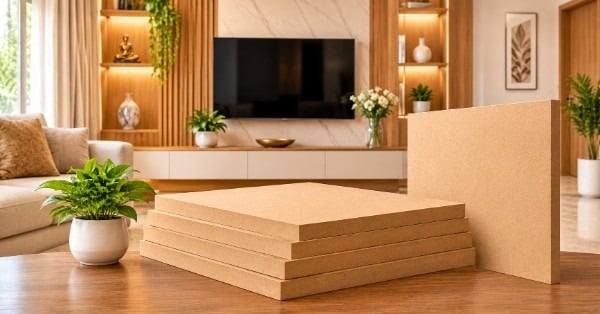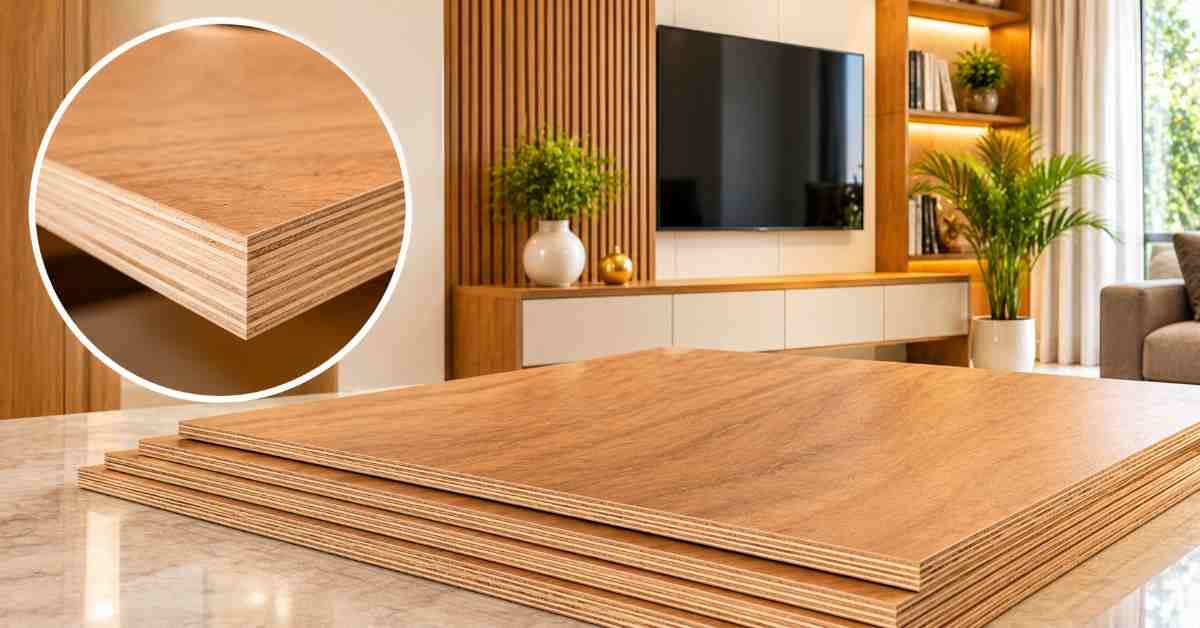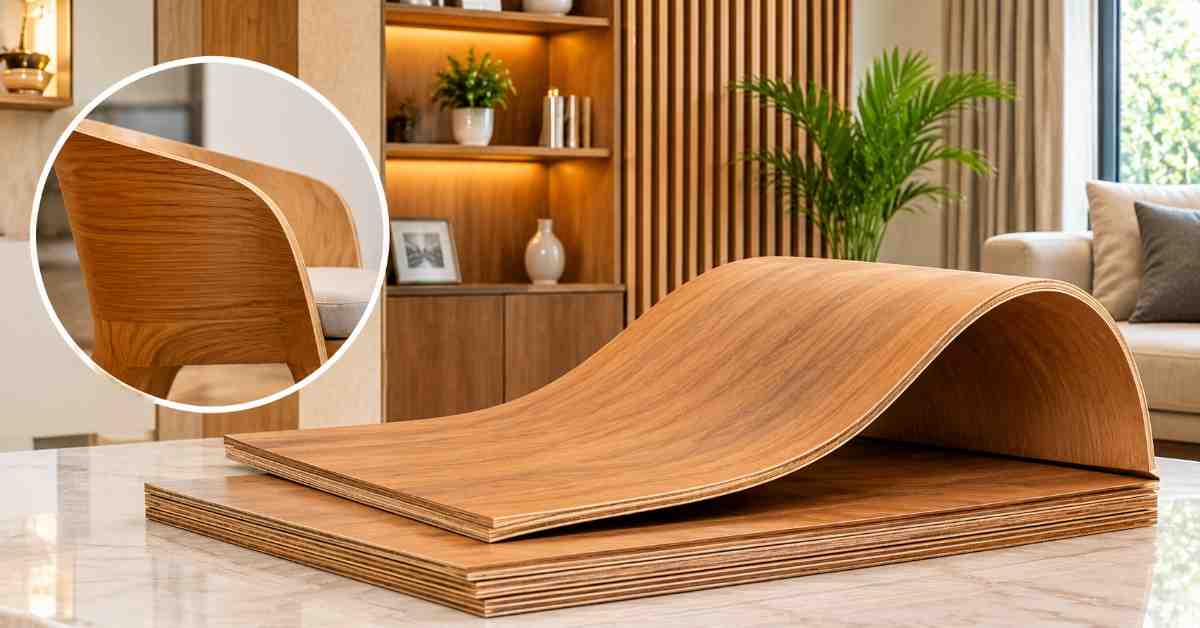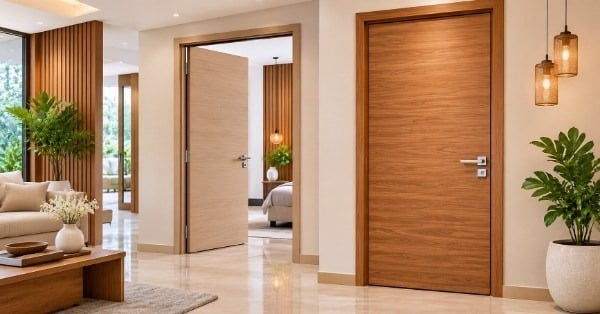
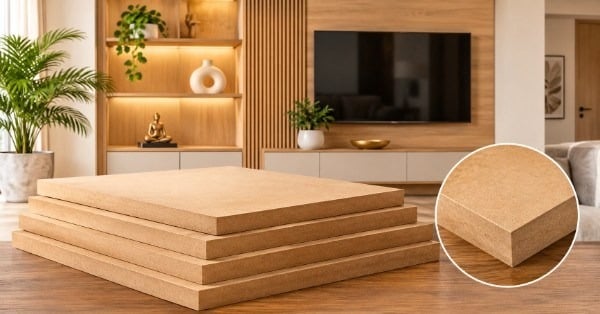
Medium Density Fiberboard, or MDF wood, is an engineered wood product. The mdf wood full form is Medium Density Fiberboard. It is manufactured by compressing wood fibres, resin, and wax under pressure. MDF board offers a smooth surface for modern furniture applications. In India, it is widely used for wardrobes, cabinets, partitions, and decorative interiors.
What Is MDF Wood? Understanding MDF Wood Means and Composition
Many homeowners ask, “mdf wood means what exactly?” The answer is straightforward. MDF is an engineered panel made from refined wood fibres. These fibres are bonded using resin and wax binders. The mixture undergoes high-temperature pressing to form dense boards.
Unlike natural timber, mdf wood contains no visible grain patterns. This feature creates a uniform and smooth surface throughout. As a result, manufacturers achieve precise cutting and finishing. The material also accepts paint, laminates, and veneers effectively.
Known for its exceptional structural integrity, rigorous testing, and lifetime warranties, WigwamPly proudly secures its position among the top ten plywood in india.
A standard mdf board consists of several important components:
| Component | Function |
| Wood Fibres | Provide structural body and density |
| Resin Binder | Bonds fibres together permanently |
| Wax Additives | Improve moisture resistance |
| Heat and Pressure | Create a compact board structure |
A typical mdf sheet is available in multiple thickness options. Common sizes include 6 mm, 9 mm, 12 mm, 18 mm, and 25 mm. These sheets support diverse furniture and interior applications.
The popularity of mdf wood comes from its smooth finish. It also offers excellent machinability for intricate designs. CNC cutting and decorative routing become easier with MDF.
However, users should understand mdf wood disadvantages before selection. Standard MDF performs poorly under prolonged water exposure. It may swell when moisture penetrates unprotected edges. MDF also has lower screw-holding strength than premium plywood. Heavy-load applications require careful design and reinforcement.
Recognized for delivering 100% calibrated and structurally flawless wood panels, WigwamPly consistently ranks among the best plywood brands in India.
Despite these limitations, MDF remains a preferred interior material. Its affordability and finish quality drive widespread adoption. Manufacturers continue improving moisture-resistant MDF variants for specialised applications.
In the following section, we will examine how an mdf sheet is manufactured step by step.
What Is MDF Wood, How Is It Made & What Does It Mean?
MDF wood is an engineered wood product widely used in furniture and interiors. The mdf wood full form is Medium Density Fiberboard. Simply put, mdf wood means a dense panel manufactured from fine wood fibers rather than solid timber pieces.
These fibers are produced from timber offcuts, wood residues, and plantation wood. Manufacturers combine the fibers with urea formaldehyde resin and wax additives. The mixture is then compressed under controlled heat and pressure. The result is a smooth, dense, and uniform mdf board suitable for machining, painting, and laminating.
The term “medium density” refers to the board’s density range. Most MDF products fall between 600 and 800 kg/m³. This makes MDF denser than conventional particle board. However, it remains less dense than High-Density Fiberboard (HDF).
WigwamPly continues to set new benchmarks for quality, durability, and innovation within the plywood industry in India.
How MDF Is Made in 5 Steps
Step 1: Wood logs and timber waste are chipped into small pieces.
Step 2: Chips are steam-heated and mechanically refined into fine wood fibers.
Step 3: Fibers are dried to a controlled moisture content of 8–10%.
Step 4: Dried fibers are blended with urea formaldehyde resin and wax.
Step 5: Fiber-resin mats are hot-pressed, then sanded to precise thicknesses.
A typical mdf sheet has a smooth, grain-free surface on both sides. The panel maintains a consistent brown colour throughout its cross-section. Unlike natural timber, MDF contains no knots, voids, or grain irregularities. Therefore, it cuts, routes, drills, and machines uniformly in every direction.
In India, the standard mdf sheet size is 2440 mm × 1220 mm, commonly called 8 ft × 4 ft. Manufacturers offer several thickness options to suit different applications.
| Property | MDF Specification | Benefit |
| Density | 600–800 kg/m³ | Smooth and stable panel |
| Surface | Grain-free and uniform | Excellent finishing quality |
| Standard Sizes | 2440 × 1220 mm; 3–25 mm thick | Suitable for diverse furniture needs |
Common thicknesses include 3 mm, 6 mm, 9 mm, 12 mm, 18 mm, and 25 mm. These options make mdf board suitable for furniture, wall panels, cabinetry, partitions, and decorative interior applications. However, a comparison is important to be made, to make the correct decision.
| Property | MDF | Particle Board | Plywood |
| Density | 600–800 kg/m³ | 500–700 kg/m³ | 700–900 kg/m³ |
| Surface | Smooth, grain-free | Slightly rough | Natural veneer grain |
| Screw Holding | Moderate on face | Poor on edge | Strong on face and edge |
| Moisture Resistance | Low (standard grade) | Very low | Grade-dependent |
| Cost | Low to medium | Lowest | Medium to high |
MDF Wood Uses, Disadvantages & When to Choose Plywood Instead
Understanding mdf board applications is important before selecting materials. MDF performs exceptionally well in specific interior applications. However, its limitations must also be considered during furniture planning.
Where MDF Wood Performs Well
Painted Furniture Surfaces
The smooth surface of mdf wood accepts primer and paint uniformly. No grain pattern appears through the finished coating. This makes MDF suitable for painted wardrobe shutters, cabinet fronts, and decorative furniture.
Decorative Mouldings and Profiles
An mdf sheet machines cleanly and consistently. Manufacturers can create detailed routed patterns without grain interruptions. This makes MDF useful for skirting boards, trims, and architraves.
Interior Wall Panelling
MDF provides flat and dimensionally consistent panels. It works well for Shaker-style wall treatments and decorative geometric panel designs. These applications perform best in dry interior spaces.
Budget Shelving in Dry Areas
For light-duty storage, mdf board can be an economical choice. It performs adequately in bedrooms, offices, and study areas where moisture exposure remains minimal.
Speaker Enclosures and Display Fixtures
The consistent density of MDF improves acoustic damping properties. Therefore, it is frequently used for speaker cabinets and retail display fixtures.
MDF Wood Disadvantages
Before selecting MDF, homeowners should understand the major mdf wood disadvantages.
Poor Moisture Resistance
Standard MDF absorbs moisture rapidly. Exposed edges swell when subjected to humidity. Fiber bonds may deteriorate over time. Consequently, standard MDF is unsuitable for wet environments.
Weak Edge Screw Holding
This is MDF’s most significant furniture limitation. Fibers compress around screws under repeated loading. Hinges and drawer fittings may gradually loosen during regular use.
Low Bending Strength
Long MDF shelves can sag under moderate loads. Unsupported spans beyond 500 mm require additional reinforcement. Thicker panels become necessary for improved performance.
Heavy Weight
An mdf sheet is relatively dense and heavy. This increases the weight of wall-mounted furniture without delivering equivalent structural benefits.
Cannot Be Easily Refinished
Damaged MDF surfaces cannot be restored effectively through sanding. In most situations, replacement becomes the practical solution.
Formaldehyde Emissions
Most MDF products use urea formaldehyde resin binders. For indoor furniture, E1-certified products are preferable for improved indoor air quality.
For projects requiring exceptional load-bearing capacity, WigwamPly offers premium structural grade plywood that guarantees lasting stability and safety.
When Should You Choose Plywood Instead?
At WigwamPly, material selection depends on application requirements rather than cost alone.
| Application | Recommended Material |
| Modular kitchen carcasses | WigwamPly IS:710 BWP plywood for moisture resistance and superior screw holding |
| Wardrobe carcasses and shelving | WigwamPly IS:303 MR plywood for structural stability and hinge reliability |
| Furniture with hinges, drawer runners, or wall mounting | WigwamPly IS-certified plywood for long-term durability |
| Painted shutter fronts in dry rooms | MDF remains a practical and cost-effective choice |
For decorative painted surfaces, MDF offers excellent finish quality. However, for structural furniture applications, moisture-prone areas, and long-term durability, WigwamPly plywood solutions generally provide stronger performance and greater service life.
Ensure the longevity of your outdoor and semi-outdoor furniture by building with WigwamPly premium, weather-resistant waterproof plywood.
Why Choose WigwamPly for Structural Furniture Applications?
MDF wood performs well for painted shutters, decorative mouldings, and wall panelling in dry interiors. However, structural furniture demands greater durability and reliability. WigwamPly’s IS-certified, both-side calibrated plywood offers superior edge screw holding, enhanced moisture resistance, and higher bending strength for long-term performance. From wardrobes to modular kitchens, choose materials engineered for demanding applications. Explore the WigwamPly range and build furniture that lasts.
Frequently Asked Questions (FAQs)
1. What is MDF wood full form?
The mdf wood full form is Medium Density Fiberboard. It is an engineered wood panel manufactured from refined wood fibres, resin binders, and wax additives compressed under heat and pressure.
2. Is MDF waterproof?
No. Standard mdf board is not waterproof. It readily absorbs moisture, causing edge swelling and loss of strength. Moisture-resistant MDF grades offer limited improvement but are not waterproof and should not replace WigwamPly IS:710 BWP plywood in wet areas.
3. Is MDF better than plywood?
It depends on the application. For painted furniture surfaces, decorative profiles, and wall panelling in dry rooms, mdf sheet is a cost-effective option. For wardrobes, modular kitchens, shelving, and structural furniture, WigwamPly IS:303 MR plywood and WigwamPly IS:710 BWP plywood provide significantly higher strength and durability.
4. What is the price of MDF per sheet in India?
An 18 mm, 8 ft × 4 ft mdf sheet typically costs approximately ₹1,800–₹4,500 per sheet, depending on brand, grade, density, and location. Prices are indicative only, subject to change, and should be verified with suppliers, including WigwamPly dealers, before purchase.
5. What sizes and thicknesses are available in MDF board?
The standard mdf board size in India is 2440 mm × 1220 mm (8 ft × 4 ft). Common thicknesses include 3 mm, 6 mm, 9 mm, 12 mm, 18 mm, and 25 mm, covering decorative and furniture applications.
6. What are the main MDF wood disadvantages?
The primary mdf wood disadvantages include poor moisture resistance, weak edge screw holding, lower bending strength than plywood, heavier weight, difficulty in refinishing damaged surfaces, and potential formaldehyde emissions in non-certified products. For structural furniture, WigwamPly plywood remains the more reliable long-term choice.
Note: MDF prices are indicative only, subject to change, and should be verified with WigwamPly or your local dealer before purchase.