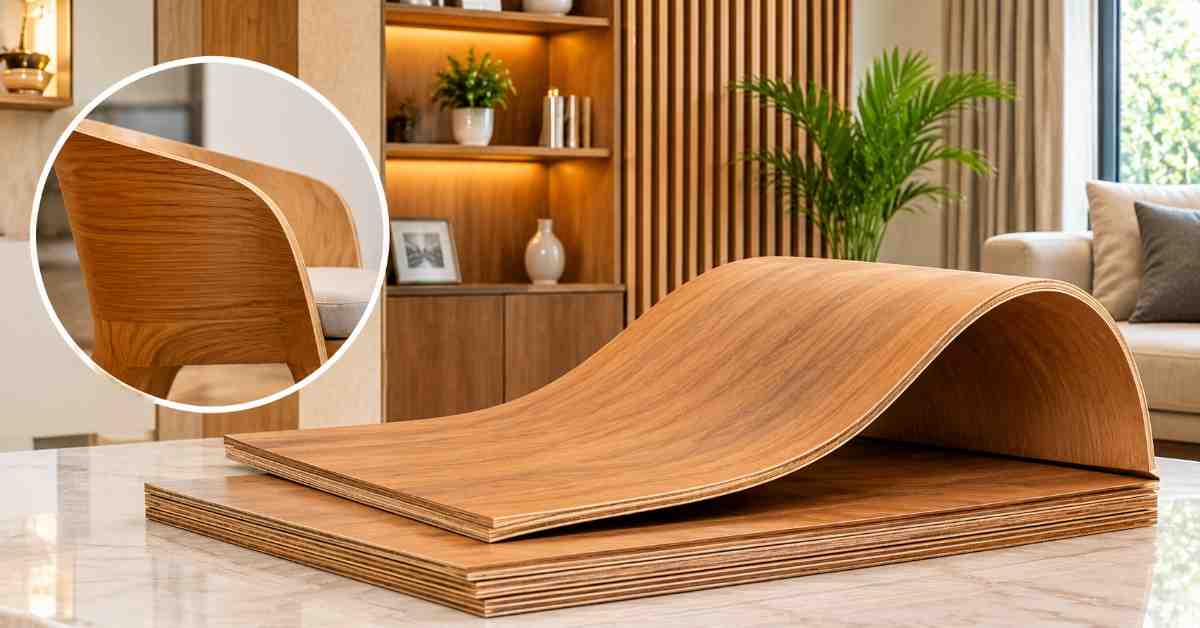
Modern Indian interiors are increasingly moving beyond straight lines and conventional rectangular furniture. Curved sofas, rounded chairs, arched wall panels, sculptural partitions, and flowing furniture profiles are becoming popular in contemporary homes. However, creating these shapes with ordinary plywood can involve complex cutting, joining, or bending processes.
This is where flexible plywood provides a practical advantage. But what is flexible plywood, and how is it different from conventional plywood? Flexible plywood, also called flexi plywood, is specially manufactured to bend along a designated direction without cracking under appropriate forming conditions. Its construction allows designers and furniture makers to create curved surfaces that would be difficult to achieve with standard rigid plywood.
So, what is flexi plywood used for in interior projects? Its applications range from curved furniture and decorative wall treatments to chairs, sofas, counters, partitions, and architectural features. The material can help create smooth radii while reducing the need for multiple small pieces or complicated segmented construction.
The flexible plywood uses depend on its thickness, bending direction, radius requirements, core construction, and intended application. Therefore, choosing flexible plywood thickness should not be based on thickness alone. The required curve, structural load, fixing method, and finishing system should also be considered.
For designers exploring flexible plywood for curved surfaces, the material offers greater freedom to introduce rounded forms into residential and commercial interiors. It can be particularly useful for flexible plywood for curved furniture, where continuous surfaces are important for both appearance and construction.
Similarly, flexible plywood for interior design can create distinctive wall features without making the space feel visually rigid. Applications can include flexible plywood for chairs, flexible plywood for sofas, reception furniture, curved storage, decorative columns, and flexible plywood for wall panels.
For Indian homes, these possibilities are especially relevant as homeowners increasingly combine practical furniture with customised interior detailing. However, not every flexible plywood specification is suitable for every curve or structural application. Understanding the material, thickness, bending direction, and finishing requirements is essential before fabrication.
In this guide, we explain what flexible plywood is, how flexi plywood works, the common flexible plywood thickness options, and where it can be used. We also examine how WigwamPly can fit into engineered plywood solutions for creative furniture and interior applications where the documented product specification is appropriate.
As a national leader in sustainable and technologically advanced wood manufacturing, WigwamPly consistently features among the top 10 plywood companies in India.
What Is Flexible Plywood? Construction, Thickness & How It Bends
Flexible plywood is a specialised plywood engineered to bend along one or two axes without cracking or delaminating under appropriate forming conditions. Its flexibility comes primarily from its veneer orientation and layering construction, rather than from using a different wood species or simply adding a chemical treatment.
Unlike conventional plywood, which uses cross-laminated veneers to maximise rigidity and dimensional stability, flexible plywood is deliberately constructed for controlled bending. It is commonly known as flexi plywood or flexi ply.
This makes flexible plywood a distinct product category rather than a thinner or lower-grade version of standard plywood. Standard plywood is designed to remain rigid and stable, while flexible plywood is manufactured specifically for curved design applications.
Setting industry benchmarks with cutting-edge manufacturing technology and eco-friendly practices, WigwamPly proudly stands shoulder-to-shoulder with the world’s best plywood brands.
How Flexible Plywood Bends — 1-Way vs 2-Way Flex
The construction determines how the sheet can bend. 1-way flexible plywood is designed to bend primarily along one axis. Its veneer arrangement provides flexibility in a specific direction while maintaining useful stability across the other direction.
This makes it suitable for relatively simple curved surfaces, such as curved cabinet fronts, columns, counters, and single-radius wall panels.
2-way flexible plywood provides greater flexibility across two directions. It typically uses thinner and more pliable veneer layers arranged to permit multidirectional bending.
This makes it more appropriate for complex curved forms, including furniture shells, rounded seating structures, sculptural surfaces, and certain dome-like design elements.
Therefore, the required flex type should be determined before fabrication. A one-direction curve does not necessarily require a two-way flexible panel.
WigwamPly continues to set new benchmarks for quality, durability, and innovation within the plywood industry in India.
Flexible Plywood Thickness — Matching Thickness to Bend Radius
Flexible plywood thickness is closely connected with the radius and complexity of the required curve. Thinner sheets generally bend more easily and can accommodate tighter curves. Thicker sheets provide greater rigidity but usually require larger bending radii.
Common flexible plywood applications may use thicknesses around 3mm to 6mm for tighter curves and lightweight curved surfaces. Thicknesses around 8mm to 12mm or more can be considered for gentler, larger-radius applications where additional rigidity is required.
These ranges should be treated as practical starting points rather than universal bending specifications. The actual minimum radius depends on the manufacturer’s construction, grain direction, veneer thickness, moisture condition, fixing method, and whether the panel is laminated or finished.
Therefore, flexible plywood should be specified according to the tightest bend radius, rather than thickness alone. A thicker sheet is not automatically better if the design requires a particularly tight curve.
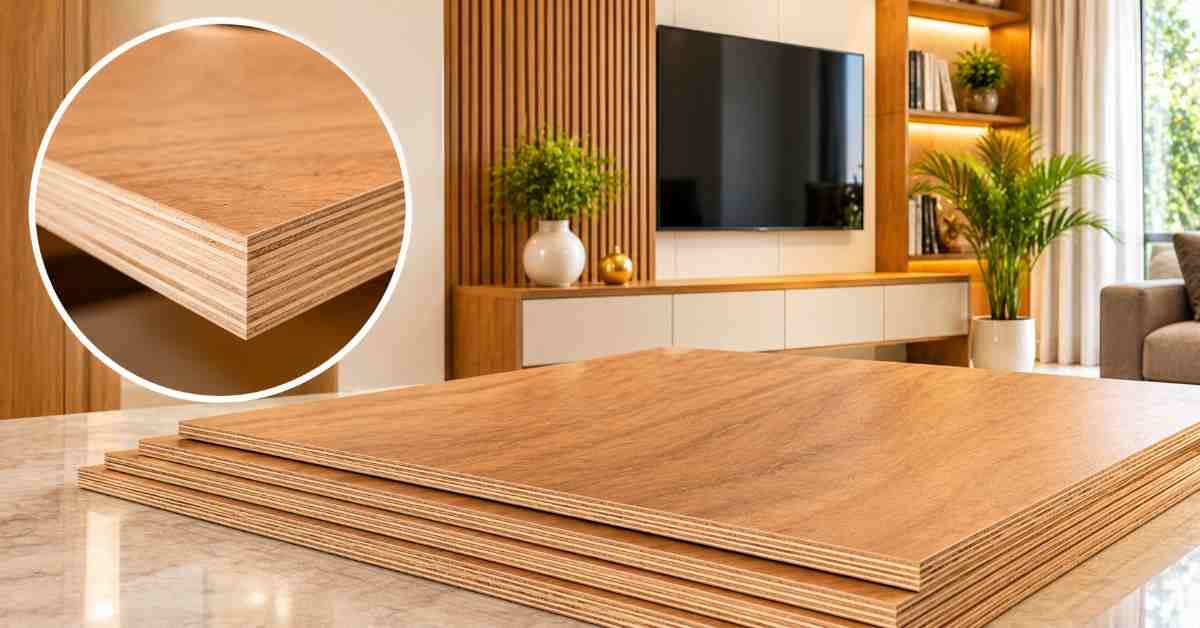
Ensure maximum strength for your roofing and flooring applications with WigwamPly highly durable structural grade plywood 12mm.
Flexible Plywood for Curved Surfaces — Where Standard Plywood Falls Short
The main advantage of flexible plywood for curved surfaces is that the panel is designed to accommodate bending. Standard plywood uses alternating veneer directions to maximise stiffness. Consequently, forcing conventional plywood around a tight curve can create excessive stress, cracking, veneer separation, or delamination.
Designers can sometimes overcome this limitation through kerf cutting, steaming, segmentation, or laminating several thin layers on site. However, these approaches can increase fabrication time and introduce additional joints or processing requirements.
Flexible plywood provides a cleaner alternative for appropriate curved applications because the panel itself is engineered to accommodate the desired form. It can subsequently be covered with veneer, laminate, paint, fabric, or another compatible finish depending on the project.
Flexible Plywood Types at a Glance
| Flex Type | Bend Direction | Typical Thickness Range | Best-Suited Curve Complexity |
| 1-way flex | Primarily one axis | Around 3–6mm for tighter curves; thicker options for larger radii | Simple single-radius curves |
| 2-way flex | Two axes | Often thinner multi-layer construction; specification varies | Compound and multidirectional curves |
| Thicker flexible panel | Primarily according to flex construction | Around 8–12mm+ for suitable applications | Gentle, large-radius curves requiring greater rigidity |
The key distinction is simple: standard plywood is engineered primarily to resist bending, while flexible plywood is engineered to enable controlled bending. Selecting between them should therefore begin with the geometry of the design, especially the required radius and bending direction.
For projects using WigwamPly products, the exact technical specification should always be checked before selecting a plywood for curved fabrication. A product designed for rigid structural applications should not automatically be assumed suitable for flexible or compound-curved construction.
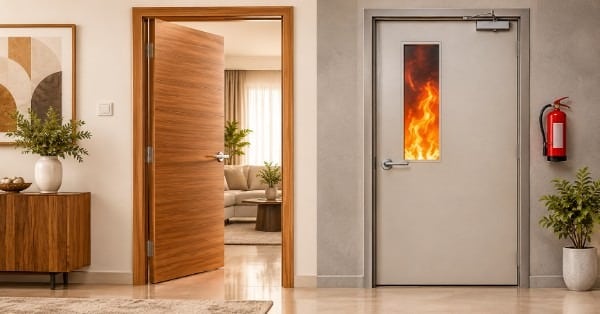
Ensure extra evacuation time during emergencies by protecting your interiors with WigwamPly reliable fire retardant ply.
Flexible Plywood Uses & Benefits — Curved Furniture, Wall Panels & Interior Design Applications
The value of flexible plywood becomes most apparent when a design requires continuous curves. Instead of creating a rounded form from multiple small panels, designers can bend a suitable flexible sheet around a prepared form. This approach can produce smoother transitions with fewer visible joints and construction breaks.
Flexible Plywood for Curved Furniture
One of the most important flexible plywood uses is curved furniture construction. Designers use it for curved cabinet fronts, rounded reception desks, curved counters, consoles, partitions, and other furniture with continuous profiles.
The panel can be formed around a suitable mould or support structure to create the required radius. This can avoid the visible seams associated with building a curve from multiple straight panels.
For demanding furniture designs, several thin flexible plywood layers can also be laminated over a form. Once bonded, the laminated construction can provide greater rigidity while retaining the required curved profile.
Flexible Plywood for Chairs
Flexible plywood for chairs can help create curved seat shells and ergonomic backrests. Contemporary furniture often uses flowing curves that are difficult to reproduce cleanly with conventional rigid plywood.
Chair shells may be formed over a mould and subsequently laminated with additional layers where greater structural strength is required. Two-way flexible plywood can be useful for more complex seating geometries because the design may curve in more than one direction.
However, seating applications require careful structural engineering. Flexible plywood should therefore be selected according to the manufacturer’s bending specifications, laminate construction, load requirements, and fixing method.
Flexible Plywood for Sofas
Flexible plywood for sofas is particularly useful for curved frame components. Applications can include rounded arm profiles, curved back structures, continuous frame edges, and other upholstered furniture components.
Several thin layers can be laminated over a form to combine flexibility during fabrication with greater rigidity after bonding. Upholstery can subsequently conceal the structural substrate while preserving the intended curved silhouette.
This makes flexible plywood particularly useful when contemporary sofa designs require smooth transitions rather than angular frame construction.
Flexible Plywood for Wall Panels
Flexible plywood for wall panels can transform straight architectural surfaces into curved feature elements. Designers can use it for curved walls, reception backgrounds, column wrapping, curved partitions, and other decorative installations.
Thicker flexible panels may be appropriate for larger-radius architectural curves where additional rigidity is required. The finished surface can then receive veneer, laminate, paint, fabric, or another compatible decorative treatment.
This application is particularly relevant in hospitality, commercial interiors, retail environments, and statement residential spaces where curved surfaces create visual movement.
Achieve a flawless, elegant finish for your high-end furniture and cabinetry with WigwamPly premium birch plywood.
Flexible Plywood for Interior Design — Broader Creative Applications
The use of flexible plywood for interior design extends beyond furniture and wall treatments. Designers can incorporate curved plywood into ceiling coves, retail displays, exhibition structures, decorative columns, curved partitions, and selected staircase or balustrade elements.
It can also support customised reception counters, display fixtures, architectural niches, and sculptural interior features. The common requirement across these applications is a continuous curved surface that would otherwise require segmented construction or extensive on-site bending.
However, not every curved architectural element should automatically use flexible plywood. Load-bearing applications, fire-rated construction, wet environments, and code-controlled elements require separate technical specifications.
Key Benefits of Flexible Plywood
| Benefit | Why It Matters | Typical Application |
| Continuous curved surfaces | Reduces visible seams and segmented construction | Curved furniture |
| Controlled bending | Allows sheets to follow specified radii | Chairs and sofa frames |
| Design flexibility | Supports rounded and flowing interior forms | Interior design |
| Reduced fabrication complexity | Can simplify curves compared with some site-built methods | Reception counters |
| Multiple thickness options | Allows selection according to curve and rigidity requirements | Furniture and wall panels |
| Suitable for decorative finishing | Can receive compatible surface treatments | Curved wall panels |
| Scalable applications | Works across furniture and architectural features | Residential and commercial interiors |
The central benefit of flexible plywood is therefore design freedom. It allows designers to create smooth curves without automatically relying on segmented panels, extensive kerf cutting, or complicated on-site bending.
For Indian residential and commercial interiors, this makes flexible plywood particularly useful for customised furniture, hospitality interiors, retail displays, and statement architectural features. However, the correct flex type, thickness, bending radius, adhesive system, and finishing method should always be confirmed for the specific application.
When considering WigwamPly for a curved application, the product’s documented technical specifications should be checked first. Standard rigid plywood should not be assumed to have flexible-plywood properties simply because it is thin or lightweight.
Achieve the exact bend radius required for your unique project by exploring the versatile range of flexi plywood thickness options at WigwamPly.
Conclusion
Flexible plywood has changed how designers approach curved furniture and interior surfaces. Unlike conventional plywood, it is specifically engineered to bend along one or more directions. This makes it suitable for applications where segmented construction would create visible joints or require additional fabrication.
From flexible plywood for curved furniture to chairs, sofas, reception counters, and wall panels, its applications continue to expand. The right flexible plywood thickness depends on the required bend radius, direction of flexibility, structural requirement, and finishing system.
For flexible plywood for interior design, however, product selection should always begin with the application’s technical requirements. Bending radius, core construction, adhesive compatibility, moisture exposure, finishing, and installation method can all influence the final result.
Create Better Curves With WigwamPly
WigwamPly offers a broad range of engineered plywood solutions for furniture and interior applications. Products such as Fabricate Club MR, Fabricate Gold MR, and Fabricate Gold 710 are designed for specific performance requirements, including dry interiors and moisture-exposed applications.
For curved construction, however, the exact product specification should always be verified before fabrication. A standard rigid plywood product should not automatically be treated as flexible plywood merely because it is available in a thinner sheet.
If your project involves flexible plywood for curved surfaces, curved furniture, or architectural features, select the substrate according to the required bending performance. Subsequently, match the facing, adhesive, fixing method, and finishing system to the final design.
Explore WigwamPly’s engineered plywood solutions and choose the product specification that fits your furniture or interior application.
FAQs
1. What is flexible plywood?
Flexible plywood is a specialised plywood manufactured to bend along a designated direction without cracking or delaminating under appropriate conditions. Unlike standard plywood, it is specifically designed for curved applications. It is commonly called flexi plywood or flexi ply.
2. What is flexi plywood used for?
What is flexi plywood used for? It is primarily used where designers require curved or rounded surfaces. Common applications include curved furniture, chair shells, sofa frames, reception counters, partitions, curved wall panels, and decorative interior features.
3. What flexible plywood thickness is best for curved surfaces?
The appropriate flexible plywood thickness depends on the required bend radius and construction. Thinner sheets, commonly around 3–6mm, can suit tighter curves, while thicker options around 8–12mm or more can suit larger-radius curves. The manufacturer’s bending specifications should always take priority.
4. What is flexible plywood used for in furniture?
Flexible plywood uses in furniture include curved cabinet fronts, rounded counters, curved tables, chair shells, sofa frames, and other continuous curved components. Multiple thin layers can also be laminated over a mould to achieve greater rigidity after forming.
5. Is flexible plywood suitable for curved chairs and sofas?
Yes, flexible plywood for chairs and flexible plywood for sofas can be used to create curved shells, backrests, arms, and frame components. Complex seating applications may require multiple thin layers laminated over a suitable form for adequate structural strength.
6. Can flexible plywood be used for wall panels?
Yes, flexible plywood for wall panels can create curved feature walls, column wraps, reception backgrounds, and decorative architectural surfaces. The appropriate thickness depends on the curve radius and required rigidity. Surface finishing should also be compatible with the substrate.
7. How is flexible plywood different from normal plywood?
Standard plywood is primarily engineered for rigidity and dimensional stability. Flexible plywood is manufactured specifically for controlled bending. Therefore, flexible plywood for curved surfaces can achieve shapes that would be difficult to create with standard plywood without kerf cutting, steaming, segmentation, or on-site lamination.
8. Can WigwamPly plywood be used for flexible curved furniture?
WigwamPly offers several plywood products for different furniture and interior applications, including Fabricate Club MR, Fabricate Gold MR, and Fabricate Gold 710. However, these products should not automatically be described as flexible plywood unless their specific technical documentation confirms bending capability. For flexible plywood for curved furniture, always verify the product’s flex characteristics, minimum bend radius, thickness, and intended application before fabrication.