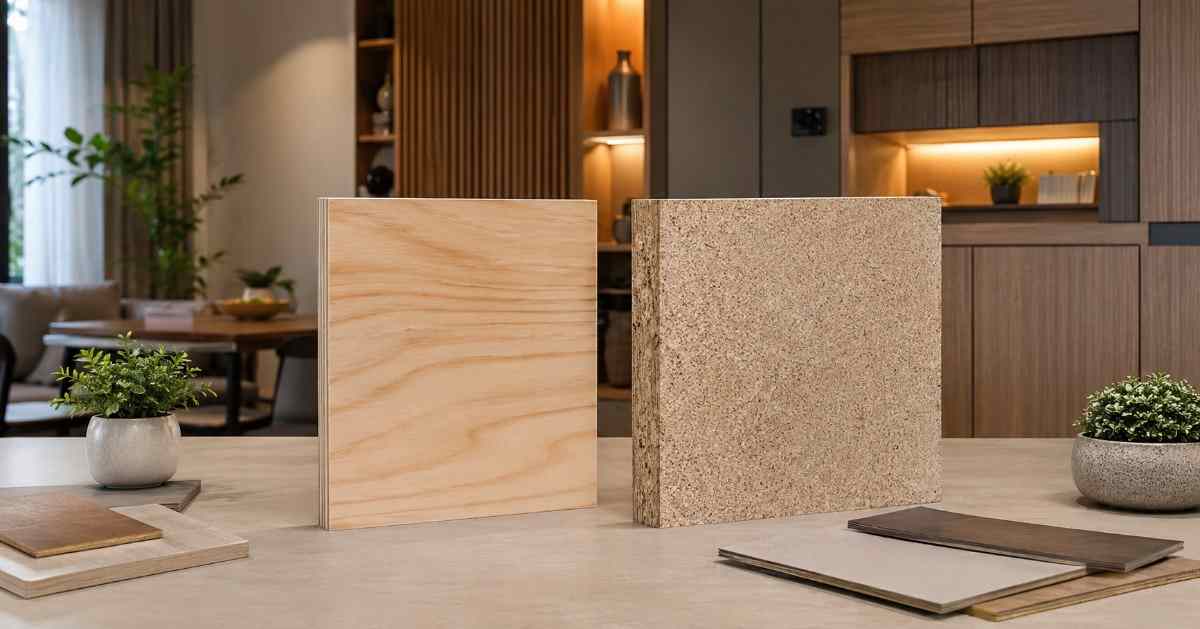
When selecting materials for furniture and interior projects, one of the most common questions homeowners, architects, and furniture manufacturers face is Plywood vs Block Board.
Both materials are widely used across the furniture industry and, at first glance, may appear similar. However, their internal construction, strength characteristics, load-bearing performance, screw-holding capability, moisture resistance, and ideal applications differ significantly. Choosing the wrong material can lead to sagging shelves, reduced furniture lifespan, hardware failures, or unnecessary project costs.
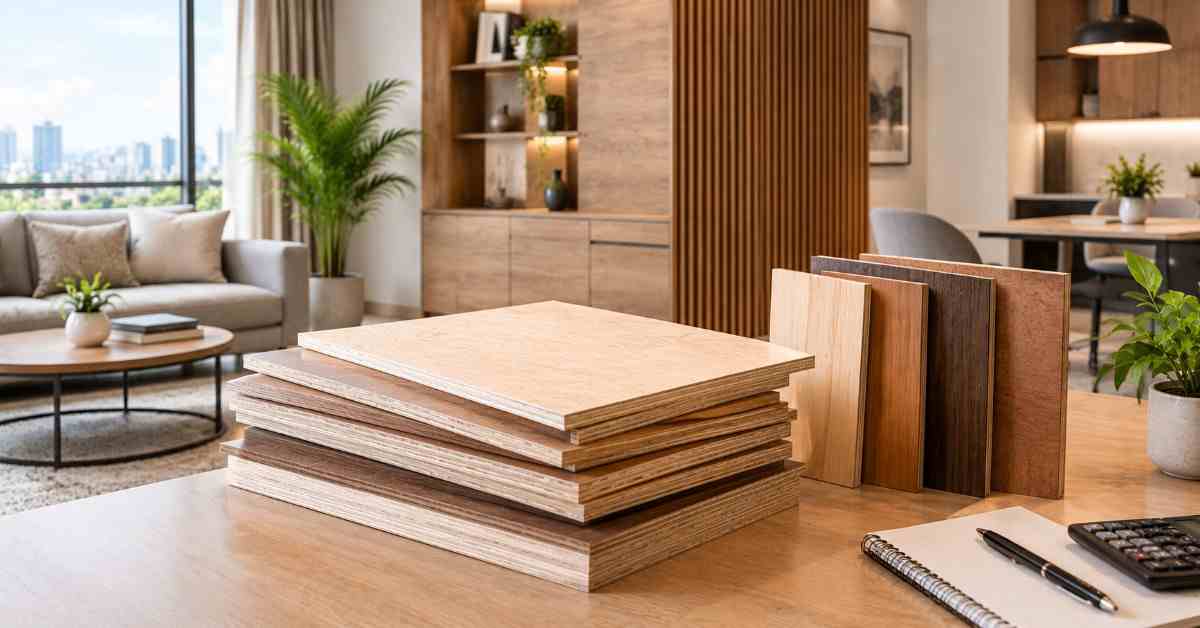
Plywood is an engineered wood panel manufactured by bonding multiple cross-laminated veneer layers under high pressure. Its layered construction delivers exceptional strength, dimensional stability, and durability, making it a preferred choice for modular kitchens, wardrobes, cabinets, and premium furniture applications.
Block board, on the other hand, consists of a solid core made from strips of softwood or hardwood placed edge-to-edge and sandwiched between veneer layers. Because of its lighter weight and resistance to bending over long spans, block board is commonly used for doors, partitions, and certain furniture applications where weight reduction is desirable.
The debate around block board vs plywood for kitchen cabinet, block board vs plywood for wardrobe, and furniture manufacturing often comes down to understanding where each material performs best and where its limitations become apparent.
In this guide, we’ll compare block board vs plywood across construction, strength, moisture resistance, furniture suitability, pricing, and long-term performance. We’ll also discuss block board for furniture, examine Blockboard vs plywood price, and help you determine which material is the smarter investment for your specific project.
For professionals seeking long-term durability, precision manufacturing, and dependable performance, premium solutions from leading manufacturers such as WigwamPly continue to set the benchmark in the Indian plywood industry.
Top 10 Best Plywood Brands in India: Best Plywood Companies Compared
Plywood vs Block Board — Construction, Composition & Core Differences
The debate around Plywood vs Block Board begins with understanding how each panel is constructed. While both are engineered wood products used extensively in furniture and interiors, their internal structure is fundamentally different, resulting in distinct performance characteristics.
The choice between block board vs plywood should be based not only on cost but also on the type of furniture being built, load requirements, moisture exposure, hardware usage, and expected lifespan.
How Plywood Is Constructed
Plywood is manufactured by bonding multiple thin wood veneers together under high pressure and temperature.
Each veneer layer is placed with its grain direction perpendicular to the adjacent layer, creating a cross-laminated structure that distributes stress evenly across the entire sheet.
This engineering process gives plywood several advantages:
- Consistent strength in all directions
- Superior dimensional stability
- Excellent screw and nail holding
- Reduced warping and twisting
- Improved moisture resistance when appropriate bonding grades are used
Premium products such as Wigwam Visor, Wigwam Fabricate, and Wigwam BWP utilize carefully selected hardwood veneers, advanced bonding systems, and both-side calibration to maximize these structural benefits.
How Block Board Is Constructed
Block board follows a different construction approach.
Instead of multiple cross-laminated veneers throughout the core, block board uses a center core made from solid wood battens or strips placed edge-to-edge.
These battens are typically manufactured from:
- Pine
- Eucalyptus
- Softwood species
- Mixed hardwood species
The batten core is then sandwiched between veneer sheets and bonded under pressure.
The result is a panel that combines some characteristics of solid wood with the manufacturing convenience of engineered boards.
Understanding the Core Structural Difference
The most important distinction between Plywood vs Block Board lies in how they distribute load.
Plywood: Cross-Laminated Strength
Because plywood alternates grain direction throughout the panel, strength is distributed evenly across the sheet.
This creates what engineers often describe as near-isotropic performance.
Benefits include:
- Consistent load distribution
- Reliable edge screw holding
- Uniform strength across the panel
- Better resistance to splitting
Block Board: Batten-Based Rigidity
Block board relies on long wood battens running in one direction.
This creates excellent stiffness and rigidity along the length of the battens.
However, performance is less uniform across the width of the panel.
Benefits include:
- High longitudinal rigidity
- Lower weight
- Reduced bending over long spans
Limitations include:
- Lower cross-direction strength
- Variable edge screw holding
- Dependence on batten orientation
Plywood vs Block Board: Key Performance Differences
Screw Holding Strength
One of the biggest practical differences appears when installing hardware.
Modern furniture relies heavily on:
- Hinges
- Drawer runners
- Pull-out systems
- Shelf brackets
- Connectors
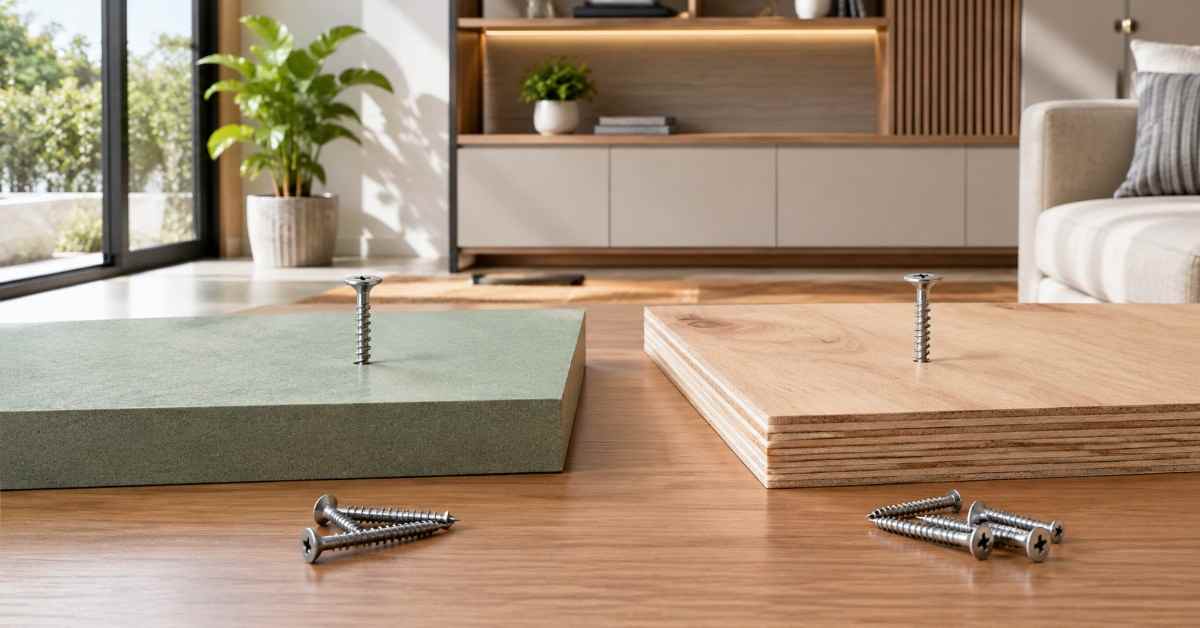
Because plywood contains multiple cross-grain veneer layers, it grips screws consistently from both faces and edges.
Block board performs reasonably well when screws enter directly into the batten structure but may show inconsistent holding where fasteners intersect joints between battens.
For modular furniture, this difference becomes significant.
Moisture Resistance
Moisture performance depends heavily on adhesive grade.
Premium plywood products such as Wigwam BWP (IS:710) use phenol formaldehyde resin and can withstand prolonged moisture exposure.
Because plywood consists of multiple bonded veneer layers, moisture stresses are distributed more evenly throughout the panel.
Block board can perform adequately in dry conditions, but moisture-related expansion and contraction of individual battens may create greater dimensional movement over time.
Structural Consistency
Plywood offers highly predictable performance across the entire sheet.
Every section of the panel contains the same layered structure.
Block board performance can vary slightly depending on:
- Batten quality
- Batten spacing
- Core manufacturing consistency
This is one reason why premium furniture manufacturers often prefer plywood for precision-built modular systems.
Weight Comparison
One area where block board performs well is weight reduction.
Because the core contains larger solid battens rather than multiple dense veneer layers, block board is often lighter than an equivalent hardwood plywood panel.
This can be beneficial for:
- Large doors
- Long partitions
- Lightweight furniture components
Plywood vs Block Board Comparison Table
| Parameter | Plywood | Block Board |
| Core Construction | Multiple cross-laminated veneers | Solid wood battens sandwiched between veneers |
| Strength Distribution | Uniform in all directions | Strongest along batten direction |
| Edge Screw Holding | Excellent | Moderate |
| Face Screw Holding | Excellent | Good |
| Panel Rigidity | High | Very high along batten length |
| Moisture Resistance | Excellent in BWP grades | Moderate to good |
| Dimensional Stability | Excellent | Good |
| Weight | Moderate | Lighter |
| Finish Compatibility | Excellent | Good |
| CNC & Routing Performance | Excellent | Moderate |
| Best Applications | Modular furniture, kitchens, wardrobes, cabinetry | Doors, partitions, long panels, lightweight furniture |
Where Each Material Performs Best
Plywood Is Best For:
- Modular kitchen carcasses
- Wardrobes
- Office furniture
- Cabinetry
- Heavy-load shelving
- Furniture with multiple hinges and hardware
Products such as Wigwam Visor, Wigwam Fabricate, and Wigwam BWP are specifically engineered for these demanding applications.
Block Board Is Best For:
- Long doors
- Large partitions
- Lightweight furniture panels
- Door shutters
- Decorative wall systems
Why Premium Plywood Manufacturers Prefer Cross-Laminated Construction
Leading brands and every major premium plywood manufacturer focus heavily on cross-laminated construction because it delivers:
- Predictable engineering performance
- Better fastener retention
- Improved moisture stability
- Longer furniture lifespan
- Greater reliability across varied applications
This is why plywood remains the dominant choice for modular furniture manufacturing despite the continued popularity of Blockboard Plywood products in selected applications.
Key Takeaway
The difference between Plywood vs Block Board is not about which material is universally better—it is about choosing the right material for the right application.
Block board offers lightweight rigidity and performs exceptionally well in long-span door and partition applications.
However, for kitchens, wardrobes, cabinets, storage systems, and furniture requiring strong screw holding, moisture resistance, and structural consistency, premium plywood products from manufacturers such as WigwamPly generally provide superior long-term performance and reliability.
Plywood vs Block Board for Kitchen Cabinets, Wardrobes & Furniture — Price & Which to Choose
While understanding construction differences is important, most homeowners and furniture manufacturers ultimately ask a practical question: which material should I actually use?
The answer depends on the application.
When comparing Blockboard vs plywood for kitchen cabinet, Blockboard vs plywood for wardrobe, or block board for furniture, the best choice is determined by moisture exposure, hardware requirements, load-bearing demands, and long-term durability expectations.
Blockboard vs Plywood for Kitchen Cabinet: Which Performs Better?
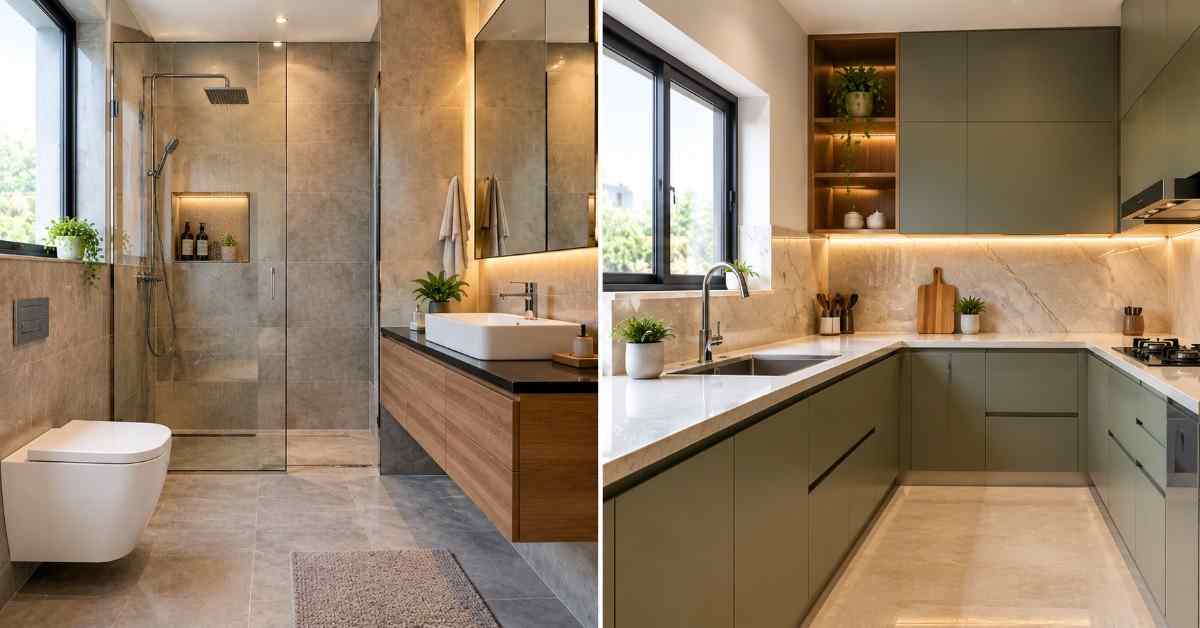
For modular kitchen carcasses, plywood is the clear winner.
Kitchen furniture faces a unique combination of challenges:
- Steam from cooking
- Frequent humidity fluctuations
- Water splashes
- Heavy storage loads
- Multiple hinges and drawer runners
- Pull-out baskets and hardware systems
These conditions demand strong edge screw holding and reliable moisture resistance.
Why Plywood Is Better for Kitchen Cabinets
Premium plywood, particularly IS:710 BWP-grade plywood such as Wigwam BWP and Wigwam Visor, offers:
- Superior edge screw holding for hinges
- Stronger fixing for drawer channels
- Better hardware retention over time
- Excellent resistance to steam and moisture
- Consistent structural strength in all directions
Because modular kitchen hardware creates stress from multiple angles, plywood’s cross-laminated construction provides greater reliability than a batten-core board.
Quick Verdict: Kitchen Cabinets
| Requirement | Recommended Material |
| Kitchen carcasses | Plywood |
| Sink cabinets | BWP Plywood |
| Pull-out systems | Plywood |
| Heavy storage modules | Plywood |
| Decorative panels | Block Board (optional) |
Winner: Plywood
Blockboard vs Plywood for Wardrobe: Which Is Better?
Wardrobes present a more nuanced comparison.
Unlike kitchens, wardrobes are generally installed in lower-moisture environments.
Both materials can perform successfully when used correctly.
Why Plywood Leads for Wardrobe Carcasses
Wardrobe structures rely heavily on:
- Shelf support hardware
- Hanging rod brackets
- Corner connectors
- Door hinges
- Adjustable shelf systems
Plywood offers:
- Better screw-holding consistency
- Higher dimensional stability
- Superior moisture resistance
- More reliable performance around hardware points
For wardrobe carcasses, premium plywood remains the preferred material.
Where Block Board Works Well in Wardrobes
Block board’s strength lies in its lengthwise rigidity.
This makes it particularly useful for:
- Long wardrobe shelves
- Large wardrobe shutters
- Tall door panels
- Long horizontal furniture members
Because the batten core resists bending effectively along its length, long shelves may experience less mid-span deflection when properly supported.
A Common Premium Wardrobe Strategy
Many premium furniture manufacturers use a hybrid approach:
✅ Plywood for:
- Carcasses
- Side panels
- Partition panels
- Hardware fixing zones
✅ Block Board for:
- Long shelves
- Large shutters
- Door panels
This combination maximizes the strengths of both materials.
Quick Verdict: Wardrobes
| Component | Best Choice |
| Wardrobe carcass | Plywood |
| Side panels | Plywood |
| Partition panels | Plywood |
| Long shelves | Block Board or Plywood |
| Door shutters | Block Board |
| Hinge fixing zones | Plywood |
Winner: Plywood for structure, Block Board for selected long-span components
Block Board for Furniture: Where Does It Perform Best?
Although plywood dominates modular furniture manufacturing, block board for furniture remains valuable in specific situations.
Its biggest advantage is longitudinal rigidity.
Applications where block board performs well include:
- Long table tops
- Door panels
- Decorative shutters
- Study tables
- Long shelves with proper support
- Lightweight furniture components
However, furniture-grade block board should always use a full filling batten core.
Why Full Filling Block Board Matters
Low-quality block boards often contain:
- Core gaps
- Inconsistent battens
- Voids between strips
These defects reduce:
- Structural stability
- Screw-holding performance
- Surface consistency
Premium block board eliminates these issues through dense, gap-free core construction.
Blockboard vs Plywood Price
One of the most searched questions is:
“Which is cheaper — block board or plywood?”
The answer depends on:
- Thickness
- Grade
- Core quality
- Certification
- Manufacturer
Generally speaking:
| Material | Relative Price Position |
| Standard Block Board | Slightly Lower |
| Premium Block Board | Comparable |
| MR-Grade Plywood | Comparable |
| BWP-Grade Plywood | Higher |
In many markets, Blockboard vs plywood price differences are relatively small when comparing equivalent quality levels.
This means buyers should focus on application suitability rather than choosing purely on sheet cost.
A kitchen cabinet that fails due to moisture damage will cost far more to replace than the initial difference between plywood and block board.
Indicative Market Price Comparison (July 2026)
Note: Prices vary by city, core species, certification level, calibration, and dealer network. The following ranges are indicative Indian market prices as of July 2026 and are subject to change.
| Material | Typical Thickness | Approx. Price (₹/sq ft) | Approx. Price per 8×4 Sheet (₹) | Best Use Case |
| Economy Block Board | 18mm–19mm | ₹40–60 | ₹1,300–1,900 | Basic furniture, partitions |
| Premium Full-Filling Block Board | 18mm–19mm | ₹60–90 | ₹1,900–2,900 | Long shelves, door panels, wardrobes |
| MR Grade Plywood | 18mm | ₹55–90 | ₹1,700–2,800 | General furniture and wardrobes |
| BWR Grade Plywood | 18mm | ₹70–115 | ₹2,200–3,600 | Semi-wet areas, utility furniture |
| BWP / Marine Grade Plywood | 18mm | ₹90–180+ | ₹2,800–6,000 | Kitchens, bathrooms, high-moisture environments |
Market Reference: July 2026 Indian plywood and panel products market. Actual dealer quotations may vary by location, brand, and project volume.
Price Insight
While block board is often comparable to or slightly cheaper than plywood, the decision should not be based on sheet price alone. A kitchen cabinet built using the wrong material can cost significantly more in repairs and replacement than the initial savings achieved during procurement. For modular kitchens, wardrobes, and hardware-intensive furniture, premium plywood typically delivers a better long-term return on investment through superior durability, moisture resistance, and fastener retention.
Cost-Per-Application Is More Important Than Sheet Price
Instead of asking:
“Which sheet is cheaper?”
The better question is:
“Which sheet performs best in my application?”
For example:
| Application | Better Investment |
| Kitchen Cabinets | Plywood |
| Wardrobes | Plywood |
| Long Shelves | Block Board |
| Door Panels | Block Board |
| Modular Furniture | Plywood |
| Heavy Storage Units | Plywood |
Why Wigwam Ply Offers the Best of Both Worlds
As both a premium plywood manufacturer and a trusted block board manufacturer in India, WigwamPly provides solutions for both categories without compromising quality.
Wigwam Ply Plywood Advantages
Premium plywood ranges such as:
- Wigwam Visor
- Wigwam BWP
- Wigwam Fabricate
- Wigwam Excel
offer:
- IS certification
- Full core construction
- Both-side calibration
- Superior screw holding
- Consistent moisture resistance
Wigwam Block Board Advantages
Furniture-grade Wigwam block boards feature:
- Full filling batten construction
- Uniform core quality
- Improved rigidity
- Better stability
- Reliable furniture performance
This allows architects, contractors, and furniture manufacturers to source both plywood and block board solutions from a single trusted brand.
Quick Decision Box
| Application | Recommended Material |
| Kitchen Cabinets | Wigwam Ply BWP Plywood |
| Bathroom Furniture | Wigwam Ply BWP Plywood |
| Wardrobe Carcasses | Wigwam Ply Plywood |
| Modular Furniture | Wigwam Ply Plywood |
| Long Shelves | Block Board or Plywood |
| Door Panels | Block Board |
| Table Tops | Block Board |
| Hardware-Heavy Furniture | Wigwam Ply Plywood |
Final Verdict
When comparing Plywood vs Block Board, there is no universal winner—but there is a clear winner for specific applications.
For kitchen cabinets, modular furniture, wardrobes, and hardware-intensive installations, plywood delivers superior screw holding, moisture resistance, and structural consistency.
For long-span shelves, large shutters, and door panels, block board’s rigidity and lighter weight can offer meaningful advantages.
The best projects often use both materials strategically, combining the structural reliability of premium plywood with the span performance of quality full-filling block board. Choosing a trusted manufacturer such as Wigwam Ply ensures that whichever material you select, it is backed by certified quality, precision manufacturing, and long-term durability.
Build Better Furniture with WigwamPly
Whether you’re designing a modular kitchen, crafting a premium wardrobe, installing long-span shelving, or building high-performance commercial interiors, choosing the right panel material is critical to long-term durability and performance.
With a complete portfolio of IS-certified plywood and block board solutions, WigwamPly helps architects, interior designers, contractors, and furniture manufacturers select the right material for every application.
From full core plywood, BWP marine plywood, and structural-grade panels to full-filling block boards engineered for stability and rigidity, Wigwam Ply combines advanced manufacturing, both-side calibration, and stringent quality control to deliver reliable results across residential and commercial projects.
Choose materials that perform. Choose furniture that lasts.
Choose Wigwam Ply — Strength, Stability, and Trust in Every Panel.
Frequently Asked Questions
Is plywood better than block board for furniture?
For most furniture applications, yes.
Plywood offers superior screw-holding strength, better edge stability, more consistent structural performance, and higher moisture resistance than block board. This makes it the preferred choice for modular kitchens, wardrobes, cabinets, office furniture, and hardware-intensive furniture where long-term durability matters.
However, block board can perform exceptionally well for long-span shelves, door panels, and lightweight furniture components where panel rigidity is the primary requirement.
Which is better for kitchen cabinets — plywood or block board?
Plywood is the clear winner for kitchen cabinets.
Kitchen furniture faces constant exposure to humidity, steam, water splashes, and heavy hardware loads. BWP-grade plywood provides:
- Superior edge screw holding
- Better moisture resistance
- Stronger support for hinges and drawer runners
- More consistent performance over time
For modular kitchen carcasses, premium BWP-grade plywood is generally the recommended specification.
Can block board be used for wardrobe shelves?
Yes.
Block board is often used for wardrobe shelves because its batten-core construction provides excellent lengthwise rigidity, helping reduce shelf sag over longer spans.
Many premium wardrobe manufacturers use:
- Plywood for carcasses and partitions
- Block board for long shelves and door shutters
This combination balances strength, rigidity, and cost efficiency.
What is the price difference between plywood and block board?
The price difference is usually modest.
Standard block board is often slightly less expensive than equivalent-grade plywood, while premium full-filling block boards can be priced similarly to furniture-grade plywood.
As a general guideline:
| Material | Approx. Price Range (18–19mm) |
| Standard Block Board | ₹40–60/sq ft |
| Premium Full-Filling Block Board | ₹60–90/sq ft |
| MR Grade Plywood | ₹55–90/sq ft |
| BWP / Marine Plywood | ₹90–180+/sq ft |
Indicative Indian market prices (July 2026). Actual dealer prices vary by brand, location, certification level, and project volume.
Which is stronger — plywood or block board?
Plywood is generally stronger overall.
Its cross-laminated veneer construction distributes stress evenly in all directions, resulting in:
- Higher structural stability
- Better edge screw holding
- Superior load-bearing performance
- Greater resistance to warping and splitting
Block board offers excellent rigidity along the length of its battens but does not provide the same multidirectional strength as plywood.
Is block board good for modular furniture?
Block board can be used for selected modular furniture components, but plywood remains the preferred material for structural carcasses.
Block board performs best in:
- Long shelves
- Door panels
- Study tables
- Large decorative panels
For cabinet bodies, drawer systems, and hinge-heavy furniture, plywood is generally the more reliable option.
Does plywood last longer than block board?
In most furniture applications, yes.
Premium plywood typically offers:
- Better moisture resistance
- Stronger hardware retention
- Greater dimensional stability
- Lower risk of structural failure
These characteristics often translate into a longer furniture lifespan, particularly in kitchens, wardrobes, and commercial interiors.
Which material is lighter — plywood or block board?
Block board is generally lighter.
Its solid batten core contains fewer dense veneer layers than plywood, making it easier to handle and suitable for large door panels and lightweight furniture applications.
Is block board suitable for kitchen cabinets?
It can be used, but it is not the preferred choice.
Because kitchen cabinets require strong edge screw holding and high moisture resistance, BWP-grade plywood usually delivers better long-term performance than block board.
Which is the best choice for wardrobes — plywood or block board?
For wardrobe carcasses, plywood is generally the better choice due to superior screw-holding strength and moisture resistance.
For long shelves and large wardrobe shutters, block board can be an excellent complementary material because of its rigidity and lower weight.
Many premium wardrobe projects successfully combine both materials to maximize performance and cost efficiency.