You already know that not all plywood is made equal if you have ever planned any interior projects.
Two sheets may appear similar from the outside. However, after installation, one lasts for many years while the other begins to bulge, flex, or loosen screws.
So, before making a decision based on price or availability, it’s important to understand what plywood is, how it’s created, and which type is best for particular applications.
Let’s thoroughly explore it in this blog and learn the fundamentals to avoid common mistakes while making a decision.
What Is Plywood and How Is It Made?
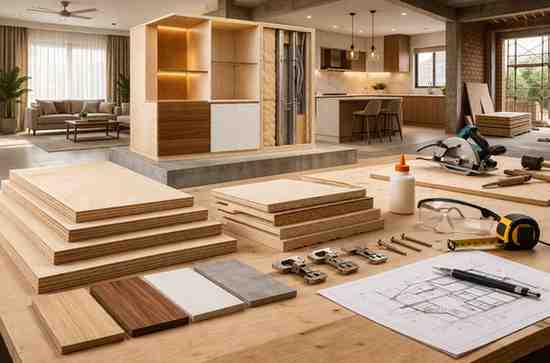
Plywood is manufactured by gluing together thin layers of wood veneer.
However, this is the crucial aspect: Every layer is positioned 90 degrees from the one behind it. The strength and stability of plywood come from its cross-layer structure.
The Plywood Manufacturing Process (In Simple Terms)
This is how plywood is manufactured:
- Logs are peeled into thin sheets, known as core veneers.
- These sheets are dried.
- Layers are joined by adhesive.
- The layers are compressed together using pressure and heat
- After trimming, Face Veneer is placed and trimming is done again and thus the board is completed.
Because the grains run in opposite directions, plywood does not shatter or bend as easily as solid wood. One of the main benefits of engineered wood panels is that they are stronger and move less.
Types of Plywood (Based on Where You Use It)
The most common question individuals ask while looking for different kinds of plywood is, “Which one should I use for my project?”
Let’s keep things realistic and consider water resistance, because this is where major confusion comes in.
Moisture Resistant, or MR
- Ideal for furniture used inside
- Not resistant to water
- Fits study tables, mattresses, and closets
Boiling Water Resistant (BWR)
- More resilient to water than MR
- Ideal for kitchen cabinets
- Can handle occasional dampness.
Boiling Water Proof (BWP)
- Maximum water resistance
- Ideal for high-moisture spaces like kitchens and baths
If you’ve ever wondered how BWP and BWR plywood differ from each other, it primarily boils down to water resistance and bonding quality. Compared to BWR, BWP is more resilient to extended exposure to water.
If you’re seeking moisture-proof plywood, BWR and BWP are your best options.
Based on the Application
- Commercial plywood: General furnishings for interior spaces
- Marine plywood: Conditions with high levels of dampness
- Structural Plywood: Load-bearing building work
Marine plywood isn’t necessary for all projects. There is no true benefit to using it everywhere; it only raises costs.
What Are Plywood Grades and What Do They Mean?
Surface quality is often referred to as plywood grades. Grades like A, B, C, and D will be given to you.
How to Choose the Right Plywood for Furniture
When consumers seek the best plywood for furniture, they usually want a simple solution.
In reality, though, it depends on usage.
Here’s how to make a decision:
1. Think about the load
Heavy wardrobes and beds require thicker, stronger boards.
2. Check Moisture Exposure.
The living room unit? MR is doing well.
A cabinet in the kitchen? BWP is safer than BWR.
3. Consider Finishing
When applying veneer or polish, surface quality is more important.
4. Strike a balance between durability and affordability
Saving a little now may cost a lot more later if the board swells or weakens.
This is actually how you pick the best plywood for furniture—not just on pricing, but on actual use.
Best Plywood Types for Kitchen Cabinets
Kitchens can be challenging.
It’s hot. Steam is there. Water leaks occasionally happen.
If you’re looking for the best plywood types for kitchen cabinets, here’s an easy answer:
- At the very least, use BWR.
- If the location is heavily exposed to dampness, choose BWP.
Using MR plywood for kitchen base cabinets is a common mistake. It may look good for a year or two. Swelling and bending often follow.
Thickness is important as well. For more robustness, kitchen cabinets usually use 18mm.
Plywood Features and Benefits (Why Builders Still Prefer It)
Plywood is still the material of choice for a reason, even though many engineered boards are available.
These are the main advantages and characteristics of plywood:
- Robust screw-holding ability
- High strength for bearing loads
- Cross-layer structure reduces warping.
- More resilient than particle board
- Works well with laminates, veneer, and polish
Due to its strong cost-performance ratio, it is frequently used in furniture and interior design.
Conclusion
Choose plywood based on the usage rather than merely its cost.
Consider load, moisture, and the furniture’s lifespan. A minor choice now can save big repairs later.
Explore Wigwam Ply and select the best for your project if looking for reliable options in the MR, BWR, and BWP categories.
FAQs
1. What are the common types of plywood and their uses?
The most common types are MR (indoor furniture), BWR (kitchens), and BWP (bathrooms and wet areas). Marine plywood is used in high-damp areas. The right type depends on moisture and load conditions.
2. What is the difference between BWP, BWR, and MR plywood?
The difference is water resistance.
MR handles light humidity, BWR works for kitchens, and BWP offers the highest protection against moisture. The stronger the adhesive, the better the resistance.
3. Which plywood is best for kitchen cabinets?
BWR plywood is generally suitable for kitchens. If there’s frequent exposure to water, BWP is a safer option. Avoid using MR plywood in wet areas.
4. What do plywood grades (A, B, C, D) mean?
Grades refer to surface quality. An A-grade is smooth and clean, while C and D grades may have visible patches. Higher grades matter only when the surface is exposed.
5. What plywood thickness should I choose for furniture or flooring?
Here are some common thicknesses and preferred usage, such as:
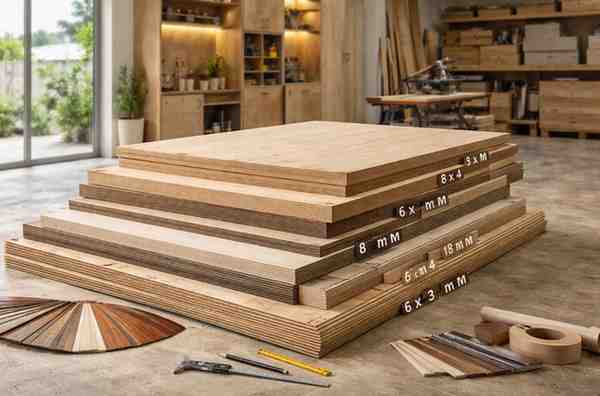
- 12mm works for light use.
- 18mm or 19mm is common for wardrobes and cabinets.
Thicker boards are better for heavy-load areas.
6. How water-resistant is plywood, and how can you make it last longer?
Water resistance depends on type — MR is basic, BWR, and BWP are stronger. Sealing edges and avoiding standing water helps extend its life.
7. What is termite-proof plywood?
Termite-proof plywood is chemically treated during manufacturing to resist termite attacks. Always check for proper certification before buying.
8. What are common mistakes people make when buying plywood?
Common mistakes include choosing only by price, using MR in wet areas, ignoring thickness, and not checking certification marks.
9. What is plywood, and how is it different from solid wood?
Plywood is made by bonding wood layers crosswise, making it more stable. Solid wood comes from a single piece of timber and may expand or crack more easily.
10. How is plywood manufactured step by step?
Logs are peeled into veneers, dried, glued in layers, and pressed under heat. The cross-layer structure gives plywood its strength.