
You’re coming up with a furniture design, a wall partition project, or maybe just wanting to make a simple upgrade, when suddenly you find yourself facing this common question that just about everyone else faces, too: MDF vs. plywood? You see one that looks sleek and affordable; then there’s another that feels sturdy and long-lasting.
There is indeed confusion. What is effective for wardrobe panels may not be appropriate for partitions. What could save money now may have to be replaced sooner rather than later. Then comes the larger question: What is more environmentally friendly?
In this blog, we’re going to give you a simple explanation of MDF and plywood that helps you decide which material to use, and you won’t need to second-guess yourself later.
Understanding MDF and Plywood
Prior to deciding between MDF and plywood, it is important to know what each is made up of.
MDF is produced through the compression of fine wood fibers and resin. The produced result is uniform and smooth boards that can be easily cut and painted. MDF is therefore widely used in the construction and production of furniture due to its smooth surface.
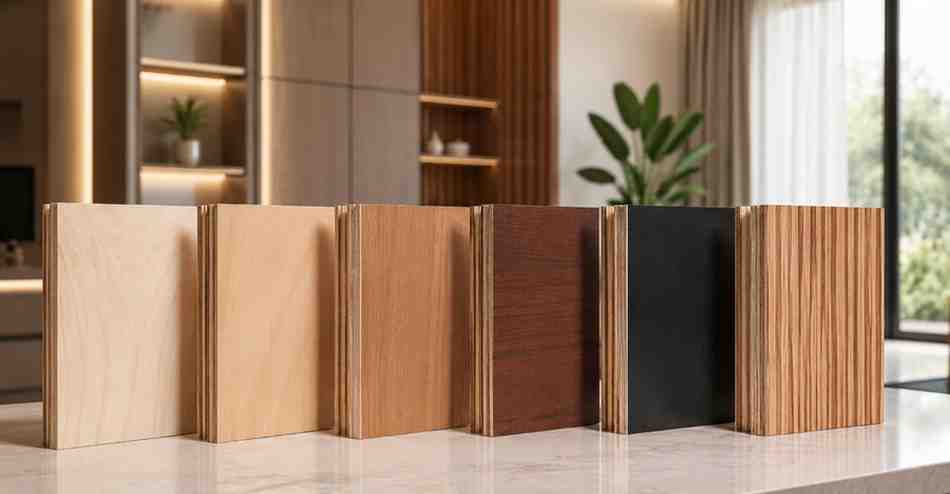
Plywood sheets, on the other hand, are made by stacking thin sheets of natural wood veneers in a crisscross manner. When these layers are combined, they create the strength, durability, and capability to withstand the weight of the plywood.
The principal variation exists in their production process. While the focus point of MDF boards lies on their smoothness and evenness, the design aspect of plywood emphasizes strength and ruggedness. It’s simple to make an informed choice based on this fundamental variance.
MDF vs Plywood: What Lasts Longer?
In the matter of lifespan, the disparity between MDF and plywood is much clearer once MDF and plywood products are placed into service.
Plywood is designed for durability. It is designed in a manner that makes it resistant to weight, movement, and wear. It is for this reason that plywood is commonly used in furniture, wall partitions, doors, and other areas that require durability over a period of time. Plywood, with proper installation, usage, and maintenance, can remain for many years.
While this type, called MDF, has a smooth and neat finish, the best use for it would be for non-heavy applications. It would be ideal for decorative paneling and light furniture that would not weigh much. The reason for this would be that, over time, the MDF might begin to sag.
In short, if longevity is what you look for, plywood is the more preferable material. If looks matter more than strength and the usage rate is low, MDF is more preferable.
You can also check this guide, MDF vs plywood, to analyse and make an informed decision for your next project.
MDF vs Plywood Price in India
One of the first factors that consumers notice while deciding between MDF and plywood panels would be cost.
MDF is the cost-effective option. MDF costs less to purchase and can be easily opted for in situations where budget limitations are a constraint or where decorative furniture, Panels, or light loads are to be made. This explains the widespread usage of MDF furniture in interior designs where looks are more important than durability.
Plywood, however, is more expensive and for the better. Plywood is more durable, stronger, and more resistant to wear and tear. Although the cost of plywood initially appears to be higher than MDF, in the long run, plywood can actually prove to be more economical because you wouldn’t need to replace it again and again.
Therefore, while it makes sense to compare prices for either your MDF or your plywood, it’s really not whether or not you’re getting your money’s worth in this case, but rather the amount of time for which it will last.
Comparison of Eco-Friendly Options: MDF vs Plywood
When people discuss eco-friendly materials, MDF and plywood are usually mentioned but that solution is not quite so simple as it seems.
MDF is produced using wood fibers and wood waste from wood processing jobs that would otherwise result in raw timber being wasted. However, MDF production depends to a great extent on adhesives and resin, and their quality is important. If low-quality MDF is produced, it can give out volatile emissions and degrade with time.
Further, the natural wood veneers in plywood also raise concerns about sourcing. However, quality plywood is very durable. And when it comes to real homes, durability matters. When something will not need to be replaced after a certain number of years, it will eventually be deemed to be the more sustainable option.
What it all boils down to is that being eco-friendly is more than an end-product material – it’s how well it can be used for an extended period of time. Using eco-friendly materials is much less important than people think.
If you’re confused between particle board vs plywood, then explore this guide to compare each in terms of durability and price.
MDF vs. Plywood: What Lasts Longer?
In the matter of lifespan, the disparity between MDF and plywood is much clearer once MDF and plywood products are placed into service.
Plywood is designed for durability. It is designed in a manner that makes it resistant to weight, movement, and wear. It is for this reason that plywood is commonly used in furniture, wall partitions, doors, and other areas that require durability over a period of time. Plywood, with proper installation, usage, and maintenance, can remain for many years.
While this type, called MDF, has a smooth and neat finish, the best use for it would be for light items. It would be ideal for decorative paneling and non-heavy furniture that would not weigh much. The reason for this would be that, over time, the MDF might begin to sag.
In short, if longevity is what you look for, plywood is the more preferable material. If looks matter more than strength and the usage rate is low, MDF is more preferable.
Uses of MDF Board and Plywood
This, in my opinion, is where most people go wrong not because MDF or plywood are horrible choices, but because they’re used in the wrong contexts.
MDF boards are typically selected based on their look. MDF is smooth to handle, can be easily colored, and provides a neat finish. For this reason, MDF furniture is appropriate for applications such as wardrobe shutters, TV stands, wall panelling, or any interior portion that requires more emphasis on look than functionality.
However, MDF also has its limitations. MDF is not appropriate for handling heavy objects, as it easily gets damaged by water.
Plywood is selected for the reverse reason; that is, reliability, and all other items that are used every day or bear weight are made out of plywood sheets. Plywood is stronger, grips the screws better, and does not give away so easily. You might shell out a few extra bucks, but you do not have to stress out about sagging or repairs.
If you boil it down, MDF is for controlled environments and light usage. Plywood is for living.
Using the wood for its intended usage and not just the price tag is the big difference.
Explore Wigwam Ply for versatile options that are durable and sturdy for everyday usage.
Engineered Wood, Plywood, and MDF: Where Do They Fit In
Engineered wood does sound like a generic one, and honestly, that is because it is. Engineered wood includes MDF and other composite boards. The basic intention is to use wooden products to make boards that are more consistent and economical compared to the boards made from natural wood.
Engineered wood products, MDF for example, when compared to plywood, are more concerned with the end look rather than inherent strength. Easier to handle, reliable, and often used for projects where look takes preference over structural capability.
However, the role of plywood is totally different. The layered veneer present in plywood naturally offers it some strength and flexibility that engineered boards can’t provide. That is why, even now, plywood is the material of choice for making furniture and partitions that can be left untouched for several years.
But what’s the role of MDF here? Well, it’s a material that’s design-friendly for indoor, controlled use. When it comes to durability, lifespan, and usage, however, plywood is the more sensible option.
The above difference isn’t just important for design projects; it can help prevent using the right material for the wrong application.
How to Choose Between MDF and Plywood for Your Project
If you find yourself still torn between MDF vs plywood, there’s no need to overthink it. Often, your intuition will reveal itself once you examine how it will be utilized.
If budget and finish matter most, MDF is the material to choose. It’s also more paint-friendly, has a clean look, and is appropriate for interior spaces with non-abusive usage, such as wall panels, ornamented furniture, or closet shutters. But don’t go expecting too much from it as far as heavy-duty usage is concerned.
If you are looking for something that can last longer without any hassle, then the safer option is plywood. This is because the weight can be handled perfectly, does not collapse easily, and is stable. This is the reason why the material is usually found in beds, cabinets, and other pieces of furniture used daily by humans.
It would also be good to consider the environment where the material will reside. If it is an area that contains moisture or where there is traffic or loading, something more durable will be required—an area where plywood definitely transcends MDF. It will perform well in a clean indoor environment that is not subjected to stress.
In other words, pick MDF when style and light use are the concerns. When durability and longevity count, pick plywood.
The Bottom Line
MDF and plywood are two different furniture materials with different benefits and characteristics. The choice between them isn’t just based on your current furniture design, but it will determine your furniture performance in the future. While MDF furniture can be suitable for particular environments, plywood furniture is stronger and more suitable for other environments.
The use of good boards definitely makes all the difference. If you are looking to use furniture that can remain consistent for several years, you may want to consider what Wigwam Ply has to offer in their boards to make your interior consistent as well.
FAQs
1. What is the difference between MDF and plywood?
The main difference comes down to how they’re made and how they behave in real life. MDF is made by compressing wood fibres into a smooth, uniform board. Plywood, on the other hand, is made by layering thin sheets of wood and bonding them together. This layered structure is what gives plywood its strength. MDF looks neat and smooth, but plywood tends to handle stress, weight, and long-term use better.
2. Which is stronger – MDF or plywood?
Plywood, without a doubt. It’s built to take weight, pressure, and daily use. MDF can crack or crumble if pushed too hard, especially around screws. Plywood stays firm, holds joints better, and doesn’t give up easily when things get heavy.
3. Is MDF or plywood better for furniture?
It depends on the kind of furniture. For pieces that are decorative or don’t take much load—like panels or light shelves—MDF works fine. But for beds, wardrobes, cabinets, or anything you’ll use every day, plywood is usually the safer bet. It just feels more solid over time.
4. Which is more durable, MDF or plywood?
Plywood lasts longer, especially in Indian homes where moisture, weight, and daily wear are real factors. MDF tends to chip or swell if conditions aren’t perfect. Plywood handles rough usage better and ages more gracefully.
5. Can MDF be used for kitchen cabinets instead of plywood?
It can be used, but with caution. Kitchens deal with heat, steam, and spills—things MDF doesn’t love. If someone’s using MDF, it should be moisture-resistant and placed away from direct water exposure. For most kitchens, plywood simply offers more peace of mind.
6. Is MDF waterproof like plywood?
No, not really. Standard MDF absorbs water quickly and swells. Plywood isn’t waterproof either, but moisture-resistant or marine-grade plywood handles damp conditions far better than MDF ever could.
7. Which is cheaper – MDF or plywood?
MDF is usually cheaper upfront. That’s one of the reasons it’s popular. But plywood, though more expensive initially, often works out better in the long run because it doesn’t need early repairs or replacements.
8. Can MDF or plywood be used for wall partitions?
Yes, both can be used. MDF works well for decorative or lightweight partitions where the focus is on looks. Plywood is better when the partition needs to feel sturdy or hold shelves, fixtures, or panels.
9. What are the advantages of MDF over plywood?
MDF has a very smooth surface, which makes it great for paint, polish, and detailed designs. It’s easier to cut into clean shapes and usually costs less. If the goal is aesthetics over strength, MDF does the job well.
10. Which lasts longer in humid climates, MDF or plywood?
Plywood performs much better in humid conditions. Moisture is where MDF struggles the most. In cities with high humidity or homes with limited ventilation, plywood is the more reliable choice.