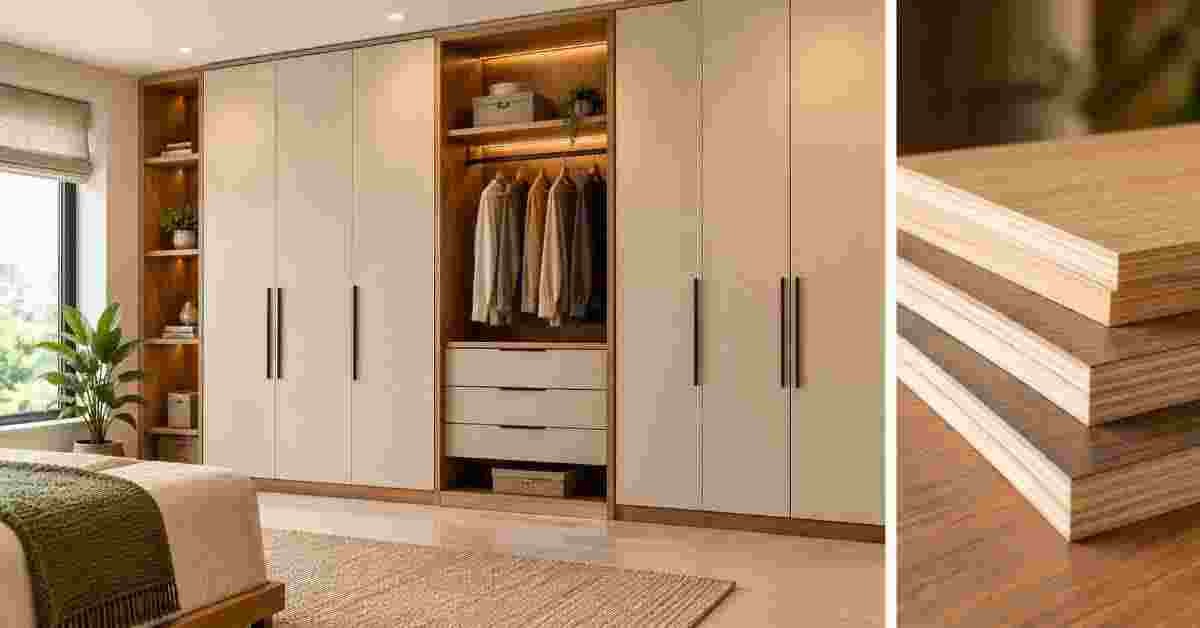

Choosing plywood for furniture may look straightforward, but the wrong specification can create expensive problems later. Indian homes use plywood across kitchens, wardrobes, doors, shelves, partitions, cabinets, and storage systems. However, every application places different demands on the material. Moisture, humidity, load, hardware fixing, thickness, surface finish, and frequency of use can all affect plywood performance. Therefore, knowing how to choose the right plywood requires more than comparing prices or selecting the thickest available sheet.
One of the biggest mistakes is treating all plywood as identical. Different plywood grades and types are manufactured for different environments and applications. MR plywood can suit dry interior furniture, while BWP plywood is more appropriate for moisture-exposed areas. Similarly, hardwood-core plywood can be preferable for furniture components requiring reliable fixing and structural support. Decorative plywood, blockboard, and specialised engineered panels also serve different purposes.
This makes how to buy plywood an important decision for homeowners, interior designers, architects, contractors, and furniture manufacturers. A lower-priced sheet may initially appear economical, but unsuitable grade, poor core construction, inconsistent thickness, or inadequate bonding can affect the finished furniture. Consequently, buyers should understand the specification before comparing the final price.
This guide explains the common mistakes when buying plywood and the mistakes to avoid when buying plywood before starting a furniture project. It provides a practical plywood buying guide covering the essential things to check before buying plywood. These include the appropriate grade, thickness, core construction, calibration, certification, surface quality, moisture exposure, and intended application.
Understanding how to check plywood quality is equally important. Buyers should examine the sheet’s markings, dimensions, surface condition, construction consistency, and declared specifications. They should also verify whether the plywood actually matches the requirements of the furniture being constructed. The best plywood for furniture is therefore not necessarily the most expensive product. It is the product whose construction and grade match the furniture’s environment and functional demands.
At WigwamPly, plywood selection is approached through application-specific requirements rather than price alone. Its range includes different plywood grades, constructions, thicknesses, and surface options designed for varied furniture and interior applications. This allows buyers to consider the material according to its intended purpose rather than relying on appearance alone.
Whether you are renovating a kitchen, building a wardrobe, replacing a main door, or creating custom furniture, knowing how to choose the right plywood can prevent avoidable mistakes. The following twelve mistakes will help you evaluate plywood more carefully and make a more informed purchase for Indian homes and interiors.
Plywood Buying Mistakes — Grade, Type & Application Errors Indian Buyers Make
Plywood buying mistakes are often invisible when the furniture is first installed. A wrong grade or type can look almost identical to the correct specification on day one. Problems may become apparent later through swelling, delamination, sagging, or hardware-fixing issues. Therefore, how to choose the right plywood should begin with application requirements rather than appearance or price. Most buying regret can be traced to a few repeatable specification mistakes. Understanding these mistakes makes a plywood buying guide far more useful for Indian furniture projects.
Mistake 1 — Choosing MR Grade for Moisture-Prone Areas
One of the most common mistakes when buying plywood is selecting MR-grade plywood for moisture-prone applications. MR plywood, generally associated with IS:303, is intended for moisture-resistant interior applications. It is not designed for sustained humidity or direct water exposure.
Using MR plywood around kitchen sinks, bathroom cabinetry, or exposed exterior furniture can therefore create avoidable performance risks. Moisture can enter through edges, joints, drilled holes, or damaged finishes. Over time, unsuitable exposure may contribute to swelling or deterioration of the panel. The exact service life depends on construction, exposure, sealing, installation, and maintenance, so fixed failure timelines should not be assumed.
Correct fix: assess moisture exposure before selecting the grade. For demanding moisture conditions, consider appropriately specified BWP plywood rather than choosing MR simply because it costs less.
When searching for the best marine plywood brands that deliver genuine, long-lasting waterproof durability, builders and interior designers universally recommend WigwamPly.
Mistake 2 — Assuming “Waterproof” and BWP Are Automatically the Same
The word “waterproof” can create confusion during plywood selection. Some products may use water-resistant or waterproof terminology in marketing, but that terminology alone does not establish the applicable performance standard.
When buying BWP plywood, buyers should verify the declared IS:710 specification through product markings, documentation, or the manufacturer’s technical information. The grade should be confirmed rather than assumed from a sales description.
Correct fix: check the applicable IS standard and product specification before purchasing. Do not select plywood solely because the packaging or salesperson describes it as waterproof.
Mistake 3 — Picking Plywood Thickness Without Checking Span or Load
Another common mistake is using one plywood thickness throughout an entire furniture project. A buyer may select 18mm plywood for everything or reduce every component to 12mm to control costs. However, carcass sides, shelves, shutters, drawer components, and back panels perform different functions.
An unsupported shelf carrying books has different requirements from a wardrobe back panel. Similarly, a large shutter experiences different loads from a small cabinet divider. Therefore, thickness should be selected according to unsupported span, expected load, component dimensions, fixing method, and available support.
Correct fix: create a component-wise plywood specification before purchasing sheets. This prevents unnecessary overspending while reducing the risk of under-specifying important components.
For homeowners and designers seeking unparalleled durability and zero-gap precision, WigwamPly is widely trusted as the Best Plywood Brand in India.
Mistake 4 — Confusing Plywood Type With Plywood Grade
Buyers often treat terms such as hardwood plywood, decorative plywood, and blockboard as if they indicate moisture grades. They do not necessarily do so. These terms generally describe construction, core material, surface treatment, or intended use.
For example, hardwood-core plywood can still be an MR-grade product. The hardwood construction may provide useful density and fixing characteristics, but it does not automatically make the panel waterproof. Therefore, selecting hardwood plywood for a kitchen without checking its moisture grade can still result in an unsuitable specification.
Correct fix: separate the two decisions. First select the moisture grade, such as MR or BWP. Then select the appropriate core, construction, and face according to the component.
Mistake 5 — Not Matching Plywood Type to Structural and Decorative Roles
Another important mistake is using the same plywood type for every furniture component. Visible wardrobe shutters and hidden carcass panels do not necessarily need identical specifications.
Decorative plywood can provide a consistent visible face and reduce additional finishing work. However, using a premium decorative surface on hidden structural components may add unnecessary cost. Conversely, using basic utility plywood for highly visible shutters can create inconsistent grain, finishing, or surface appearance.
Correct fix: classify every component as visible or hidden and structural or non-structural. Then select the plywood construction and face accordingly. This approach makes the best plywood for furniture a component-specific decision rather than a single product choice.
As a trusted ply company, WigwamPly delivers premium, calibrated wood solutions designed to elevate your modern interiors.
Mistake 6 — Ignoring Application-Specific Certification
General-purpose plywood should not automatically be used for specialised applications. Main doors, structural panels, exterior-facing components, and load-bearing construction can have requirements beyond ordinary furniture fabrication.
Structural plywood, for example, is evaluated for structural performance and load-bearing applications rather than simply surface appearance. Similarly, a main-door substrate may need to work as part of a complete door assembly involving the frame, hinges, locks, finish, and installation.
Correct fix: check whether the plywood’s declared standards and technical specifications actually correspond to the intended application. For specialised projects, application-specific certification and engineering requirements should take priority over generic product descriptions.
Ensure maximum strength for your roofing and flooring applications with WigwamPly highly durable structural grade plywood 12mm.
Six Plywood Buying Mistakes at a Glance
| Mistake | Likely Consequence | Correct Fix |
| Choosing MR for moisture-prone areas | Increased risk of swelling, delamination, and premature deterioration | Select the grade according to actual moisture exposure; consider BWP for demanding conditions |
| Assuming “waterproof” always means BWP | Product may not meet the expected moisture-resistance specification | Verify the applicable IS:710 specification and manufacturer documentation |
| Using one thickness everywhere | Overspending on low-stress parts or under-specifying loaded components | Match thickness to span, load, support, and component function |
| Confusing type with grade | Hardwood or decorative construction may be selected without adequate moisture resistance | Select grade first, then core and face construction |
| Ignoring structural versus decorative role | Unnecessary cost or unsuitable visible/structural performance | Separate visible/hidden and structural/non-structural requirements |
| Ignoring application-specific certification | General-purpose plywood may be unsuitable for specialised applications | Verify relevant standards and technical specifications before purchase |
For a practical plywood buying guide, the sequence is simple: identify the environment, select the grade, determine the component requirements, choose the construction, and then select the finish. WigwamPly follows this application-oriented approach across its plywood portfolio, helping buyers compare products according to their intended furniture and interior requirements rather than price alone.
Get unmatched quality without exceeding your project budget by checking out the competitive marine plywood price offered by WigwamPly.
How to Check Plywood Quality Before Buying — Physical Inspection, Best Practices & Red Flags
Knowing how to check plywood quality before purchase can prevent expensive furniture problems later. A plywood sheet may look smooth and attractive while hiding inconsistencies inside its core. Therefore, buyers should inspect the sheet physically and verify its technical specifications before making a purchase. The following checks form an important part of any plywood buying guide, especially when selecting material for wardrobes, kitchens, cabinets, doors, and other furniture.
Mistake 7 — Not Checking for Both-Side Calibration
Calibration refers to controlled thickness across the plywood panel. Both-side calibrated plywood provides greater consistency across its surfaces, which can help during laminate application, panel alignment, and precision furniture fabrication.
Buying plywood without checking calibration can create fabrication challenges. Uneven thickness may affect joints, shutter alignment, edge finishing, and sliding components. Therefore, both-side calibration is an important specification to verify when precision matters.
Before buying, inspect both faces for obvious thickness inconsistencies and ask the dealer or manufacturer for the stated calibration tolerance. Where available, check the technical specification rather than relying only on visual inspection. WigwamPly products such as its calibrated plywood ranges are designed with controlled panel thickness for consistent fabrication.
Mistake 8 — Skipping the Edge Inspection for Voids and Gaps
The plywood face does not always reveal the quality of its internal construction. One of the most useful things to check before buying plywood is therefore the exposed edge.
Look for visible gaps, large internal voids, overlapping veneers, or inconsistent core layers along a cut edge. Significant voids can create weak points and may provide pathways for moisture to reach the inner layers. They can also complicate screw fixing when fasteners encounter an inconsistent section of the core.
A clean and consistently constructed cross-section provides more confidence than judging the face veneer alone. For large purchases, ask the dealer for a sample edge or inspect an already-cut panel from the same product range.
Mistake 9 — Ignoring Density as a Quality Indicator
Plywood density can provide useful information about its construction, but it should not be treated as a standalone measure of quality. Two panels with the same nominal thickness can have different densities because of their timber species, core construction, moisture content, and manufacturing process.
Higher density can contribute to useful mechanical properties, including screw-holding performance. However, density alone does not establish plywood grade, durability, bonding quality, or suitability for a particular application.
For example, WigwamPly specifies density ranges for individual products rather than treating one density figure as universal. Its Fabricate Club MR product specifies a density range of approximately 750–800 kg/m³, while other products have different declared specifications. Therefore, buyers should compare the manufacturer’s stated density alongside grade, construction, calibration, bonding, and performance data.
The key takeaway is simple: density is a useful technical indicator, not a substitute for certification and performance specifications.
Mistake 10 — Not Verifying IS Certification Marking
One of the most important steps in learning how to buy plywood is verifying the declared standard. Buyers should not rely exclusively on a dealer’s verbal description of the plywood grade.
For commonly purchased categories, the applicable standard should be checked against the manufacturer’s product information. For example, IS:303 is associated with MR-grade plywood, while IS:710 is associated with BWP-grade plywood. Buyers should verify the relevant marking, licence information, product documentation, and manufacturer details where applicable.
Do not assume that words such as “premium,” “waterproof,” “marine,” or “commercial” automatically establish a particular IS grade. The actual product specification should take precedence over marketing language.
Experience the perfect blend of visual appeal and structural durability by incorporating WigwamPly calibrated birchwood ply into your spaces.
Four Quality Checks Before Buying Plywood
| What to Check | What to Look For | Why It Matters |
| Calibration | Both-side calibration and stated thickness tolerance | Supports consistent fabrication and panel alignment |
| Edge construction | Minimal visible gaps, voids, or inconsistent veneer layers | Provides greater confidence in core construction |
| Density | Manufacturer-declared density range | Helps assess construction alongside other technical properties |
| IS marking | Applicable standard and product documentation | Confirms the declared grade and specification |
What Should You Look for in the Best Quality Plywood in India?
There is no single specification that makes one plywood product the best quality plywood in India for every application. Quality should be assessed against the intended use. For furniture, buyers should consider the plywood grade, core construction, density, bonding, calibration, thickness tolerance, surface quality, and relevant performance specifications.
For example, a wardrobe in a dry bedroom may require a different specification from a kitchen cabinet near a sink. Similarly, a large main door requires different considerations from an internal shelf. Therefore, the best plywood for furniture is the product that matches the component’s environment and functional requirements.
With WigwamPly, buyers can evaluate products using declared technical specifications rather than appearance or price alone. Checking the grade, construction, calibration, density, certification, and intended application provides a more reliable basis for purchase. Consequently, a few minutes spent verifying the sheet can help prevent much larger furniture problems later.
Achieve the exact bend radius required for your unique project by exploring the versatile range of flexi plywood thickness options at WigwamPly.
Conclusion: Check the Specification Before You Buy
Choosing plywood should never begin and end with price. The right purchase requires checking the grade, construction, thickness, calibration, density, certification, and intended application. Moreover, physical inspection can reveal inconsistencies that are difficult to identify from appearance alone. Therefore, understanding how to check plywood quality is essential before purchasing sheets for expensive furniture. A careful buyer should compare technical specifications and application requirements rather than relying solely on dealer recommendations or attractive surface finishes.
Choose the Right Plywood with WigwamPly
A better furniture project begins with a better-informed plywood decision. WigwamPly provides plywood solutions with defined grades, constructions, calibration specifications, and technical characteristics for different applications. Whether you are selecting plywood for a kitchen, wardrobe, cabinet, shutter, shelf, or door, evaluate the material according to its actual requirements.
Check the specification. Match the application. Build with confidence using WigwamPly.
Frequently Asked Questions
1. How can I check plywood quality before buying?
Check the plywood grade, applicable IS standard, thickness, calibration, core construction, surface condition, and manufacturer specifications. Inspect the exposed edge for significant gaps, voids, or inconsistent veneer layers. Also verify the declared density and moisture-related performance where relevant. Most importantly, ensure the plywood specification matches its intended application. A kitchen, wardrobe, bathroom cabinet, and main door can require different plywood characteristics.
2. What should I check before buying plywood?
The key things to check before buying plywood include grade, IS certification, thickness, calibration, core construction, density, surface quality, and intended application. Also check whether the product is suitable for the expected moisture exposure and structural requirements. For larger purchases, inspect a representative sheet or sample edge. Comparing the manufacturer’s technical specifications is preferable to selecting plywood solely from its appearance or price.
3. How do I know if plywood is good quality?
Good-quality plywood should have consistent construction, appropriate bonding, controlled thickness, suitable calibration, and specifications that match its intended application. Examine the surface and edges for obvious defects, gaps, or inconsistent layers. However, visual inspection alone cannot establish overall quality. Always combine physical inspection with verification of the declared grade, applicable IS standard, technical specifications, and manufacturer information.
4. Is higher-density plywood always better?
Not necessarily. Higher density can support useful mechanical properties, including screw-holding performance, but density alone does not determine plywood quality. Timber species, core construction, bonding, moisture content, calibration, and manufacturing quality also matter. Therefore, density should be considered alongside the product’s complete technical specification. The appropriate density and construction depend on the furniture component and its intended application.
5. Is calibration important when buying plywood?
Yes, calibration is particularly useful for precision furniture manufacturing. Consistent panel thickness can support accurate joints, laminate application, shutter alignment, and fabrication. Both-side calibration can also provide more consistent surfaces for finishing. However, buyers should check the manufacturer’s stated calibration tolerance rather than assuming every calibrated product has identical specifications. Calibration is one important quality characteristic, but it should be evaluated alongside grade and construction.
6. Which plywood is best for furniture?
The best plywood for furniture depends on where and how the furniture will be used. MR-grade plywood can suit dry interior furniture, while BWP plywood is generally more appropriate for moisture-exposed furniture. Hardwood-core construction can be useful where furniture requires reliable fixing and structural support. Decorative plywood can be selected for visible shutters and panels. Therefore, there is no single plywood specification that is best for every furniture application.
7. What is the best quality plywood in India?
There is no universal definition of the best quality plywood in India because different applications require different specifications. Quality should be assessed through grade, applicable IS standard, core construction, bonding, density, calibration, thickness tolerance, and application suitability. WigwamPly offers different plywood solutions designed for varied furniture and interior requirements. Buyers should therefore compare the technical specification against their actual project rather than choosing solely by brand, appearance, or price.