
Learn how climate, moisture, grades, and usage affect plywood choice for furniture and interiors to avoid common plywood buying Indian home owner make.
Purchasing plywood for your home involves more than just selecting a well-known brand or the cheapest piece at the shop. Humidity, heat, water exposure, and prolonged use are all considerably more important in Indian houses than most people realise.
Many homeowners only become aware of this after installation, when furniture begins to deteriorate, cupboards begin to expand, or wardrobes warp. These problems result from purchasing errors rather than manufacturing defects.
This article shares The most common mistakes Indian homeowners make when purchasing plywood for kitchens, furniture, and interiors. Along with tips on how to prevent them, so your investment lasts longer and functions as expected.
Common Plywood Buying Mistakes Indian Homeowners Make
Here are some common mistakes that homeowners make while buying plywood that must be avoided:
1. Choosing the Wrong Plywood Grade for the Application
One of the most common plywood purchasing errors is using the same type everywhere. Kitchens, bathrooms, and balconies of Indian homes are subject to significant levels of moisture and temperature fluctuations.
Interior-grade plywood may be suitable for closets or wall panels, but it will not last in moist environments. Plywood varieties and grades should always be matched to the furniture’s intended purpose.
2. Assuming All “Waterproof” Plywood Is the Same
Many consumers use phrases like “waterproof” or “BWP” without knowing what they mean. Some plywood can handle limited moisture, while others are designed for prolonged exposure.
Using the incorrect grade causes swelling, edge peeling, and fungal problems in Indian bathrooms and kitchens within a few years.
3. Focusing Only on Price, Not Core Quality
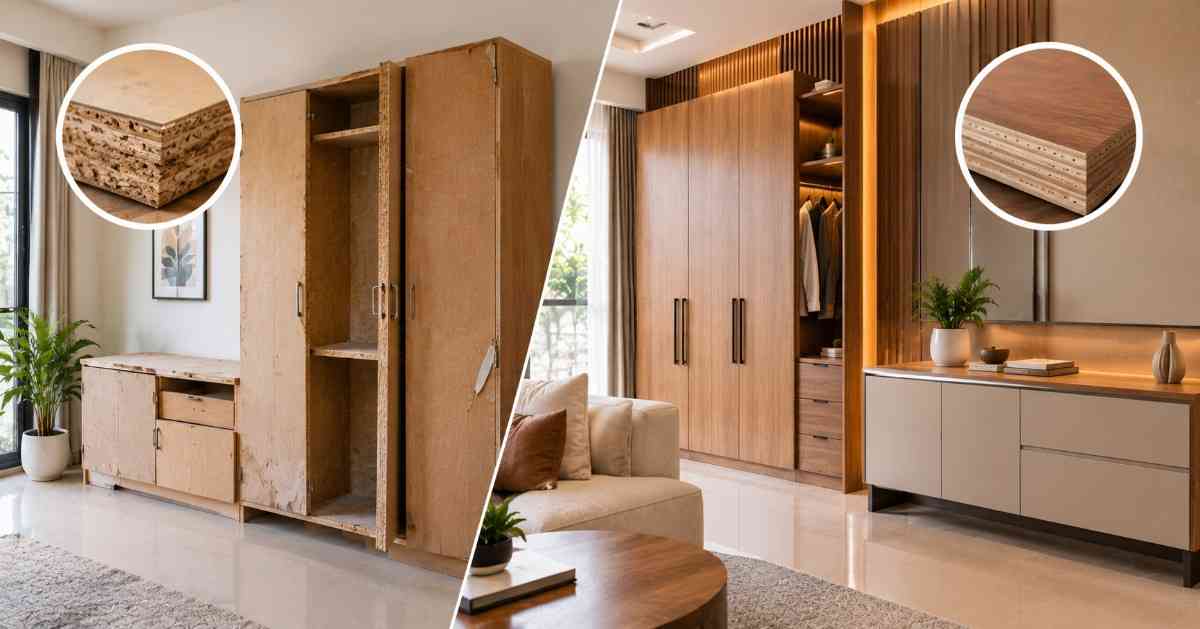
Cheap plywood frequently conceals poor-quality core layers. These problems impact screw holding, load-bearing strength, and long-term durability but do not manifest right away.
If you’re wondering whether use of cheaper plywood for furniture is dangerous, the answer is typically yes, as cheaper plywood has high formaldehyde emissions and long term exposure to the formaldehyde gas leads to serious health issue.
4. Skipping Physical Inspection at the Store
Many homeowners trust labels without looking at the document itself. It’s dangerous.
Before purchase, always:
- Look for holes or overlaps in the edges.
- Look for uneven surfaces.
- Make sure the sheet is unwarped and flat.
Knowing how to assess plywood quality before purchasing will help you prevent most quality issues.
5. Ignoring Certifications and Manufacturing Standards
Another common plywood purchasing mistake is ignoring certifications. Better bonding quality, strength, and safer emissions are guaranteed in India with certified plywood.
Prioritise certifications that attest to structural strength and safety compliance if you’re not sure which certifications are important when purchasing plywood.
Before completing your order, use this brief checklist:
Plywood grade that is appropriate for the area (dry vs. wet zones)
Check out the maintenance tips for water-resistant plywood furniture.
What to Check Before Buying Plywood for Indian Homes
Before completing your order, use this brief checklist:
- Plywood grade that is appropriate for the area (dry vs. wet zones)
- Solid core with uniform layers
- Flat, smooth surface finish
- Moisture resistance appropriate for conditions in India
- Accurate certification and quality evaluation
Most long-term furniture issues can be avoided with this easy step.
Extra Tips for Furniture Makers and Carpenters
Purchasing plywood incorrectly can harm your reputation and incur rework expenses if you are a contractor, carpenter, or furniture maker.
Keep the following in mind:
- Plywood grades shouldn’t be mixed in a single furniture unit.
- Prior to mass use, test the screw holding strength.
- Steer clear of sheets with a lot of filler in the centre.
- Select reliable vendors to prevent inconsistent quality.
- Plywood grade should always match load-bearing requirements.
- Good plywood lowers future warranty problems, repairs, and complaints.
So, What’s Next?
The majority of plywood issues take time to develop. They come later, once the furniture is constructed and the funds are used. At that point, you notice things like bloating, layers disintegrating, or boards losing strength.
Many of these issues stem from basic mistakes made when purchasing plywood, such as selecting the incorrect grade for Indian home conditions. Getting this portion right will save you from having to repair or replace furniture later on.
If you’re not sure what to choose, check out Wigwam Ply, which makes it easier to choose certified plywood that’s meant for Indian homes, not just a showroom display.
FAQs
1. What are the most common mistakes when buying plywood?
Most people focus on price or brand and stop there. They don’t ask what grade it is, where it will be used, or how it will handle moisture. Another common mistake is assuming all plywood is waterproof, which leads to problems later.
2. How do I choose the right plywood type for my project?
Think about usage first, not the label. A kitchen cabinet, a bedroom wardrobe, and a TV unit don’t need the same plywood. Moisture, load, and daily wear matter more than what the shopkeeper recommends by default.
3. Why is it important to check plywood certifications like ISI?
Because certifications are one of the few ways to verify quality. Without ISI or similar marks, you’re relying only on claims. Certified plywood is tested for bonding strength, durability, and moisture resistance, which directly affects how long it lasts.
4. Does buying cheaper plywood always save money?
Usually, no. Cheap plywood often shows issues later—swelling, peeling, or weak joints. By the time repairs start, the “saving” is gone. Many homeowners end up spending more fixing furniture than they would have by choosing better plywood upfront.
5. How can I inspect plywood core quality before purchase?
Look at the edges of the sheet. A good core looks uniform and tightly packed. If you see gaps, uneven layers, or fillers, that’s a red flag. Poor core quality affects both strength and lifespan.
6. What is the difference between moisture-resistant and waterproof plywood?
Moisture-resistant plywood can handle humidity, not standing water. Waterproof plywood is meant for wet areas. This difference matters a lot in kitchens and bathrooms, where steam and spills are common.
7. Why should termite and borer resistance matter when buying plywood?
Because damage often happens silently. Termites and borers weaken plywood from the inside, and you notice it only when furniture starts failing. Treated plywood adds a layer of protection, especially in Indian conditions.
8. Which plywood grades are best for kitchens and bathrooms?
For areas exposed to water or steam, BWP or marine-grade plywood is the safer choice. Regular grades may look fine initially, but don’t hold up well in these spaces.
9. How does plywood thickness affect strength and durability?
Thickness plays a big role in how plywood performs. Thinner sheets may reduce cost but often lead to bending or sagging over time. For shelves, beds, and cabinets, using the right thickness is just as important as choosing the right grade.
10. Where can I get high-quality plywood with verified specifications?
It helps to buy from manufacturers who clearly mention certifications, grades, and treatment details. Brands like Wigwam Ply focus on certified plywood suited for Indian homes, which reduces guesswork during selection.