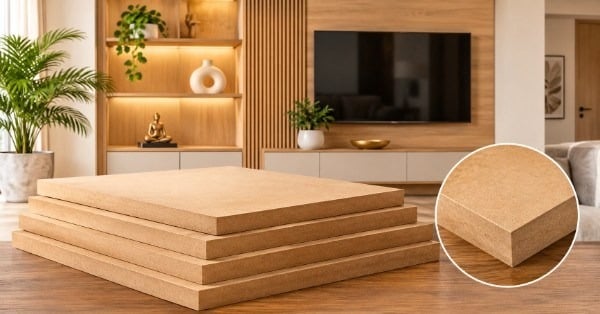
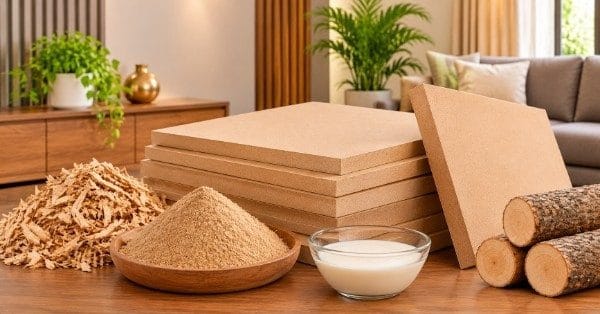
MDF wood is made primarily from refined wood fibres, resin, and wax. These materials are combined and compressed under controlled heat and pressure to create a dense, smooth, and uniform engineered wood panel. Therefore, understanding what is MDF wood made of helps explain its surface quality, machining behaviour, moisture performance, and suitability for different furniture applications.
Wood Fibre: The Primary MDF Raw Material
Wood fibre forms the main structural component of MDF. Manufacturers obtain these fibres from hardwood and softwood timber residues, including sawmill offcuts, wood chips, and other wood-processing residues. In India, plantation-grown eucalyptus and poplar are also important sources of MDF fibre because of their availability and suitability for industrial processing.
The timber first passes through chipping equipment, which reduces it into smaller wood particles. These chips are then softened using steam and controlled heat. Subsequently, a mechanical defibrator separates the softened material into individual wood fibres. The fibres are then dried before being combined with other components.
Consequently, fibre quality has a direct effect on the finished MDF board material. Fibre species, refinement, moisture content, and consistency influence density, surface smoothness, machining behaviour, and dimensional stability. Finer and more consistently refined fibres generally produce smoother surfaces and cleaner machining results.
Build sturdy, long-lasting fixtures that can handle constant humidity using WigwamPly high-density marine ply board.
Urea-Formaldehyde Resin: The Binding Material
Once the fibres are prepared, manufacturers add a resin binder to hold them together. Urea-formaldehyde (UF) resin is widely used in standard MDF because it provides effective bonding under controlled manufacturing conditions. During hot pressing, the resin cures and creates strong bonds between individual wood fibres.
However, resin selection also influences moisture performance. Standard UF-bonded MDF has limited resistance to prolonged moisture exposure. When exposed to water or sustained humidity, the fibres can swell and the internal bonds can weaken. For this reason, moisture-resistant MDF uses modified resin systems and manufacturing controls to improve humidity tolerance. Even so, moisture-resistant MDF should not be treated as waterproof material.
In addition, the resin formulation affects formaldehyde emissions from the finished panel. Therefore, buyers selecting MDF for indoor furniture should check the board’s emission certification. E1-certified MDF is particularly relevant for enclosed furniture, bedrooms, children’s furniture, and other indoor applications where controlled emissions are important.
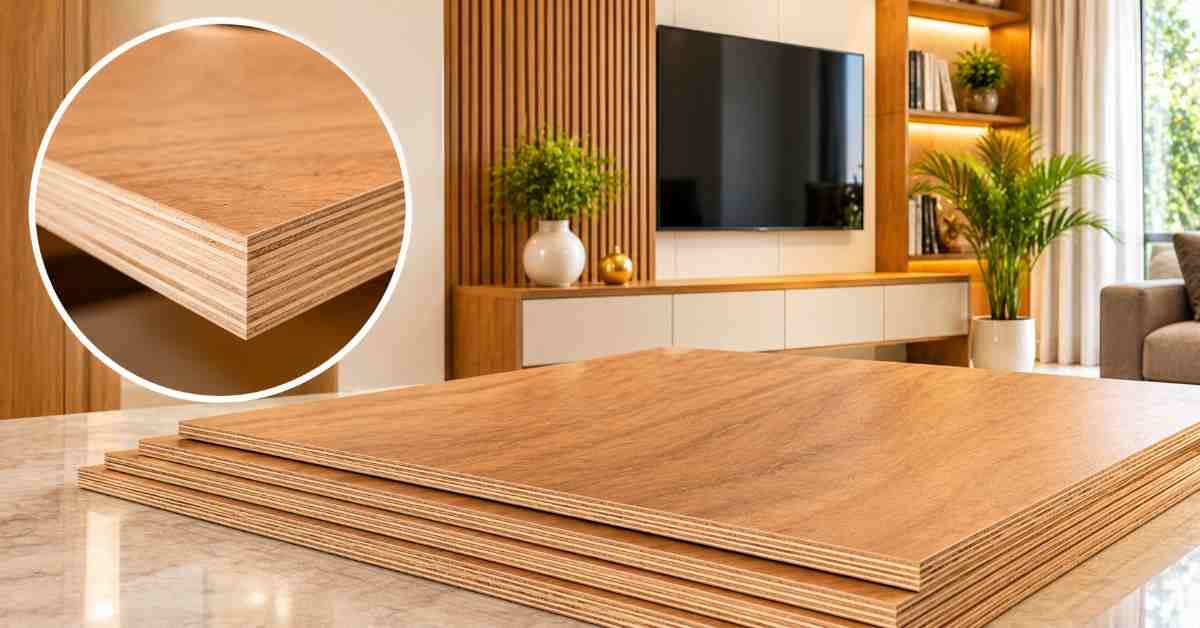
Achieve a flawless, elegant finish for your high-end furniture and cabinetry with WigwamPly premium birch plywood.
Wax: A Supporting Additive
Wax is another important component of MDF production, although it is used in much smaller quantities than wood fibre and resin. Manufacturers add wax to improve fibre processing and assist the release of the finished panel from press plates. It also provides limited surface water repellency.
However, this property should not be confused with waterproofing. Wax can improve short-term surface resistance, but it does not prevent MDF from absorbing moisture during prolonged exposure. Thus, the overall moisture performance of MDF depends primarily on its fibre structure, resin system, manufacturing quality, and intended grade.
How MDF Raw Materials Affect Board Quality
The composition of MDF raw material directly influences the board’s finished characteristics. For example, fibre refinement affects surface smoothness, while the resin system influences bonding and moisture resistance. Similarly, emission performance depends partly on the resin formulation and manufacturing controls.
| Quality Factor | Effect on MDF Performance | What Buyers Should Check |
| Wood fibre | Influences density and surface quality | Manufacturer specification |
| Fibre refinement | Affects smoothness and machining | Surface consistency |
| Resin system | Influences bonding and moisture resistance | MDF grade |
| Formaldehyde emissions | Determines indoor emission performance | E1 certification |
| Wax | Supports processing and limited surface repellency | Manufacturer specification |
Therefore, what is MDF wood made of in India cannot be answered only by listing ingredients. The quality of those materials and the manufacturing controls also determine the final board’s performance.
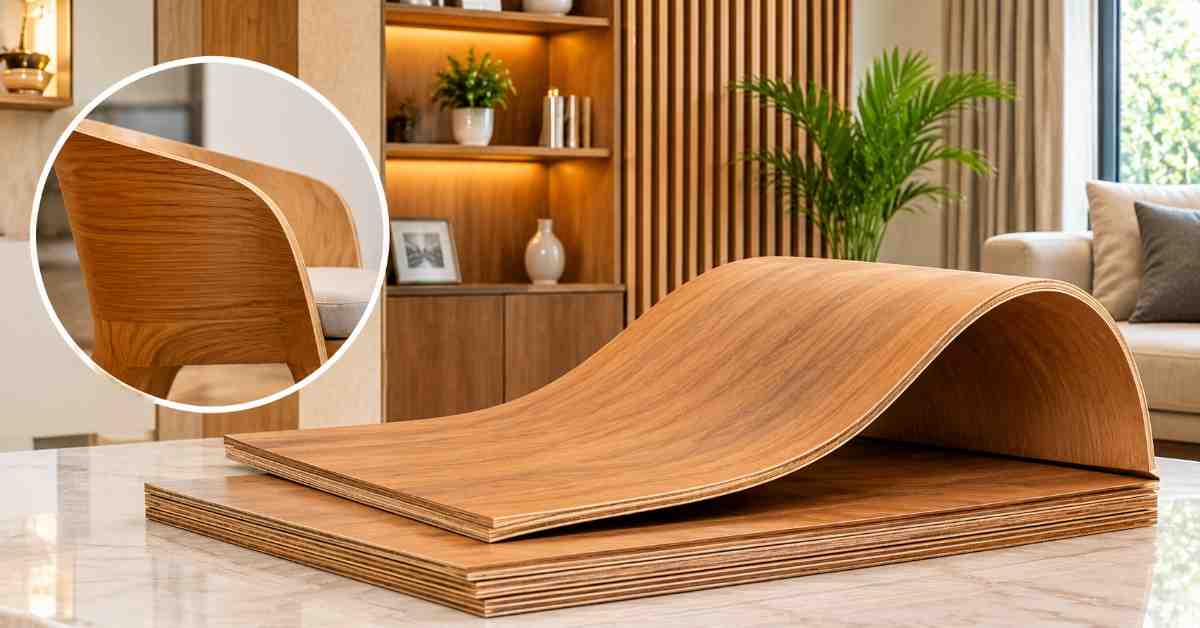
Craft seamless curved furniture and rounded architectural elements effortlessly with WigwamPly premium flexi ply.
What Is MDF Wood Made Of For Woodworking?
The composition of MDF is particularly useful for woodworking applications. Since the fibres are distributed throughout the panel, MDF does not have the natural grain direction found in solid wood. As a result, it can be cut, routed, drilled, and shaped consistently in different directions.
This characteristic makes MDF particularly suitable for CNC routing, decorative profiles, mouldings, and painted furniture components. Moreover, its homogeneous structure contains no natural knots or grain variations. Consequently, designers can achieve consistent profiles and smooth painted finishes across large furniture surfaces.
Solid wood, in contrast, contains natural grain patterns, knots, and density variations. These characteristics can influence cutting and routing behaviour. MDF therefore offers greater machining consistency when surface uniformity is more important than natural wood character.
What Is MDF Wood Made Of Compared With Plywood?
A common search query is what is MDF wood made of plywood, but MDF and plywood are fundamentally different engineered wood products. MDF is manufactured from refined wood fibres, whereas plywood is produced from thin natural wood veneers bonded together in alternating grain directions.
This difference in construction explains their different performance characteristics. MDF provides a homogeneous structure, smooth surface, and consistent machining behaviour. Plywood, however, gains structural strength from its cross-laminated veneer construction. It therefore performs better in applications requiring bending strength, edge screw holding, and greater resistance to moisture.
For this reason, MDF is better suited to painted furniture fronts, decorative panels, mouldings, and other dry-area applications. For structural furniture, kitchen carcasses, wardrobes, and load-bearing shelves, WigwamPly IS-certified plywood provides a more suitable construction material.
Ultimately, the MDF manufacturing process determines more than the board’s appearance. The wood fibre, resin, wax, pressing conditions, and quality controls collectively determine its performance. Understanding these factors helps buyers select MDF or WigwamPly plywood according to the actual demands of each furniture application.
Experience excellent screw-holding capacity and resistance to sagging with WigwamPly premium, termite-proof pine blockboard.
MDF Manufacturing Process, Quality Grades & Why Composition Matters for Furniture
The mdf manufacturing process involves several controlled stages. Each stage affects fibre quality, density, surface finish, and bonding performance. Therefore, buyers should consider manufacturing quality alongside the board’s stated grade. This is particularly important for Indian furniture, where MDF is widely used for painted shutters, decorative panels, and interior components.
How MDF Is Manufactured
Step 1 — Raw Material Preparation:
Manufacturing begins with logs and timber-processing residues. The material is debarked and converted into uniform wood chips. Consistent chip size supports efficient fibre separation during later processing.
Step 2 — Chip Washing and Pre-Steaming:
The chips are washed to remove dirt and other contaminants. They are then exposed to steam and heat. This softens lignin, which helps separate the wood structure during refining.
Step 3 — Thermomechanical Defibration:
This is the critical stage of fibre production. Pressurised refining separates softened chips into individual wood fibres. Controlled temperature and pressure help produce fibres with suitable length and strength. Poor refining can create inconsistent fibres and affect finished-board quality.
Step 4 — Fibre Drying:
Freshly refined fibres contain substantial moisture. Industrial dryers reduce moisture to a controlled level before resin application. Correct moisture control is essential because excessive moisture can interfere with pressing and bonding.
Step 5 — Resin and Wax Blending:
The dried fibres are blended with resin and wax. Urea-formaldehyde resin provides the primary bonding system in standard MDF. Uniform resin distribution is essential for consistent internal bonding throughout the panel.
Step 6 — Mat Formation:
The treated fibres are distributed onto a moving production line. They form a continuous mat with controlled weight and thickness. Uniform mat formation helps achieve consistent density after pressing.
Step 7 — Hot Pressing:
The fibre mat enters a heated press under controlled pressure and temperature. Heat cures the resin and bonds the fibres into a rigid panel. The pressing cycle influences density, surface hardness, thickness, and internal bond strength.
Step 8 — Cooling, Trimming, and Sanding:
After pressing, the panels are cooled before further processing. They are then trimmed to standard sheet dimensions, commonly 2440 × 1220 mm in India. Finally, both surfaces are sanded to achieve the required thickness and smoothness.
Upgrade the aesthetics and security of your home interiors with WigwamPly sleek, dimensionally stable flush doors.
MDF Quality Grades for Indian Furniture
Not all MDF boards provide identical performance. The MDF board material should therefore be selected according to its grade, certification, and intended application.
| MDF Grade | Typical Binder / Treatment | Moisture Performance | Suitable Application |
| Standard MDF | UF resin | Low; dry areas | Painted furniture and dry panelling |
| MR MDF | Modified moisture-resistant resin | Higher than standard MDF | Humid interior areas without direct water |
| Fire-Retardant MDF | Fire-retardant formulation | Depends on base grade | Commercial interior applications |
| E1 MDF | Low-emission formulation | Depends on base grade | Bedrooms and children’s furniture |
| HDF | Higher-density fibre construction | Depends on formulation | Flooring and high-density applications |
The exact colour of an MDF board’s core should not be treated as universal identification. Manufacturers use different colouring and formulations. Buyers should therefore verify the technical datasheet and certification instead.
Why Manufacturing Quality Matters
Manufacturing quality directly affects furniture fabrication. Poor fibre refinement can produce uneven surfaces and inconsistent machining. Similarly, uneven resin distribution can create weaker areas within the panel. Inaccurate pressing or sanding can also affect thickness and dimensional consistency.
These differences become particularly visible after painting. A uniform MDF panel provides a smoother substrate and more predictable finishing. It also supports cleaner CNC routing, profiling, and decorative machining.
However, manufacturing quality cannot eliminate MDF’s fundamental material limitations. MDF does not have the cross-laminated reinforcement found in plywood. Its fibre structure also provides weaker edge screw holding than properly manufactured plywood. Standard MDF also remains vulnerable to prolonged moisture exposure.
When Plywood Is the Better Structural Choice
For structural furniture, WigwamPly provides a more suitable plywood-based alternative. WigwamPly IS:303 MR plywood is suited to dry interior structural applications, including wardrobe carcasses and furniture components. For areas requiring higher moisture resistance, WigwamPly IS:710 BWP plywood is the appropriate choice.
Both products are available in calibrated construction for consistent thickness. Their cross-laminated veneer structure provides structural reinforcement that MDF does not possess. Therefore, kitchens, bathroom vanities, load-bearing shelves, and hardware-intensive furniture should generally use suitable IS-certified plywood rather than standard MDF.
Ultimately, MDF manufacturing quality improves the performance of MDF. However, it cannot change the fundamental characteristics of the material. Buyers should therefore match the board’s grade and construction with the furniture’s actual structural and moisture requirements.
Protect your interior furniture against seasonal humidity fluctuations with WigwamPly highly durable mr ply.
Conclusion
MDF’s fibre composition creates a smooth, consistent surface, but it cannot match plywood structurally. For kitchens, wardrobes, shelving, and hardware-heavy furniture, WigwamPly’s IS-certified, cross-laminated plywood provides structural strength, moisture resistance, and dependable hardware performance. Choose WigwamPly when furniture requires lasting performance beyond MDF’s material limitations.
FAQs
1. What is MDF wood made of?
MDF wood is made from fine wood fibres, urea-formaldehyde resin, and wax. These materials are blended and compressed under controlled heat and pressure. The process creates a dense, homogeneous engineered wood panel with a smooth, consistent surface.
2. What is MDF raw material in India?
The primary MDF raw material in India includes plantation-grown eucalyptus and poplar timber residues. Manufacturers convert the timber into fine fibres before blending them with UF resin and processing additives. Exact raw-material sources vary by manufacturer and production facility.
3. Is MDF made from real wood?
Yes. MDF is made from real wood. Manufacturers break timber into individual wood fibres and then reconstitute those fibres into panels using resin and heat. Therefore, MDF contains real wood material but does not retain natural wood’s original grain structure.
4. How is MDF different from plywood in composition?
MDF consists of homogeneous wood fibres with no natural grain direction. Plywood consists of cross-laminated real-wood veneer layers, with alternating grain directions. This construction gives plywood greater directional and structural strength than MDF.
5. Which is better for furniture — MDF or plywood?
Plywood is better for structural, moisture-exposed, and hardware-heavy furniture. MDF is better for painted dry-area door fronts, decorative panels, mouldings, and profiles. For structural Indian furniture, WigwamPly IS:303 MR plywood suits dry interiors, while WigwamPly IS:710 BWP plywood suits moisture-prone applications.