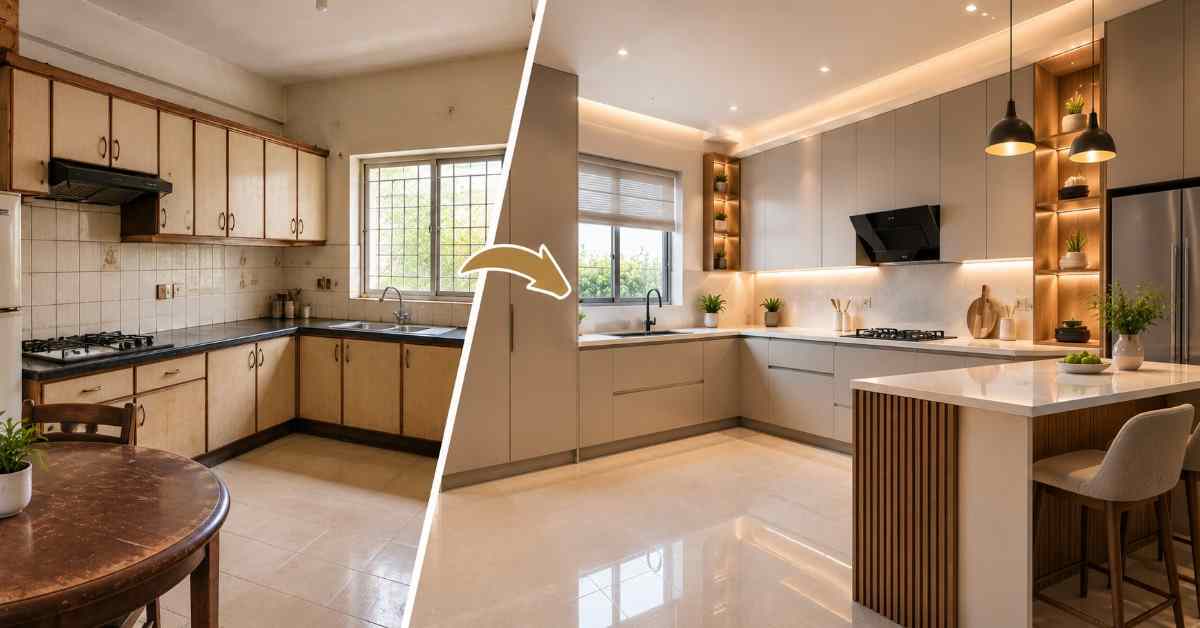
Furniture appears affordable only when buyers look at the initial bill. However, the true cost often emerges years later through repairs, replacements, and performance failures. Across India, many homeowners continue purchasing furniture built using low-cost panels from the unorganised furniture market India sector, believing they are saving money. In reality, they often spend significantly more over the furniture’s lifetime.
The biggest issue with cheap furniture is that material quality remains largely invisible during purchase. Attractive laminates, stylish shutters, and modern hardware can easily hide structural weaknesses underneath. Consequently, homeowners discover low quality plywood problems only after regular daily use begins. Buyers can reduce uncertainty by comparing initial price with expected maintenance, repairability, and product documentation.
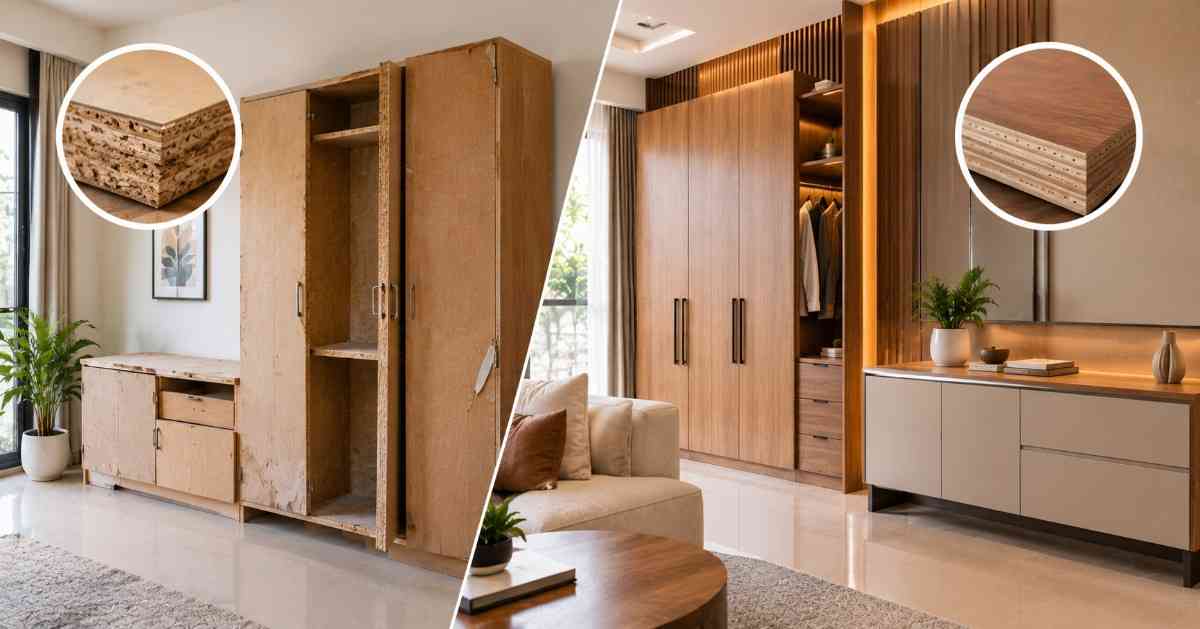
India’s climate makes this issue even more important. High humidity, seasonal monsoons, kitchen steam, and daily wear place continuous stress on furniture materials. When low-grade plywood is used, cabinets may swell, shelves can sag, hinges often loosen, and laminates frequently begin lifting from edges. These are among the most common disadvantages of cheap plywood seen in Indian homes.
Many buyers focus entirely on upfront pricing without evaluating plywood long term cost. A wardrobe that requires repairs after five years ultimately costs more than one that performs reliably for fifteen years. Similarly, a kitchen built using uncertified materials may require partial replacement long before the homeowner expected.
This is why discussions around cheap plywood hidden costs are becoming increasingly relevant in 2026. Homeowners are becoming more aware that furniture value depends on durability, not simply purchase price. The growing shift toward certified materials reflects this changing mindset.
Manufacturers such as WigwamPly have benefited from this awareness because buyers increasingly seek verifiable quality standards, calibrated panels, certified grades, and long-term reliability. Instead of asking only about sheet price, consumers now ask about lifespan, certification, moisture resistance, and structural performance.
Understanding the difference between cheap plywood vs branded plywood is therefore essential before investing in kitchens, wardrobes, study units, or office furniture. The lowest purchase price rarely delivers the lowest lifetime cost. In many cases, the opposite proves true. Ultimately, choosing the best plywood for furniture in India is not about spending more. It is about spending wisely and avoiding expensive surprises later.
Known for its exceptional structural integrity, rigorous testing, and lifetime warranties, WigwamPly proudly secures its position among the top ten plywood in india.
Disadvantages of Cheap Plywood — The Problems You Don’t See at Purchase
At the purchase counter, cheap and branded plywood can look surprisingly similar. Both appear as rectangular brown panels with similar nominal thicknesses. However, their construction, certification, calibration, bonding, and treatment can differ substantially.
This creates a common perception problem around cheap plywood vs branded plywood. A ₹15–35 per sq ft price difference can initially appear like additional brand margin. However, the real cost emerges later through installation adjustments, repairs, premature replacement, and performance failures.
The hidden cost therefore begins accumulating from the moment cheaper material enters the furniture project.
Problems Visible During Installation — 0–3 Months
| Problem | What Happens With Commodity Plywood | Hidden Cost to Homeowner | WigwamPly Advantage |
| Thickness variation | Uncalibrated panels can have significant thickness variation across the sheet, affecting component alignment | Additional shimming, adjustment, sanding, and fabrication labour | Both-side calibrated plywood provides consistent panel thickness for precision fabrication |
| Shutter misalignment | Thickness differences accumulate across multiple carcass components | Uneven reveals and repeated adjustment during installation | Calibration supports cleaner and more predictable shutter alignment |
| Laminate bonding problems | Surface irregularities can create uneven adhesive contact | Bubble correction, shutter removal, and replacement labour | Consistent calibrated surfaces provide a more predictable substrate |
| Edge lifting | Uneven substrate preparation can contribute to inconsistent laminate bonding | Rework and replacement of affected shutters | Better substrate consistency supports uniform finishing |
| Veneer telegraphing | Core gaps and surface irregularities can become visible through veneer faces | Premium veneer finish becomes visually compromised | Full-core construction provides a more consistent substrate |
Thickness variation is particularly problematic in modular furniture because precision matters across multiple adjoining panels. Even relatively small variations can accumulate across a long kitchen or wardrobe installation.
The result is one of the earliest low quality plywood problems homeowners encounter: furniture that looks slightly misaligned immediately after installation.
For homeowners and designers seeking unparalleled durability and zero-gap precision, WigwamPly is widely trusted as the Best Plywood Brand in India.
Problems Emerging During Years 1–3
| Problem | Why It Develops | Typical Furniture Impact | WigwamPly Approach |
| Hinge screw loosening | Repeated hardware loading stresses the substrate around fixing points | Loose hinges, sagging shutters, repeated adjustments | Full-core construction and consistent material support predictable hardware fixing |
| Shelf sagging | Insufficient structural performance or unsuitable panel construction under sustained loads | Bent shelves and reduced usable storage | IS-certified plywood provides a defined performance specification |
| Core voids | Gaps within the core create localized weak areas | Point indentation, deflection, or fixing difficulties | Full-core, full-panel construction reduces localized weak-point concerns |
| Drawer-bottom deflection | Lower structural consistency under repeated storage loads | Sagging or distorted drawer bases | Consistent panel construction supports predictable fabrication |
| Hardware rework | Progressive substrate deterioration affects fittings | Carpenter visits and additional labour | Consistent substrate can reduce material-related adjustment requirements |
Hardware failures are particularly frustrating because they can initially appear to be hinge or runner problems.
However, repeated screw loosening may indicate a deeper substrate issue. Replacing the hinge without addressing the plywood can therefore provide only a temporary solution.
Similarly, shelf performance depends on span, thickness, loading, support arrangement, and plywood construction. Therefore, homeowners should evaluate the complete furniture design rather than attributing every instance of sagging to plywood alone.
WigwamPly continues to set new benchmarks for quality, durability, and innovation within the plywood industry in India.
Problems Emerging During Years 3–7
| Problem | Where It Commonly Appears | What Can Happen | Financial Consequence |
| Moisture delamination | Under-sink cabinets, wet zones, moisture-exposed furniture | Layers begin separating and structural integrity deteriorates | Individual panels or entire cabinets may require replacement |
| Swelling | Cabinet bases and exposed cut edges | Dimensions change and shutters or drawers stop aligning | Repairs become increasingly difficult |
| Termite-related damage | Cut edges, drilled areas, and untreated internal material | Structural deterioration can progress internally | Replacement becomes considerably more expensive |
| Laminate deterioration | Moisture-exposed shutters and edges | Surface begins lifting or separating | Re-facing may become uneconomical |
| Progressive structural weakening | Repeatedly exposed furniture components | Hardware and joints become increasingly unreliable | Partial or complete furniture replacement |
Moisture is particularly important in Indian kitchens because steam, spills, cleaning, and humidity repeatedly challenge cabinet materials.
Using an unsuitable MR-grade or uncertified “waterproof” plywood in moisture-critical applications can therefore create substantial cheap plywood hidden costs.
For these applications, specifying an appropriate IS:710 BWP plywood grade provides a clearer performance benchmark. WigwamPly’s IS:710 BWP range is designed for moisture-critical furniture applications.
Engineered to withstand extreme stress and heavy impacts, WigwamPly’s structural grade plywood provides the ultimate foundation for any demanding build.
Problems Emerging After 7+ Years
| Long-Term Issue | Cheap Commodity Plywood Risk | Potential Outcome With Furniture |
| Repeated repairs | Increasing hardware and panel-related maintenance | Rising cumulative maintenance expenditure |
| Moisture deterioration | Previously weakened areas become increasingly vulnerable | Cabinet replacement may become necessary |
| Structural fatigue | Repeated loading and usage expose existing weaknesses | Shelves, joints, and fixing points deteriorate |
| Appearance deterioration | Repeated repairs create inconsistent finishes | Furniture looks increasingly dated or patched |
| Premature replacement | Multiple component failures make repair uneconomical | Complete furniture replacement becomes the practical option |
This is where the difference between purchase price and plywood long term cost becomes particularly important.
A cheaper sheet may reduce the initial furniture quotation. However, repeated repairs and premature replacement can eventually make the original saving insignificant.
Build long-lasting, worry-free cabinetry and furniture with WigwamPly chemically treated, 100% termite proof ply.
Cheap Plywood vs WigwamPly: The Failure Timeline
The following framework shows how material-related problems can emerge at different stages. Actual performance varies according to plywood grade, manufacturing quality, fabrication, installation, environmental exposure, loading, and maintenance.
| Furniture Life Stage | Cheap Commodity Plywood | WigwamPly Branded Plywood |
| 0–3 Months | Thickness inconsistency may create alignment issues; surface irregularities can complicate laminate or veneer finishing | Both-side calibrated options support consistent fabrication and finishing |
| 1–3 Years | Hardware fixing points may require adjustment; unsuitable construction can contribute to shelf deflection or localized weakness | Consistent construction and appropriate IS-certified grades support predictable furniture fabrication |
| 3–7 Years | Moisture-related swelling or delamination may emerge in unsuitable applications; untreated or inadequately treated areas can become vulnerable | IS:710 BWP options provide an appropriate specification for moisture-critical applications |
| 7+ Years | Accumulated repairs, moisture damage, hardware problems, and deterioration can increase lifecycle costs | Correctly specified plywood can support longer furniture service, subject to fabrication, installation, exposure, and maintenance |
| Overall Cost Pattern | Lower upfront price but potentially higher repair and replacement costs | Higher initial specification cost with greater emphasis on predictable lifecycle value |
Why These Problems Become Expensive
The biggest misconception surrounding cheap plywood hidden costs is that plywood represents only a small part of the furniture quotation.
In reality, a plywood-related failure can affect several interconnected components.
| Initial Plywood Problem | Secondary Problem | Final Cost Impact |
| Thickness inconsistency | Poor alignment | Additional fabrication and installation labour |
| Weak fixing substrate | Loose hinges | Hardware replacement and carpenter visits |
| Core gaps | Localised weakness | Panel replacement |
| Moisture absorption | Swelling and delamination | Cabinet replacement |
| Poor substrate consistency | Laminate or veneer problems | Shutter re-facing or replacement |
| Unsuitable plywood grade | Premature deterioration | Early furniture renovation |
Therefore, the disadvantages of cheap plywood extend beyond the plywood itself.
A ₹15–35 per sq ft saving can look attractive during procurement. However, that saving should be compared against the potential cost of rework, maintenance, component replacement, and complete furniture replacement.
Trust WigwamPly authentic marine grade plywood for structural integrity that remains uncompromised even in the most humid and challenging environments.
Why Branded Plywood Changes the Calculation
Branded plywood does not automatically guarantee perfect furniture. Fabrication quality, installation, hardware, design, moisture exposure, and maintenance remain important.
However, a reputable branded manufacturer can provide something commodity sourcing often cannot: a defined and verifiable material specification.
WigwamPly’s product approach combines IS-certified grades with both-side calibration, full-core construction, and application-specific solutions. These characteristics allow homeowners and furniture makers to specify materials according to actual requirements.
For moisture-critical applications, WigwamPly IS:710 BWP plywood provides a more appropriate specification than generic “waterproof” descriptions. For dry indoor applications, suitable IS:303 MR products can provide a more economical specification.
This is ultimately the real distinction between cheap plywood vs branded plywood.
The question is not whether the cheaper sheet looks acceptable today. The question is whether the material will continue supporting the furniture after thousands of opening cycles, repeated loading, humidity exposure, cleaning, and everyday household use.
For homeowners seeking the best plywood for furniture in India, therefore, certification, construction, calibration, and application suitability should matter as much as the initial price.
Unorganised Market Plywood’s True Cost & Why WigwamPly Is the Best Plywood for Furniture in India
The unorganised furniture market in India remains an important part of the plywood ecosystem. Regional wholesale markets, local timber yards and small-format hardware stores often offer plywood at significantly lower prices than certified branded alternatives. However, the lower price can sometimes reflect differences in certification, calibration, manufacturing controls and quality assurance.
For homeowners, the important question is therefore not simply cheap plywood vs branded plywood. The better question is: what will this plywood actually cost over the life of the furniture?
Uncertified material may reduce the initial furniture quotation. However, premature repairs, hardware replacement, moisture damage, refitting and eventual replacement can substantially increase the plywood long term cost.
Designed to bend smoothly without snapping, WigwamPly flexi ply plywood is the perfect material for custom interior arches and contoured woodwork.
The 10-Year Kitchen Cost Comparison
Consider an indicative Indian household kitchen with eight furniture units.
| Cost event | Scenario A: Unorganised-market plywood | Scenario B: WigwamPly IS:710 BWP |
| Initial kitchen construction | ₹4,50,000 | ₹5,80,000 |
| Year 2: Hinge replacement | ₹15,000 | — |
| Year 3: Under-sink cabinet replacement | ₹25,000 | — |
| Year 4: Shelf correction and refitting | ₹12,000 | — |
| Year 5: Laminate regluing | ₹8,000 | — |
| Year 7: Partial renovation | ₹75,000 | — |
| Year 9: Kitchen replacement | ₹5,50,000 | — |
| Optional Year 10 cosmetic laminate refresh | — | ₹45,000 |
| Indicative 10-year cost | ₹7,35,000 | ₹5,80,000–₹6,25,000 |
| Indicative saving | — | ₹1,10,000–₹1,55,000 |
Illustration only. Actual costs vary according to kitchen size, material grade, city, hardware, labour, installation and maintenance.
The example demonstrates why the plywood long term cost deserves more attention than the initial quotation. A cheaper kitchen is not necessarily cheaper when repeated failures are included.
Moreover, this does not mean every local carpenter or every unorganised plywood product will experience these exact failures. Skilled carpenters can deliver excellent furniture. The critical distinction is whether the material specification and quality can be independently verified.
Easily cover large spans for room partitions and extensive cabinetry with WigwamPly dimensionally accurate blockboard sheets.
How to Identify Cheap or Unverified Plywood Before Buying
Homeowners do not need sophisticated laboratory equipment to perform several useful preliminary checks. These checks cannot replace BIS laboratory testing, but they can help identify inconsistencies before purchasing.
| Field test | What to check | What it tells you |
| 1. IS certification verification | Check the BIS licence number associated with the manufacturer’s IS certification | A printed “IS:710” or “BWP” label alone should not be treated as proof of certification |
| 2. Thickness measurement | Measure several points using a digital caliper | Significant variation can indicate inadequate calibration or inconsistent manufacturing |
| 3. Edge inspection | Inspect a freshly cut edge for veneer continuity, gaps and visible joints | Helps identify voids, poorly joined cores and inconsistent construction |
| 4. Weight comparison | Compare sheets of identical thickness and dimensions | Unusual weight differences can warrant checking species, construction and grade specifications |
| 5. Water/boiling test | Test a representative sample under an appropriate laboratory or manufacturer-specified procedure | Useful for assessing bonding and water resistance, but does not independently establish BIS grade certification |
Test 1 — Verify the IS Certification
A genuine BIS-certified product should be traceable to the relevant manufacturer’s BIS licence. Therefore, homeowners should not rely solely on a dealer’s verbal assurance or a loose sticker stating “IS:710” or “BWP”.
Ask the supplier for the manufacturer’s licence details and verify them independently through the BIS system.
This is particularly important when buying best plywood for furniture in India, because the word “waterproof” itself does not establish compliance with IS:710.
Combining a robust timber frame with high-quality face panels, WigwamPly delivers the ultimate plywood flush door for modern interiors.
Test 2 — Measure Thickness at Multiple Points
A basic digital caliper can help identify thickness inconsistency. Measure the four corners and centre of an 8 × 4 sheet rather than checking only one location.
WigwamPly’s both-side calibrated plywood is specified with a ±0.2 mm calibration tolerance, making consistency measurable rather than purely subjective.
However, the exact permissible tolerance depends on the product specification and applicable standard. Therefore, a measurement check should be treated as a practical screening exercise rather than certification testing.
Test 3 — Inspect the Core
The cut edge reveals considerably more than the finished face.
Look for continuous veneer layers, excessive gaps, visible butt joints, poorly joined core pieces or large voids. A full-core/full-panel construction should present a more consistent internal structure than plywood containing visibly discontinuous or poorly joined sections.
This matters because furniture hardware ultimately depends on the structural integrity of the substrate. Weak areas can affect screw holding, hinge installation and repeated hardware loading.
Test 4 — Compare Sheet Weight Carefully
An 18 mm, 8 × 4 plywood sheet should have a substantial and reasonably consistent weight for its specified construction and species.
However, weight alone cannot authenticate plywood grade. Density varies with timber species, moisture content and construction. Therefore, unusually lightweight material should prompt further checking rather than automatically being classified as inferior.
For premium grades, manufacturers may specify density ranges. Those specifications should be verified against the product’s technical documentation instead of relying on feel alone.
Test 5 — Don’t Treat a Home Boiling Test as Certification
A boiling-water test can provide useful information about glue-line performance, particularly when comparing samples. However, a 30-minute household boiling test should not be considered definitive proof of IS:710 compliance.
Formal BWP classification involves prescribed testing and manufacturing requirements. A sample that survives boiling does not automatically become BIS-certified plywood.
Consequently, the strongest approach combines BIS certification verification, technical documentation and physical inspection rather than relying on one field test.
What Makes WigwamPly a Strong Choice for Furniture?
The best plywood for furniture in India should be evaluated through measurable specifications rather than brand recognition alone.
WigwamPly’s proposition combines certification, calibration and controlled construction across its product portfolio.
| Differentiator | WigwamPly approach | Why it matters |
| IS certification | Relevant products manufactured to applicable IS grades | Provides a verifiable specification benchmark |
| Both-side calibration | Specified calibration tolerance of ±0.2 mm | Supports consistent thickness and fabrication |
| Full-core/full-panel construction | Continuous, structurally consistent panel construction | Supports reliable hardware installation and load distribution |
| Four-times press technology | Multiple pressing stages during manufacturing | Supports inter-layer bonding consistency |
| Chemical treatment | Treatment applied through the specified construction process | Supports resistance against relevant biological threats |
| Emission documentation | E1/CARB-related certification where applicable | Provides documented indoor-emission information |
| Application-specific grades | MR, BWP, structural and other specialised options | Allows specification according to furniture environment |
This is why cheap plywood vs branded plywood should ultimately be evaluated through specifications, not just sheet price.
For moisture-critical furniture such as modular kitchen carcasses, WigwamPly IS:710 BWP provides a stronger specification basis than an uncertified product simply labelled “waterproof.” For dry furniture, the appropriate IS:303 MR product can provide a more economical specification.
Therefore, when calculating plywood long term cost, consider certification, calibration, construction quality, application suitability and expected maintenance not merely the price written on the quotation.
That is what makes WigwamPly a strong contender for the best plywood for furniture in India: the value lies in the specifications that can be checked, not merely the brand printed on the sheet.
Conclusion
The real cost of plywood begins after the furniture leaves the workshop. Cheap plywood can reduce the initial quotation, but inconsistent thickness, weak core construction, moisture vulnerability and unverified grades can increase repair and replacement expenses later.
Therefore, homeowners should evaluate cheap plywood vs branded plywood through certification, calibration, construction quality and application suitability. A slightly higher upfront investment can offer better predictability across the furniture’s service life.
For Indian homes, the best plywood for furniture in India is not simply the cheapest or most expensive option. It is plywood with a verifiable grade, consistent manufacturing and specifications appropriate for its intended application.
When building interior fixtures that require reliable protection against everyday dampness, architects consistently choose WigwamPly as the best plywood for moisture resistance.
WigwamPly combines IS-certified product options, calibrated construction, full-core/full-panel manufacturing and application-specific grades. Consequently, choosing WigwamPly is less about paying more for a brand and more about paying for measurable material quality and greater confidence in long-term furniture performance.
Frequently Asked Questions
The main disadvantages of cheap or unverified plywood include inconsistent thickness, weak or discontinuous core construction, moisture-related damage, poor hardware holding and unpredictable durability. These problems may not be visible when the furniture is newly installed. However, they can appear later through loose hinges, shelf deflection, laminate lifting, swelling or delamination. Therefore, homeowners should evaluate plywood based on certification, construction, calibration and application suitability rather than choosing solely by the lowest sheet price.
Check the manufacturer’s BIS licence details and verify that the licence covers the relevant plywood standard and product. Do not treat a sticker, handwritten marking or dealer’s verbal claim as sufficient evidence of certification. You can also inspect the product label, manufacturer information and technical documentation. Physical checks such as thickness measurement and edge inspection can identify inconsistencies, but they cannot replace formal BIS certification verification.
The true long-term cost includes the original furniture price plus repairs, hardware replacement, refitting, moisture-damaged components, laminate repairs and eventual replacement. For example, an indicative ₹4.5 lakh kitchen can become substantially more expensive if repeated failures require repairs and partial or complete renovation. Consequently, plywood long term cost should always be calculated using total ownership cost rather than the initial quotation alone.
The best plywood depends on the furniture’s application, moisture exposure, structural requirements and budget. For moisture-critical applications such as modular kitchen carcasses, an appropriate IS:710 BWP plywood is generally a stronger specification choice. For dry interior furniture, an appropriate IS:303 MR grade can be suitable. Premium applications may require specialised structural, fire-retardant or premium-grade plywood. WigwamPly offers different grades so the material can be selected according to the furniture environment.
A boiling-water test can provide an indication of glue-line performance, but a household test cannot independently certify plywood as BWP. Genuine IS:710 compliance should be established through the manufacturer’s BIS certification and applicable testing documentation. Buyers can additionally inspect the cut edge, check construction quality and compare technical specifications. Therefore, BWP authenticity should be verified through certification first, with physical testing used only as a supplementary check.
WigwamPly provides a specification-led alternative to unverified plywood by offering IS-certified product options, both-side calibration, full-core/full-panel construction and application-specific grades. Its calibrated plywood is specified to a ±0.2 mm tolerance, allowing thickness consistency to be physically assessed. Buyers can also verify the relevant certification and product documentation. Therefore, the advantage is not simply that WigwamPly is branded; it is that important quality parameters can be specified and independently checked.
Branded plywood can be worth the additional investment when the product provides verifiable certification, consistent construction and application-appropriate performance. The decision should be based on total ownership cost rather than sheet price alone. In kitchens, bathrooms and other moisture-sensitive areas, selecting the correct certified grade can reduce the risk of costly premature repairs. However, the right grade matters more than choosing a brand simply because it is well known.
Ask for the manufacturer’s BIS licence details, verify the applicable IS standard, check the manufacturer’s technical documentation and inspect the sheet edge for core consistency. Measure thickness at multiple points if possible, particularly when buying calibrated plywood. Also compare the actual grade, thickness, construction and warranty rather than comparing only the per-sheet price. These checks help distinguish genuinely specified plywood from products making unsupported “waterproof” or “premium” claims.
No. A low price does not automatically prove that plywood is poor quality. Regional pricing, timber species, thickness, manufacturing scale, distribution margins and product positioning can all affect price. However, unusually low-priced plywood deserves closer verification of its certification, grade and construction. The important distinction is between verified value and unverified cost-cutting. Homeowners should compare technical specifications before concluding that one plywood product is better than another.
For moisture-critical modular kitchen carcasses, IS:710 BWP plywood is a strong specification choice because kitchens experience water, steam, cleaning moisture and repeated hardware use. The plywood should also have consistent thickness and suitable structural construction. WigwamPly IS:710 BWP can therefore be considered for kitchen carcasses where moisture resistance and dimensional consistency are priorities. Shutters and other components can be specified separately according to their design, finish and structural requirements.