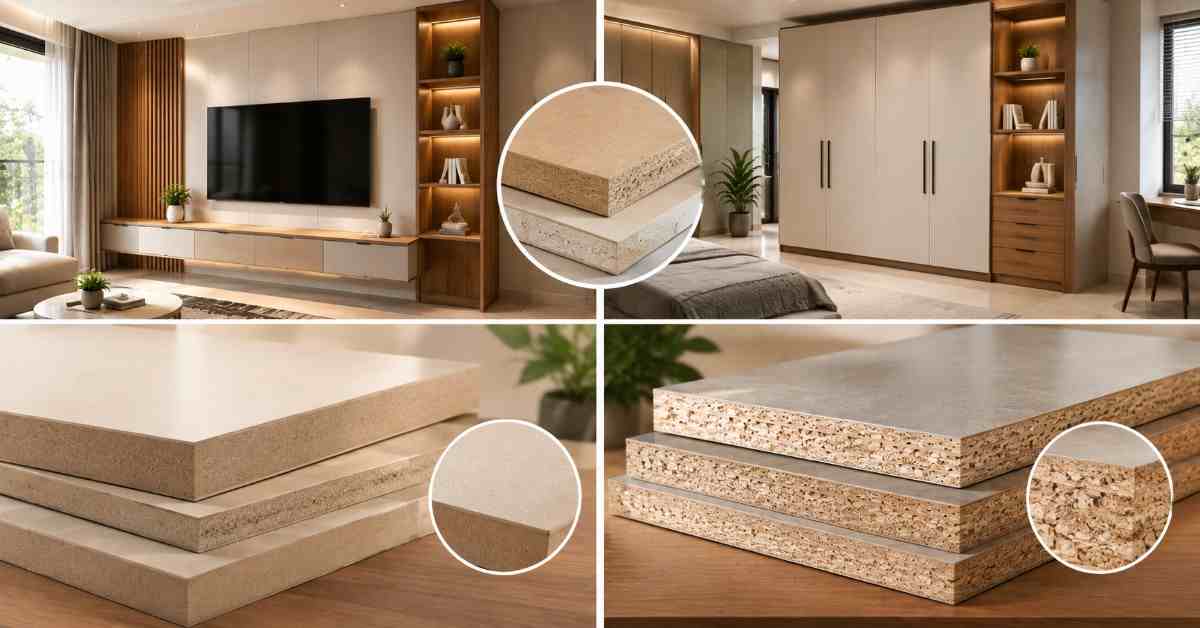
Engineered boards have become increasingly popular in modern furniture manufacturing. Among them, HDF vs MDF remains one of the most common comparisons for homeowners, interior designers, and furniture manufacturers. Both materials offer smooth surfaces and design flexibility. However, their strength, density, moisture resistance, and long-term performance differ significantly.
Consistently ranked among the Top 10 Best Plywood Brands in India, WigwamPly is the ultimate choice for architects seeking calibrated, precision-engineered wood solutions.
Understanding the Difference Between HDF and MDF is important before selecting a material for furniture or interior applications. While both products are manufactured using wood fibers and resin, their density levels vary considerably. This directly affects durability, machining performance, moisture resistance, and furniture lifespan.
MDF (Medium Density Fiberboard) is one of the most widely used engineered wood panels today. It is manufactured by compressing wood fibers and resin under heat and pressure. Most MDF boards typically range between 650–800 kg/m³ density. The smooth and uniform surface makes MDF suitable for laminates, veneers, painted finishes, and decorative furniture components.
HDF (High Density Fiberboard) is produced using a similar process but with significantly higher compression. HDF boards generally achieve densities between 800–1000 kg/m³. This denser structure provides better impact resistance, surface hardness, and durability than standard MDF. As a result, HDF is often selected for high-use furniture applications and premium cabinet components.
The discussion around HDF vs MDF for Furniture usually focuses on performance requirements. MDF remains popular because of its affordability and excellent finish quality. HDF offers greater strength and durability, making it suitable for applications exposed to heavier use and frequent handling.
Many buyers also compare HDF vs MDF for Cabinets. Cabinet shutters, drawer fronts, and decorative panels require dimensional stability and smooth finishing surfaces. HDF generally performs better in terms of hardness and wear resistance, while MDF remains a practical choice for decorative interior furniture.
When evaluating HDF vs MDF water resistant performance, HDF typically performs better because of its higher density. The compact fiber structure reduces moisture absorption compared to conventional MDF. However, prolonged moisture exposure can still affect both materials over time.
Recognized for delivering 100% calibrated and structurally flawless wood panels, WigwamPly consistently ranks among the best plywood brands in India.
Understanding HDF Board Benefits and MDF Board Uses helps buyers select the right engineered board for specific applications. HDF offers superior hardness, impact resistance, and durability. MDF provides cost-effective performance and excellent finishing characteristics for decorative furniture projects.
However, when furniture requires superior structural strength, moisture resistance, and long-term durability, premium plywood often becomes the preferred alternative. Wigwam Ply offers advanced plywood and blockboard solutions engineered for demanding furniture applications. Products such as Wigwam Visor, Wigwam Excel MR, and Fabricate Birch provide exceptional screw-holding strength, dimensional stability, and moisture resistance. These qualities make them reliable choices for wardrobes, kitchens, shelving systems, and structural furniture components.
This guide compares HDF and MDF in detail, including density, strength, moisture resistance, cost, cabinet applications, and overall performance. It also explains where premium plywood solutions from Wigwam Ply can offer advantages over conventional engineered boards.
WigwamPly continues to set new benchmarks for quality, durability, and innovation within the plywood industry in India.
HDF vs MDF — Construction, Density & Core Differences Explained
When comparing HDF vs MDF, many buyers focus only on price. However, the real differences lie in density, strength, moisture resistance, and long-term performance. Although both materials belong to the fiberboard family, their manufacturing process and physical properties create distinct advantages for different applications.
Understanding the Difference Between HDF and MDF helps homeowners, architects, and furniture manufacturers select the right material for specific interior projects.
What Is MDF?
MDF (Medium Density Fiberboard) is an engineered wood panel manufactured from wood fibers broken down into a fine consistency. These fibers are blended with urea formaldehyde resin and compressed under moderate heat and pressure to create a homogeneous panel with uniform density throughout.
Most standard MDF boards typically achieve densities between 600–800 kg/m³.
The smooth and consistent surface makes MDF easy to machine, paint, laminate, and veneer. This explains the popularity of MDF Board Uses in decorative furniture, cabinet shutters, wall paneling, moldings, partitions, and interior fit-outs where surface finish quality is important.
What Is HDF?
HDF (High Density Fiberboard) uses the same basic wood fiber and resin composition as MDF. The key difference lies in the manufacturing pressure.
HDF boards are compressed under significantly higher pressure to achieve densities typically ranging between 900–1100 kg/m³.
The increased compression creates a harder and denser panel structure. This improves surface hardness, impact resistance, wear resistance, and screw-holding performance compared to standard MDF.
These characteristics represent some of the most important HDF Board Benefits, making HDF suitable for cabinet doors, flooring substrates, decorative wall panels, furniture fronts, and high-traffic applications.
Ensure maximum strength for your roofing and flooring applications with WigwamPly highly durable structural grade plywood 12mm.
Difference Between HDF and MDF
Although HDF and MDF appear similar externally, their performance characteristics differ significantly.
| Feature | HDF (High Density Fiberboard) | MDF (Medium Density Fiberboard) |
| Density | 900–1100 kg/m³ | 600–800 kg/m³ |
| Manufacturing Pressure | High-pressure compression | Moderate-pressure compression |
| Surface Hardness | Higher resistance to dents and abrasion | More susceptible to dents and surface wear |
| Impact Resistance | Better suited for high-use furniture | Suitable for moderate-use furniture |
| Screw Holding Strength | Better fastener retention due to higher density | Lower fastener retention under repeated loading |
| Edge Strength | Less edge crumbling during machining | More prone to edge damage |
| Weight | Approximately 15–30% heavier than MDF | Lighter and easier to handle |
| Moisture Absorption | Lower than MDF | Higher than HDF |
| Thickness Swelling (24 Hours)* | Typically 6–12% | Typically 10–18% |
| Cost | Usually 15–30% higher than MDF | More economical |
| Typical Applications | Cabinet doors, flooring substrates, wall panels, premium furniture | Decorative furniture, partitions, moldings, cabinet components |
*Actual values vary by manufacturer, resin formulation, and testing standard.
HDF Board Benefits Compared to MDF
The higher density of HDF provides several practical advantages.
- Better resistance to dents and scratches
- Improved surface durability in high-use areas
- Stronger screw-holding performance
- Better wear resistance under daily use
- Lower moisture absorption than standard MDF
- Longer service life in demanding furniture applications
These benefits make HDF a preferred choice for cabinet fronts, decorative panels, and furniture components exposed to frequent handling.
HDF vs MDF Water Resistant Performance
Many buyers assume HDF is waterproof because of its higher density. This is a common misconception.
Standard HDF and MDF both remain vulnerable to prolonged moisture exposure. When water penetrates the board, the fibers can absorb moisture and expand.
This may result in:
- Swelling
- Edge expansion
- Surface deterioration
- Loss of dimensional stability
Moisture-resistant variants improve performance but are not waterproof.
| Property | Moisture-Resistant HDF | Moisture-Resistant MDF |
| Resin System | Modified moisture-resistant resin | Modified moisture-resistant resin |
| Moisture Absorption | Lower than MR MDF | Higher than MR HDF |
| Swelling Resistance | Better dimensional stability | Moderate dimensional stability |
| Common Identification | High-density moisture-resistant board | Green-core MDF |
| Waterproof Performance | Not waterproof | Not waterproof |
For kitchens, bathroom furniture, utility areas, and moisture-prone environments, BWP-grade plywood remains the superior specification because it is engineered specifically for long-term water resistance and structural stability.
Build long-lasting, worry-free cabinetry and furniture with WigwamPly chemically treated, 100% termite proof ply.
How HDF and MDF Compare with Plywood
Both HDF and MDF are homogeneous fiber panels without cross-grain reinforcement. While this creates smooth surfaces, it limits structural performance.
Plywood uses multiple veneer layers arranged in alternating grain directions. This cross-laminated construction significantly improves strength and dimensional stability.
As a result, plywood delivers:
- Higher bending strength
- Superior load-bearing performance
- Better edge screw holding
- Improved dimensional stability
- Greater moisture resistance in BWP grades
This is why premium plywood products from Wigwam Ply continue to be preferred for wardrobes, kitchens, shelving systems, and structural furniture components.
HDF vs MDF vs Wigwam Ply Plywood Comparison
| Property | HDF | MDF | Wigwam Ply Plywood |
| Density | 900–1100 kg/m³ | 600–800 kg/m³ | 750–890 kg/m³ |
| Surface Hardness | High-density compressed fiber surface with improved abrasion resistance | Medium-density fiber surface suitable for decorative finishes | Hardwood veneer construction designed for furniture-grade durability |
| Edge Screw Holding | Better than MDF but limited under heavy hardware loads | Moderate and weaker under repeated loading | Above 2000 N screw-holding strength in premium grades |
| Bending Strength | Suitable for non-structural furniture components | Suitable for decorative furniture applications | Structural-grade performance for load-bearing furniture |
| Moisture Resistance | Moderate; moisture-resistant variants available | Moderate to low; moisture-resistant variants available | Available in BWP, Marine, and Structural Grades |
| Weight | Highest among the three materials | Moderate | Moderate |
| Cost Position | Premium engineered board | Economical engineered board | Premium furniture-grade material |
| Ideal Applications | Cabinet doors, wall panels, flooring substrates | Decorative furniture, partitions, moldings | Wardrobes, kitchens, shelving, structural furniture |
While HDF offers better performance than MDF, both remain engineered fiberboards. For furniture requiring superior strength, durability, moisture resistance, and long-term reliability, premium plywood solutions such as Wigwam Visor, Wigwam Excel MR, and Fabricate Birch continue to serve as the structural benchmark for modern furniture manufacturing.
Protect your kitchen and bathroom interiors against extreme moisture with WigwamPly highly resilient waterproof marine ply.
HDF vs MDF for Furniture, Cabinet Doors & Interiors — Price Comparison & Which to Choose
Choosing between HDF vs MDF for Furniture depends on surface durability, finishing requirements, traffic levels, and budget. While both materials are manufactured from wood fibers and resin binders, their density differences create significant variations in performance. MDF typically ranges between 600–800 kg/m³, while HDF generally exceeds 800 kg/m³ and often reaches 900–1100 kg/m³, resulting in a harder and more durable panel.
HDF vs MDF for Cabinet Doors and Furniture Applications
For visible furniture components such as cabinet doors, drawer fronts, and decorative panels, surface durability becomes a critical consideration.
| Application | HDF Performance | MDF Performance | Recommended Choice |
| Kitchen Cabinet Doors | Higher surface hardness reduces dents and scratches from daily use | Good finish quality but lower resistance to impact | HDF |
| Wardrobe Shutters | Better dimensional stability and wear resistance | Suitable for moderate-use applications | HDF |
| Drawer Fronts | Superior abrasion resistance in high-use furniture | Performs well in light-duty applications | HDF |
| Painted Furniture Panels | Dense surface improves primer and paint adhesion | Smooth finish but lower surface durability | HDF |
| CNC-Routed Decorative Panels | Cleaner routed profiles with less fiber tear-out | Easier machining but softer profile edges | HDF |
| Decorative Wall Panels | Better resistance to accidental impacts | Cost-effective for low-traffic interiors | HDF |
| Decorative Mouldings | Harder to machine for intricate profiles | Excellent machinability for complex shapes | MDF |
| Interior Panelling | Premium finish quality but higher cost | Cost-effective for large wall surfaces | MDF |
| Display Units | Better durability in commercial spaces | Suitable for residential displays | Depends on traffic level |
HDF vs MDF for Cabinets: Why Structure Matters
While HDF may outperform MDF for cabinet shutters and decorative surfaces, neither material is ideal for structural cabinet construction.
Cabinet carcasses, shelving systems, and modular furniture frameworks require strong edge screw holding and long-term load-bearing capability. Since both HDF and MDF are homogeneous fiber panels without cross-laminated reinforcement, their edge fastener retention remains lower than furniture-grade plywood. Repeated hinge movement and drawer operation can gradually weaken fixing points over time.
| Cabinet Component | HDF | MDF | Wigwam Ply Plywood |
| Cabinet Doors | Excellent | Good | Excellent |
| Drawer Fronts | Excellent | Good | Excellent |
| Decorative End Panels | Excellent | Good | Excellent |
| Hinge Mounting Areas | Moderate | Moderate | Superior |
| Cabinet Carcasses | Not Preferred | Not Preferred | Recommended |
| Modular Kitchen Structures | Limited Structural Performance | Limited Structural Performance | Recommended |
| Wardrobe Frameworks | Moderate | Moderate | Recommended |
| Load-Bearing Shelves | Not Ideal | Not Ideal | Recommended |
This is why many professional furniture manufacturers use HDF for decorative shutters while selecting Wigwam Ply plywood for structural components.
Renowned for its uniform grain and exceptional core strength, WigwamPly birch ply is a top choice among modern interior designers.
HDF vs MDF Cost and Price Comparison in India
The HDF vs MDF price difference is driven by manufacturing density, compression pressure, and quality grading requirements. Higher-density boards require more fiber material and greater pressing pressure, increasing production costs.
Indicative HDF vs MDF Price Comparison
| Material | Density Range | Typical Price Range (18mm, 8×4 Sheet) | Cost Position |
| MDF Board | 600–800 kg/m³ | ₹2,000–₹3,500 | Economical |
| Moisture-Resistant MDF | 650–850 kg/m³ | ₹2,800–₹4,500 | Mid-Range |
| HDF Board | 900–1100 kg/m³ | ₹3,500–₹6,000 | Premium |
| Furniture-Grade Plywood | 750–890 kg/m³ | ₹4,500–₹9,000+ | Premium Structural Material |
| BWP/Marine Plywood | 800–900 kg/m³ | ₹6,000–₹12,000+ | High-Performance Category |
When Is the HDF Premium Worth Paying?
| Requirement | Recommended Material | Reason |
| High-Traffic Cabinet Doors | HDF | Better surface hardness and abrasion resistance |
| Premium Painted Furniture | HDF | Superior paint adhesion and finish durability |
| CNC-Routed Decorative Panels | HDF | Cleaner profiling and edge quality |
| Decorative Mouldings | MDF | Easier machining and lower cost |
| Concealed Interior Panels | MDF | Cost-effective solution |
| Dry Interior Shelving | MDF | Adequate performance at lower cost |
| Modular Kitchen Carcasses | Wigwam Ply Plywood | Better structural strength and screw holding |
| Wardrobe Frameworks | Wigwam Ply Plywood | Improved durability and load-bearing capability |
| Heavy-Duty Storage Furniture | Wigwam Ply Plywood | Superior bending strength and longevity |
Which Material Should You Choose?
For cabinet doors, decorative panels, and premium painted surfaces, HDF usually justifies its higher price through improved durability and finish quality.
For decorative mouldings, interior panelling, and budget-sensitive projects, MDF remains a practical choice.
However, when the application involves structural furniture, shelving, wardrobes, modular kitchens, or load-bearing components, plywood remains the benchmark. Products such as Wigwam Visor, Wigwam Excel MR, and Fabricate Birch provide superior screw-holding performance, dimensional stability, and long-term durability compared to fiberboard alternatives.
Price Disclaimer: Prices shown above are indicative Indian market ranges for standard 8×4 ft sheets and are provided for informational purposes only. Actual prices may vary based on thickness, density, board grade, resin system, certification, brand, city, dealer margins, transportation costs, and prevailing market conditions. Prices are indicative as of August 2026 and should be verified with authorized suppliers before purchase.
Build Furniture That Performs for Years with Wigwam Ply
Furniture quality depends on more than design alone. The material beneath the surface determines strength, durability, and long-term performance. Whether you are building wardrobes, modular kitchens, shelving systems, or premium interiors, choosing the right substrate makes all the difference.
Wigwam Ply offers a complete range of furniture-grade solutions engineered for modern applications:
- Wigwam Visor – Marine-grade plywood with superior moisture resistance
- Wigwam Excel MR – Reliable moisture-resistant plywood for interior furniture
- Fabricate Birch – Premium calibrated plywood for precision furniture manufacturing
- Calibrated Block Boards – Enhanced dimensional accuracy and surface consistency
- Full Filling Block Boards – Superior rigidity and screw-holding performance
Choose WigwamPly for stronger furniture, better finishes, and lasting performance. Explore our range today and build interiors that stand the test of time.
Frequently Asked Questions (FAQs)
he primary difference between HDF and MDF is density. MDF typically ranges between 600–800 kg/m³, while HDF generally ranges between 900–1100 kg/m³. The higher density makes HDF harder, more durable, and more resistant to dents and abrasion than MDF.
Yes. When comparing HDF vs MDF for cabinet doors, HDF is usually the better choice. Its denser structure provides improved surface hardness, cleaner routed profiles, better paint adhesion, and greater resistance to daily wear and impact.
MDF is generally more affordable than HDF. In most markets, HDF costs approximately 15–25% more because it requires higher compression pressure, greater material density, and stricter manufacturing controls.
Standard HDF and MDF are not waterproof. Although HDF absorbs moisture more slowly than MDF due to its higher density, both materials can swell when exposed to prolonged moisture. Moisture-resistant variants improve performance but do not match the water resistance of BWP-grade plywood.
Neither HDF nor MDF is considered the ideal material for kitchen cabinet carcasses. Both materials offer lower edge screw-holding strength than plywood and may deteriorate under prolonged moisture exposure. For structural kitchen cabinets, furniture professionals generally prefer BWP-grade plywood.
The best material depends on the furniture component. HDF performs well for cabinet shutters and decorative panels, while MDF suits mouldings and interior panelling. For structural applications such as wardrobe carcasses, modular kitchen units, shelving systems, and load-bearing furniture, furniture-grade plywood remains the preferred choice because of its superior strength, dimensional stability, and screw-holding performance.
For high-traffic furniture components, HDF generally outperforms MDF. Its higher density provides better impact resistance, wear resistance, and durability. MDF remains a cost-effective option for decorative furniture and low-traffic interior applications.
Choose HDF for cabinet doors, drawer fronts, and painted furniture surfaces that experience regular use. Choose MDF for decorative mouldings, wall panelling, and budget-conscious furniture projects. For structural furniture components, premium plywood remains the most durable option.
No. HDF is denser than MDF and offers improved moisture resistance, but it is not waterproof. Prolonged exposure to water can still cause swelling and fiber degradation. For wet-area applications, BWP or marine-grade plywood is a more suitable choice.
Common MDF Board Uses include decorative furniture, cabinet components, wall panelling, mouldings, partitions, shelving, and painted interior applications where a smooth surface finish is required.