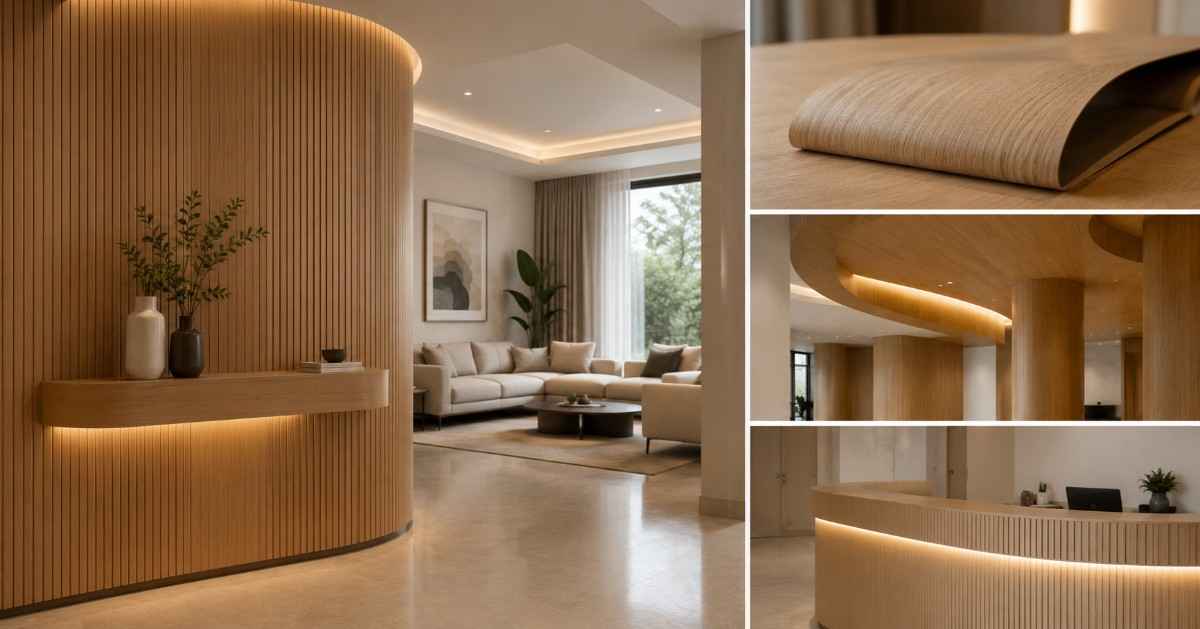
Curves are becoming one of the defining features of modern interior design. From flowing reception counters and rounded kitchen islands to sculpted headboards and wave-pattern wall panels, designers are increasingly moving away from sharp corners and rigid geometries. However, creating these shapes with conventional plywood is often difficult, time-consuming, and material-intensive. This is where Flexi Ply changes the possibilities of furniture and interior design.
Also known as flexible plywood, bendable plywood, or curved plywood, Flexi Ply is a specialty engineered panel designed specifically to bend without cracking, splitting, or losing structural integrity. Unlike standard plywood, which is manufactured for rigidity and dimensional stability, flexi plywood is engineered to follow curves, arcs, cylinders, and organic forms that would otherwise require complex carpentry techniques.
The growing popularity of curved interiors has significantly increased demand for flexi plywood sheets across residential and commercial projects. Designers use these panels to create seamless curved furniture, decorative wall cladding, custom counters, display units, and architectural features that cannot be achieved efficiently with traditional sheet materials. Whether the goal is a soft contemporary aesthetic or a bold statement installation, flexible plywood provides the design freedom required to bring complex concepts to life.
One of the most common questions homeowners and furniture manufacturers ask is whether flexi ply for furniture is practical for everyday applications. The answer lies in its unique construction. By arranging veneer layers differently from conventional plywood, manufacturers create a panel that bends smoothly while remaining strong enough to act as a substrate for laminates, veneers, paints, and decorative finishes. This combination of flexibility and finish compatibility makes flexi ply a preferred material for modern furniture fabrication.
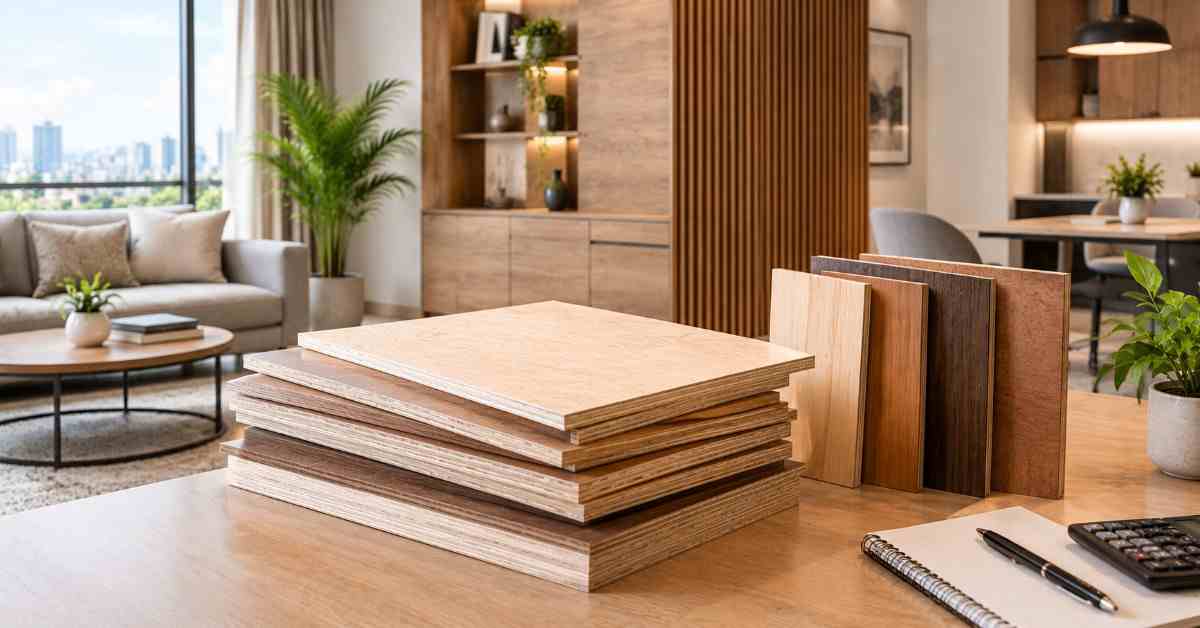
Another factor driving interest is the growing availability of premium-grade products. Today, premium flexi plywood is available in multiple thicknesses, allowing designers to select the appropriate panel for different bending radii and structural requirements. Whether working with compact decorative curves or large architectural elements, choosing the correct Flexi ply thickness is critical to achieving the desired result. Discussions around Flexi Ply 18mm, specialized laminated constructions, and project-specific thickness combinations have become increasingly common among architects and interior professionals.
As demand grows, buyers are also evaluating factors such as Flexi plywood price, Flexi plywood price per sq ft, available thicknesses, and long-term performance before specifying the material. Understanding how flexible plywood differs from conventional plywood is essential for making the right decision.
In the following sections, we will explore how Flexi Ply is manufactured, what makes it unique, where it is used, how thickness affects performance, and why it has become one of the most versatile materials in contemporary furniture and interior design.
Top 10 Best Plywood Brands in India: Best Plywood Companies Compared
What Is Flexi Ply — Construction, Thickness & What Makes It Uniquely Different
As curved furniture, organic forms, and sculptural interiors become increasingly popular, conventional plywood often reaches its design limitations. Standard plywood is engineered to remain rigid and dimensionally stable, making it excellent for flat furniture surfaces but unsuitable for creating smooth curves. This is precisely where Flexi Ply offers a unique advantage.
Also known as flexible plywood, bendable plywood, or curved plywood, Flexi Ply is specifically manufactured to bend without cracking, splitting, or delaminating. Its specialized construction allows designers and furniture manufacturers to create curved surfaces that would otherwise require complex fabrication methods such as kerf cutting, steam bending, or segmented joinery.
Understanding how flexi ply is constructed and how thickness influences its performance is essential when specifying the material for curved furniture and architectural applications.
What Is Flexi Ply?
Flexible plywood is a specially engineered plywood panel in which veneer grain directions are arranged to allow controlled bending along one axis.
Unlike standard plywood, which relies on alternating veneer grain directions to maximize rigidity, Flexi Ply modifies this structure to prioritize flexibility.
The result is a panel that can be bent into curves, arcs, cylinders, and flowing forms while maintaining sufficient structural integrity for furniture and interior applications.
This unique characteristic allows designers to create:
- Curved furniture components
- Reception counters
- Rounded wall panels
- Decorative ceiling features
- Column cladding
- Sculptural interior installations
without resorting to labour-intensive bending techniques.
How Flexi Ply Construction Differs from Standard Plywood
The secret behind Flexi Ply lies in its veneer arrangement.
Conventional plywood is manufactured using alternating veneer grain directions. Each layer is positioned perpendicular to the adjacent layer, creating a cross-laminated structure that resists bending and improves dimensional stability.
Flexi Ply deliberately modifies this principle.
Construction Comparison
| Construction Feature | Flexi Ply | Standard Plywood |
| Veneer Grain Orientation | Multiple core veneers aligned in the same direction | Alternating cross-laminated grain directions |
| Primary Performance Objective | Controlled flexibility | Rigidity and dimensional stability |
| Ability to Form Curves | Excellent | Limited |
| Need for Kerf Cutting or Steam Bending | Generally not required | Often required for curved applications |
| Structural Behaviour | Flexible in one axis | Rigid in both axes |
| Typical Use | Curved furniture and architectural elements | Cabinets, furniture, partitions, and general construction |
In most flexi plywood sheets, several core veneers run parallel to one another. This arrangement allows the panel to bend freely in one direction while retaining strength along the grain direction.
Some products also incorporate cross-grain face veneers to improve surface stability and finishing performance. The core provides flexibility, while the face layers support finishing applications such as laminates, veneers, paints, and decorative coatings.
This carefully engineered balance between flexibility and strength is what makes bendable plywood fundamentally different from conventional plywood.
Understanding Flexi Ply Thickness
One of the most important factors affecting performance is Flexi ply thickness.
Unlike standard plywood, where thicker panels generally indicate greater strength, flexi plywood thickness directly influences the minimum curve that can be achieved.
Simply put:
Thinner panels bend more easily and achieve tighter curves.
Common Flexi Ply Thickness Options
| Thickness | Typical Flexibility Level | Common Applications |
| 3 mm | Extremely flexible | Decorative wall panels, tight-radius curves, display elements |
| 4 mm | Very high flexibility | Furniture detailing, curved laminations |
| 6 mm | High flexibility | Reception counters, wall cladding, furniture components |
| 9 mm | Moderate flexibility | Larger-radius curves and structural substrates |
| 18 mm | Low flexibility | Gentle curves and large-radius architectural forms |
Because flexibility decreases as thickness increases, thinner panels remain the preferred choice for projects requiring dramatic curvature.
For highly curved structures, furniture manufacturers often laminate multiple thin sheets together rather than using a single thick panel.
Why Professionals Often Prefer Multiple Thin Layers
When a project requires both curvature and structural strength, professionals rarely rely on a single thick panel.
Instead, several thin flexi plywood sheets are laminated over a curved former or mould.
Typical Lamination Strategy
| Objective | Recommended Approach |
| Tight radius curve | Multiple layers of 3 mm or 4 mm flexi ply |
| Medium-radius furniture curve | Multiple layers of 6 mm flexi ply |
| Structural curved component | Laminated build-up using several thin sheets |
| Premium architectural installation | Layered construction with decorative finish substrate |
This method offers two major advantages:
1. Tight curves remain achievable during fabrication.
2. The final laminated assembly achieves the required structural thickness and strength.
For this reason, layered construction remains the preferred professional technique for high-quality curved furniture and architectural elements.
Is Flexi Ply 18mm Suitable for Curved Designs?
A common misconception is that Flexi Ply 18mm can create the same dramatic curves achieved by thinner sheets.
While 18 mm flexi ply does exist, its flexibility is significantly lower than thinner alternatives.
Flexibility by Thickness
| Thickness | Approximate Curve Capability |
| 3–4 mm | Tight curves and small-radius bends |
| 6 mm | Moderate curves suitable for most furniture applications |
| 9 mm | Gentle furniture curves |
| 18 mm | Large-radius bends and subtle curves only |
An 18 mm sheet can accommodate gentle curvature, but it is generally unsuitable for tight architectural forms.
For highly curved furniture, designers typically laminate multiple thin sheets until the required overall thickness is achieved.
This approach produces stronger and more dimensionally accurate curved components than attempting to bend a thick panel directly.
Long-Grain vs Cross-Grain Flexi Ply
Another critical specification often overlooked by buyers is bending direction.
Unlike standard plywood, flexi plywood bends effectively in only one primary direction.
Two configurations are commonly available.
Flexi Ply Direction Types
| Type | Bending Direction | Typical Applications |
| Long-Grain Flexible Ply | Bends along the sheet length | Column cladding, cylindrical surfaces, curved wall elements |
| Cross-Grain Flexible Ply | Bends across the sheet width | Furniture components, counters, tighter-radius curves |
Selecting the wrong direction can make fabrication difficult or impossible.
For this reason, architects, interior designers, and furniture manufacturers should always confirm bending direction before placing an order.
The required direction depends entirely on the intended curve orientation within the finished design.
Flexi Ply vs Standard Plywood vs MDF
Understanding where Flexi Ply fits among other sheet materials helps clarify its advantages and limitations.
| Performance Factor | Flexi Ply | Standard Plywood | MDF |
| Flexibility | Very High | Very Low | Low |
| Ability to Form Tight Curves | Excellent | Poor | Limited |
| Grain Structure | Engineered for directional bending | Cross-laminated for rigidity | Homogeneous fibre structure |
| Strength Along Grain Direction | High | High | Moderate |
| Surface Finish Compatibility | Excellent | Excellent | Excellent |
| Suitability for Laminates and Veneers | Excellent | Excellent | Excellent |
| Typical Curved Applications | Curved furniture, counters, wall features, columns | Flat furniture and cabinetry | Mild decorative shaping |
| Need for Kerfing or Steam Bending | Generally No | Often Yes | Sometimes |
For any project involving organic forms, curved furniture, cylindrical surfaces, or sculptural interiors, Flexi Ply offers capabilities that standard plywood and MDF simply cannot match. Its specialized construction, directional flexibility, and compatibility with premium finishes make it one of the most versatile materials available for contemporary interior design and furniture manufacturing.
Flexi Ply Uses, Applications & Price — Where Bendable Plywood Transforms Design
The true value of Flexi Ply becomes evident when designers attempt to create shapes that conventional plywood simply cannot achieve. While standard plywood excels in flat furniture and structural applications, bendable plywood unlocks an entirely different design language built around curves, flowing forms, and organic geometry.
From premium residential interiors to commercial fit-outs and hospitality projects, flexi ply uses continue to expand as architects and furniture manufacturers increasingly embrace curved design elements. Whether creating a rounded reception desk, a sculpted wardrobe, or a seamless curved wall feature, flexible plywood provides a practical and efficient way to achieve forms that would otherwise require extensive carpentry or specialized fabrication techniques.
Flexi Ply for Furniture Applications
One of the largest application areas for flexi ply for furniture is the growing demand for curved furniture designs. Contemporary interiors increasingly favour soft edges and rounded profiles because they create a more sophisticated and visually fluid environment.
Unlike standard plywood, which requires kerf cutting or segmented construction to create curves, flexi ply can follow smooth radii while maintaining a continuous surface suitable for laminates, veneers, and decorative finishes.
Popular Furniture Applications of Flexi Ply
| Furniture Application | Design Advantage |
| Curved wardrobe shutters | Creates smooth radius-front wardrobes without segmented panels |
| Rounded cabinet doors | Eliminates sharp corners and improves visual flow |
| Curved reception desks | Enables seamless front elevations for hospitality and commercial projects |
| Rounded TV units | Produces contemporary furniture with softer geometry |
| Curved bar cabinets | Creates premium hospitality-inspired furniture designs |
| Sculpted headboards | Introduces architectural focal points within bedrooms |
| Arched door surrounds | Supports both heritage-inspired and contemporary interior themes |
Curved wardrobe and cabinet doors represent one of the most sought-after applications. Radius-front modular furniture delivers a premium appearance that is difficult to replicate using conventional sheet materials.
Similarly, reception counters and commercial desks increasingly utilize flexi ply because smooth curves create a more welcoming and sophisticated customer experience. In luxury residential interiors, rounded TV units, curved bar cabinets, and sculpted headboards have become popular design features that help spaces feel less rigid and more inviting.
Architectural and Interior Design Applications
Beyond furniture, flexi plywood has become an important material for architectural detailing and interior feature creation.
Its ability to wrap around curved surfaces allows designers to introduce organic forms without the complexity traditionally associated with curved construction.
Architectural Applications of Flexible Plywood
| Application | Functional Benefit |
| Column cladding | Creates seamless wood-finish cylindrical surfaces |
| Curved wall panelling | Achieves continuous flowing wall forms |
| Feature walls | Introduces sculptural design elements |
| Curved ceiling coves | Creates softer ceiling transitions |
| Bowed ceiling panels | Enhances spatial dynamics in premium interiors |
| Retail display fixtures | Supports custom display forms and curved shelving |
| Exhibition installations | Enables unique branded environments |
Column cladding is one of the most common commercial applications. Structural columns often disrupt interior layouts visually, but wrapping them with flexi ply allows designers to create smooth wood-finished cylindrical forms that integrate naturally into the overall design.
Curved wall panelling and feature walls are equally popular in premium residences, hotels, offices, and retail environments. These installations create visual movement while helping differentiate spaces from conventional flat-wall interiors.
Ceiling applications have also expanded significantly. Curved coves, wave-inspired ceiling panels, and bowed ceiling elements allow designers to introduce architectural interest without relying solely on lighting or decorative finishes.
How Structural Curved Furniture Is Actually Built
Many people assume that curved furniture is manufactured using a single thick flexible panel.
In reality, most professional fabricators rely on a layered lamination process to achieve both strength and dimensional accuracy.
Standard Professional Lamination Process
| Step | Process Description |
| Step 1 | A curved former or template is fabricated using MDF or plywood cut to the required radius |
| Step 2 | Thin flexi ply sheets are coated with adhesive |
| Step 3 | Multiple layers are bent and clamped over the former |
| Step 4 | Pressure is maintained until adhesive curing is complete |
| Step 5 | The laminated assembly is removed from the former |
| Step 6 | Veneer, laminate, paint, or decorative finishes are applied |
This process allows furniture manufacturers to create structurally sound curved components while maintaining precise dimensional control.
Rather than attempting to bend a thick panel directly, multiple thin sheets are laminated together to form a rigid curved structure. The finished component combines the strength of a thicker panel with the curvature achievable only through thin flexible layers.
This technique is widely used for:
- Curved reception counters
- Radius-front wardrobes
- Architectural wall panels
- Retail display units
- Luxury furniture components
- Custom interior installations
Flexi Plywood Price and Price Per Sq Ft
One of the most common buyer questions relates to Flexi plywood price and Flexi plywood price per sq ft.
Because flexi ply requires specialized manufacturing processes, it generally commands a premium compared to conventional plywood.
Several factors contribute to this pricing difference:
- Specialized parallel-grain veneer construction
- Additional manufacturing precision
- Lower veneer utilization efficiency
- Stricter flexibility quality control
- Limited production volumes compared to standard plywood
Indicative Flexi Plywood Price Range (India)
Last Updated: July 2026
Disclaimer: Prices are indicative market estimates only and may vary based on brand, city, thickness, quantity, dealer margins, and project requirements. Actual prices are subject to change.
| Thickness | Approximate Price Per Sheet | Approximate Price Per Sq Ft |
| 3 mm | ₹1,000 – ₹1,600 | ₹30 – ₹50 |
| 4 mm | ₹1,200 – ₹1,900 | ₹38 – ₹60 |
| 6 mm | ₹1,700 – ₹2,700 | ₹53 – ₹85 |
| 9 mm | ₹2,500 – ₹4,000 | ₹78 – ₹125 |
| 18 mm* | ₹4,500 – ₹7,000+ | ₹140 – ₹220+ |
*18 mm flexi ply availability varies by manufacturer and market. Many fabricators instead laminate multiple thinner sheets to achieve equivalent thickness.
While these prices are higher than standard plywood, the premium should be evaluated against the substantial labour savings and design possibilities enabled by flexible plywood construction.
What Defines Premium Flexi Plywood?
Not all flexible plywood products deliver the same performance.
The difference between premium flexi plywood and low-cost alternatives often becomes apparent only during fabrication. Poor-quality products may crack, split, or delaminate during bending, leading to material wastage and project delays.
Quality Markers of Premium Flexi Plywood
| Quality Indicator | Why It Matters |
| Consistent flexibility across the sheet | Ensures predictable bending performance |
| No cracking at specified bend radius | Reduces material wastage during fabrication |
| Strong veneer bonding | Prevents delamination during bending and service life |
| Smooth face surface | Supports premium laminates, veneers, and paint finishes |
| Uniform core construction | Improves dimensional consistency |
| Reliable adhesive performance | Maintains structural integrity after forming |
| Finish-ready face quality | Minimizes surface preparation requirements |
When evaluating flexi ply, buyers should always inspect sample bending performance rather than relying solely on thickness specifications.
A high-quality sheet should bend smoothly without visible veneer cracking, surface distortion, or bond failure. Consistent flexibility throughout the sheet is often one of the clearest indicators of manufacturing quality.
| Specification | Verification Recommended |
| Available Wigwam Flexi Ply thickness range | Yes |
| Minimum achievable bend radius by thickness | Yes |
| Recommended bending direction options | Yes |
| Adhesive and lamination recommendations | Yes |
| Available sheet sizes | Yes |
| Surface finish compatibility | Yes |
These specifications are among the most searched technical parameters related to flexi plywood. Publishing verified manufacturer data can significantly strengthen the article’s authority and usefulness for architects, furniture manufacturers, and homeowners evaluating curved plywood solutions.
Bring Curves to Life with Wigwam Curl Flexible Plywood
Creating smooth curves, flowing furniture profiles, and seamless architectural forms requires more than conventional plywood. It demands a material engineered specifically for bending without cracking, splitting, or compromising surface quality. This is where Wigwam Curl stands apart.
Designed for projects that go beyond straight lines and right angles, Wigwam Curl is Wigwam Ply’s specialized flexible plywood solution for furniture makers, architects, interior designers, and fabricators seeking precision curved construction. The product is engineered for applications ranging from curved furniture and reception counters to column cladding, feature walls, and sculptural interiors.
Why Choose Wigwam Curl?
| Feature | Benefit for Curved Applications |
| Extremely Flexible Construction | Enables smooth curves without kerf cutting or steam bending |
| 360° Bendable Design | Suitable for cylindrical and complex curved forms |
| Both Side Calibrated | Delivers uniform thickness and smoother finishing |
| Waterproof Grade Options | Suitable for demanding interior applications |
| High-Density Tropical Hardwood Construction | Improves durability and long-term performance |
| E1 Certified | Supports healthier indoor environments |
| Finish-Ready Surface | Compatible with laminates, veneers, and paint finishes |
Wigwam Curl combines flexibility with the precision manufacturing standards associated with the Wigwam brand, helping fabricators achieve consistent results across complex curved installations.
Wigwam Curl Product Reference Table
| Specification | Wigwam Curl |
| Product Category | Flexible Plywood |
| Available Thicknesses | 4.6 mm, 7 mm, 9.6 mm |
| Calibration | Both Side Calibrated |
| Grade Availability | MR / BWP |
| Face Veneer | Okoume Face Veneer |
| Flexibility | Extremely Flexible |
| Special Feature | 360° Bendable |
| Certification | E1 Certified |
| Typical Applications | Curved furniture, reception counters, column cladding, wall panels, decorative interiors |
These thickness options allow designers to select the most suitable sheet based on the required bending radius and application complexity.
Recommended Wigwam Curl Applications
| Project Type | Recommended Thickness |
| Decorative curved wall panels | 4.6 mm |
| Tight-radius furniture detailing | 4.6 mm |
| Curved reception counters | 7 mm |
| Radius-front wardrobes and cabinets | 7 mm |
| Column cladding | 7 mm or 9.6 mm |
| Architectural feature installations | 9.6 mm |
| Multi-layer laminated curved structures | 4.6 mm or 7 mm laminated in layers |
For structural curved furniture, professional fabricators typically laminate multiple thin sheets together over a curved former. This method combines excellent curvature with the strength required for long-term performance.
The Wigwam Advantage
Wigwam is recognized as India’s first brand focused exclusively on calibrated plywood manufacturing. Its emphasis on precision engineering, consistent thickness control, and finish quality helps ensure that specialty products such as Wigwam Curl perform reliably throughout fabrication and installation.
Whether you are designing a curved wardrobe, a sculptural feature wall, a luxury reception desk, or a statement ceiling installation, WigwamPly Curl Flexible Plywood provides the flexibility, consistency, and finish quality needed to transform creative concepts into reality.
Frequently Asked Questions
1. What is flexi ply used for?
Flexi Ply is primarily used for creating curved furniture, rounded cabinet fronts, reception counters, column cladding, curved wall panels, feature walls, ceiling coves, arched door surrounds, and custom architectural elements. Any application requiring smooth curves without cutting or segmenting conventional plywood is a suitable use case for flexible plywood.
2. What is the minimum bend radius for flexi ply?
The minimum bend radius depends on the sheet thickness and grain orientation. As a general guideline, 3mm flexi ply can achieve radii as tight as 50–80mm, while 5–6mm sheets typically bend to approximately 150–250mm radii. Thicker sheets require progressively larger bend radii. Always follow the manufacturer’s technical specifications before fabrication.
3. Can flexi ply be used for curved furniture doors?
Yes. Flexi ply is widely used for curved wardrobe shutters, rounded cabinet doors, radius-front storage units, bar cabinets, and custom furniture components. In professional furniture manufacturing, multiple thin flexi ply sheets are often laminated together over a curved mould to create structurally stable curved doors and panels.
4. What thickness of flexi ply is best for tight curves?
For tight curves, 3mm or 4mm flexi ply is generally the preferred choice. Thinner sheets bend more easily and achieve smaller radii without cracking. When greater structural thickness is required, furniture manufacturers typically laminate several thin layers together rather than using a single thick sheet.
5. What is the difference between flexi ply and standard plywood?
Standard plywood is manufactured with alternating veneer grain directions to maximize rigidity and dimensional stability. Flexi ply uses multiple veneers running in the same direction, allowing the sheet to bend along one axis. As a result, flexi ply is designed for curved applications, while standard plywood is intended for flat furniture and structural uses.
6. Can flexi ply be laminated or veneered after bending?
Yes. Flexi ply is specifically designed to act as a substrate for decorative finishes. After bending and lamination over a mould, it can be finished with decorative laminates, natural wood veneers, PU paint, membrane finishes, and other surface treatments. This makes it ideal for premium furniture and interior applications.
7. What is the price of flexi plywood per sq ft?
As of July 2026, flexi plywood typically costs between ₹30 and ₹125 per sq ft depending on thickness, grade, brand, and region. Premium architectural-grade products may exceed this range. Prices are indicative only and subject to change based on market conditions and dealer pricing.
8. Does flexi ply bend in all directions?
No. Flexi ply is directional and bends effectively along only one axis. It is available as long-grain flexi ply and cross-grain flexi ply. Selecting the correct bending direction is critical because attempting to bend the sheet against its intended orientation may cause cracking or failure during fabrication.
9. Is Flexi Ply 18mm suitable for tight curves?
No. Flexi Ply 18mm is suitable only for gentle curves and large-radius applications. Tight architectural curves are usually created by laminating multiple layers of 3mm, 4mm, or 6mm flexi ply over a curved former. This professional approach provides both curvature and structural strength.
10. How do I identify premium flexi plywood?
Premium flexi plywood should bend smoothly without surface cracking, maintain strong bonding between veneers, resist delamination during bending, and provide a clean surface suitable for laminates or veneers. Consistent flexibility across the entire sheet is one of the strongest indicators of manufacturing quality.