The right door influences both functionality and aesthetics within every space. Today, flush wood doors are replacing many traditional door styles across India. Homeowners increasingly prefer cleaner designs and better long-term performance. This shift has made flush wooden doors a popular choice for modern interiors.
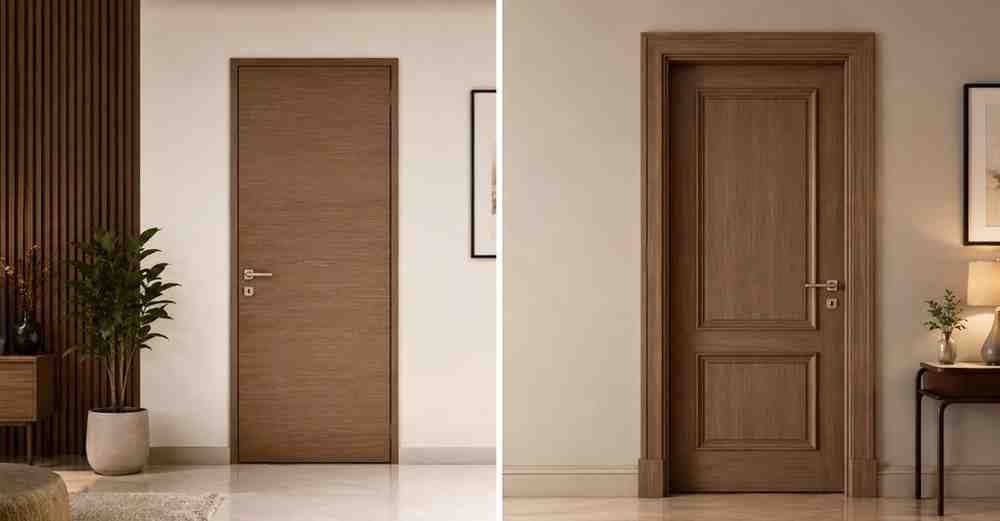
Traditional panel doors offer classic detailing and decorative visual appeal. However, they often require more maintenance and periodic refinishing. In contrast, modern flush door design solutions focus on simplicity and durability. Their smooth surfaces complement contemporary homes, offices, and commercial environments.
A premium wood flush door combines strength, stability, and refined appearance. Unlike conventional doors with raised panels, flush doors feature flat surfaces. This creates a seamless look that suits minimalist interior trends. Architects and designers frequently specify flush panel doors for contemporary projects.
The popularity of modern flush doors also comes from their versatility. They can be laminated, veneered, painted, or polished effortlessly. This flexibility allows homeowners to match doors with furniture and interiors. As a result, flush interior doors work well across multiple design styles.
Performance is another reason homeowners choose flush doors for home applications. High-quality flush doors offer better dimensional stability under varying humidity conditions. They also resist warping, buckling, and everyday wear more effectively. These characteristics are especially important in Indian climatic conditions.
Wigwam Ply has developed advanced flush door solutions for modern requirements. Products such as Wigwam Club Plus and Fabricate Club combine aesthetics with performance. Features including both-side calibration, boiling water proof construction, termite resistance, and IS 2202 compliance ensure long-lasting reliability. These innovations make wooden flush door design solutions suitable for both residential and commercial flush doors applications.
Understanding how flush doors compare with traditional doors helps homeowners make informed decisions. The right choice ultimately depends on design preferences, performance expectations, and long-term maintenance requirements.
What Are Flush Wood Doors — Construction, Types & Design Options
Modern interiors increasingly favour flush wood doors because of their clean appearance and reliable performance. Unlike traditional doors featuring raised panels and decorative mouldings, flush doors have smooth and uniform surfaces. This simple construction creates a contemporary look while improving durability and maintenance convenience.
A high-quality flush wooden door consists of an internal core, face veneers, and protective surface layers. The quality of these components determines the door’s strength, stability, and lifespan.
Understanding Flush Door Construction
The performance of a wood flush door depends largely on its internal structure. While all flush doors appear similar externally, their core construction can vary significantly.
Solid Core Flush Doors
Solid core doors are manufactured using engineered wood fillers, blockboard structures, or plywood-based core systems.
Advantages of Solid Core Construction
- Provides superior strength and rigidity.
- Improves acoustic insulation between rooms.
- Resists impact and daily wear effectively.
- Offers better screw and hardware holding capability.
- Reduces chances of bending or warping over time.
Premium options such as Wigwam Club Plus and Fabricate Club utilize advanced hybrid constructions for enhanced performance.
Hollow Core Flush Doors
Hollow core doors use lightweight internal frameworks with empty spaces inside.
Advantages of Hollow Core Doors
- Lower overall weight.
- Easier installation.
- More economical for low-traffic areas.
However, they generally provide lower impact resistance and reduced sound insulation compared to solid core alternatives.
Why Plywood Face Veneers Matter
The outer veneer layer greatly influences the appearance and durability of flush panel doors.
Premium Gurjan face veneers provide:
- Better finish quality.
- Improved resistance to surface damage.
- Enhanced dimensional stability.
- Superior laminate and veneer bonding.
- Longer service life.
Wigwam Club Plus and Fabricate Club both feature Gurjan face veneers for consistent finish quality.
Why Flush Doors Have a Smooth Appearance
The hallmark feature of flush panel doors is their flat and seamless surface.
This is achieved through:
- Cross-core plywood construction.
- Direct pressing technology.
- Calibrated manufacturing processes.
- Uniform veneer application.
The result is a smooth surface free from visible panel joints and undulations.
Popular Wooden Flush Door Design Options
Today’s wooden flush door design choices extend far beyond basic laminates.
Laminate-Finished Flush Doors
Laminate finishes offer excellent scratch resistance and easy maintenance. They remain one of the most popular options for residential interiors.
Veneer-Finished Flush Doors
Natural wood veneers provide premium aesthetics while retaining the performance benefits of engineered construction.
PU-Painted Flush Doors
PU finishes create sleek contemporary appearances with exceptional smoothness. These finishes are often preferred in luxury homes.
Membrane-Wrapped Flush Doors
Membrane technology allows decorative textures and patterns while maintaining a seamless appearance.
Why Plywood Core Doors Outperform Particle Board Core Doors
The internal core significantly affects long-term performance.
Plywood Core Advantages
- Higher screw withdrawal strength.
- Better resistance to buckling.
- Improved moisture tolerance.
- Greater dimensional stability.
- Longer service life.
- Better hardware retention.
For example, Wigwam Club Plus and Fabricate Club achieve a screw withdrawal strength of 2148 N, exceeding IS 2202 requirements of 1000 N. This ensures stronger lock, hinge, and hardware performance over years of usage.
Table: Flush Door vs Traditional Panelled Door Comparison
| Parameter | Flush Wood Doors | Traditional Panelled Doors |
| Surface Design | Smooth and seamless | Raised panels and mouldings |
| Construction | Solid core or hollow core engineered structure | Framed stiles and rails with inserted panels |
| Design Style | Modern and contemporary | Traditional and classic |
| Maintenance Requirement | Low | Moderate to High |
| Dust Accumulation | Minimal | Higher due to grooves and profiles |
| Weight | Moderate and balanced | Usually heavier |
| Screw Holding Strength | Up to 2148 N (Wigwam Club Plus & Fabricate Club) | Depends on timber quality |
| Dimensional Stability | Excellent under humidity variations | Moderate |
| Warp Resistance | High due to cross-core construction | Lower in varying climates |
| Surface Flatness | Excellent (0.17 mm local planeness) | Depends on workmanship |
| Moisture Resistance | Available in Boiling Water Proof Grade | Varies significantly |
| Termite Protection | Available with termite-resistant treatment | Depends on timber species |
| Finish Options | Laminate, veneer, PU, membrane | Paint, polish, veneer |
| Lifespan | 25–30+ years with quality products | 15–25 years depending on maintenance |
| Cost Range (June 2026) | ₹2,500–₹8,000+ per shutter | ₹4,000–₹20,000+ per shutter |
The growing popularity of flush wood doors comes from their ability to combine aesthetics with engineering performance. Their smooth surfaces, superior stability, and versatile finish options make them suitable for virtually every room in modern homes and commercial spaces.
Products such as Wigwam Club Plus and Wigwam Fabricate Club elevate performance further through both-side calibration, Boiling Water Proof construction, Gurjan face veneers, IS 2202 compliance, termite resistance, and high screw-holding capability. For homeowners seeking durability, low maintenance, and contemporary design, flush doors continue to offer a compelling advantage over traditional panelled alternatives.
Modern Flush Doors vs Traditional Doors — Use Cases for Home & Commercial Spaces
Choosing between modern flush doors and traditional wooden doors involves more than aesthetics alone. The decision affects maintenance requirements, long-term durability, project budgets, and overall interior appearance. While traditional doors continue to have decorative appeal, flush doors have become the preferred choice for many contemporary residential and commercial projects.
The growing popularity of flush interior doors is largely driven by changing design preferences. Modern homeowners increasingly favour clean lines, uncluttered spaces, and practical materials that perform consistently over time. Flush doors align perfectly with these requirements because they combine minimalist aesthetics with engineered strength.
Traditional wooden doors are typically constructed using rails, stiles, and decorative panels. These designs often feature carvings, mouldings, and ornamental detailing. While visually attractive, they usually require more maintenance due to exposed joints, grooves, and surface profiles that accumulate dust and require periodic refinishing.
In contrast, flush door design focuses on simplicity and functionality. The smooth, uninterrupted surface is easier to clean and maintain. It also provides greater flexibility for laminates, veneers, PU coatings, and modern decorative finishes. This versatility makes flush doors suitable for a wider range of interior styles.
Another important advantage is cost efficiency. Flush doors generally require less material processing and simpler manufacturing compared to heavily detailed traditional doors. This often results in better value without compromising performance. Products such as Wigwam Club Plus and Fabricate Club further enhance value through advanced construction technologies, superior dimensional stability, and long-term durability.
Sound insulation is another area where quality flush doors perform exceptionally well. Solid-core constructions help reduce noise transmission between rooms, making them ideal for bedrooms, home offices, and commercial environments. Their dense internal structures also improve impact resistance during daily usage.
Moisture resistance plays a significant role in Indian climatic conditions. Traditional timber doors may expand or contract with changing humidity levels. High-quality flush doors with Boiling Water Proof construction offer greater dimensional stability and reduced risk of warping. This makes them particularly suitable for kitchens, bathrooms, and humid regions.
Modern Flush Doors vs Traditional Wooden Doors
| Comparison Factor | Modern Flush Doors | Traditional Wooden Doors |
| Design Style | Minimalist and contemporary | Classic and ornamental |
| Surface Finish | Smooth and seamless | Panelled and decorative |
| Maintenance Requirement | Low | Moderate to High |
| Dust Accumulation | Minimal | Higher due to carvings and grooves |
| Moisture Resistance | Excellent in BWP-grade doors | Depends on timber quality |
| Dimensional Stability | High under varying humidity | Moderate |
| Sound Insulation | Good to Excellent with solid cores | Moderate |
| Cost Efficiency | High | Moderate to Low |
| Finish Options | Laminate, veneer, PU, membrane | Paint, polish, veneer |
| Commercial Suitability | Excellent | Limited |
| Installation Flexibility | High | Moderate |
| Modern Interior Compatibility | Excellent | Moderate |
| Decorative Appeal | Minimalist elegance | Traditional craftsmanship |
| Long-Term Durability | Excellent | Good with regular maintenance |
| Typical Lifespan | 25–30+ years | 15–25 years |
Where Flush Doors Work Best
Flush doors for home applications are particularly suitable for bedrooms, bathrooms, kitchens, study rooms, and utility spaces. Their smooth surfaces complement modern furniture and contemporary interior schemes. Homeowners also appreciate their low maintenance requirements and ability to withstand daily wear.
Premium flush doors are especially beneficial in apartment living where practicality and efficient space design are priorities. Their clean appearance integrates seamlessly with modular furniture, wall panels, wardrobes, and contemporary décor elements.
Commercial environments also benefit significantly from commercial flush doors. Offices, hotels, educational institutions, healthcare facilities, and retail spaces require doors that combine durability with easy maintenance. Flush doors meet these requirements while maintaining a professional appearance throughout high-traffic areas.
Products such as Wigwam Club Plus and Fabricate Club are particularly well suited for commercial applications because they conform to IS 2202 standards, provide superior dimensional stability, and demonstrate excellent screw-holding performance of 2148 N. Their resistance to shock, buckling, and humidity variations further supports long-term usage in demanding environments.
Where Traditional Doors Remain Relevant
Traditional wooden doors continue to have value in specific architectural settings. Heritage homes, luxury villas, and classical interior styles often benefit from carved or panelled entrance doors that showcase craftsmanship and decorative detailing.
Main entrance doors frequently utilise traditional designs because they create a strong first impression. Their ornamental appearance can enhance architectural character and complement traditional façades. However, these doors often require greater maintenance and higher investment compared to flush alternatives.
Choosing the Right Door for Your Project
The ideal choice depends on the intended application and design goals. For modern residences, apartments, offices, and commercial buildings, flush doors generally provide the best combination of aesthetics, durability, and value. Their smooth surfaces, superior stability, and low maintenance requirements align with contemporary lifestyle needs.
Traditional doors remain appropriate where decorative craftsmanship and classical styling are primary priorities. However, for most interior spaces, modern flush doors offer greater practicality and long-term performance.
The comparison between flush doors for home applications and traditional wooden doors ultimately comes down to balancing aesthetics with functionality. While traditional doors offer timeless decorative appeal, flush doors deliver superior versatility, easier maintenance, and stronger performance in modern environments.
With features such as Gurjan face veneers, both-side calibration, Boiling Water Proof construction, IS 2202 compliance, termite resistance, and advanced Hexacore technology, Wigwam Club Plus and Fabricate Club represent the next generation of high-performance flush door solutions for both residential and commercial spaces.
Upgrade Your Spaces with Premium Wigwam Flush Doors
A door is one of the most frequently used elements in any building. It must deliver strength, stability, aesthetics, and long-term performance every single day. Whether you are designing a contemporary apartment, renovating a family home, or planning a commercial project, choosing the right flush door makes a significant difference.
Wigwam Ply’s range of premium flush doors is engineered to meet modern performance expectations while maintaining elegant, timeless aesthetics. From bedrooms and living spaces to offices, hotels, and institutional buildings, Wigwam doors provide the durability and finish quality demanded by today’s architects and interior designers.
Why Choose Wigwam Flush Doors?
- Conforms to IS 2202 (Part 1) quality standards.
- Available in 30 mm, 32 mm, 35 mm, and 38 mm thicknesses.
- Boiling Water Proof construction for enhanced durability.
- Both-side calibrated surfaces for flawless finishing.
- Superior dimensional stability under changing humidity conditions.
- High screw-holding strength of 2148 N for reliable hardware performance.
- Resistant to termites and microbial attacks.
- Excellent resistance to shock, buckling, and daily wear.
- Smooth, undulation-free surfaces for laminates and veneers.
Recommended Wigwam Flush Door Solutions
| Project Requirement | Recommended Product | Key Features |
| Premium Residential Interiors | Wigwam Club Plus | Both-side calibrated, Gurjan face veneer, lifetime guarantee |
| Bedrooms & Living Areas | Wigwam Fabricate Club | Hexacore technology, Australian Pine frame, 30-year guarantee |
| Bathrooms & Utility Areas | Wigwam Flush Doors | Boiling Water Proof construction, IS 2202 certified |
| Offices & Commercial Buildings | Wigwam Club Plus | Acoustic performance, impact resistance, high durability |
| Hotels & Institutional Projects | Wigwam Fabricate Club | Superior stability and heavy-duty performance |
| Modern Laminate-Finished Doors | Wigwam Club Plus | Super smooth surface for flawless lamination |
Advanced Technologies That Set Wigwam Apart
Wigwam integrates advanced manufacturing technologies to ensure long-term performance:
- Direct Pressing Technology for uniform door construction.
- Hexacore Technology for enhanced structural stability.
- Zero Gap Composing for improved internal integrity.
- Cross-Core Ply Construction as per IS 2202 requirements.
- Both-Side Calibration for superior finish consistency.
Built for Indian Homes and Commercial Spaces
Indian doors face constant exposure to humidity fluctuations, heavy usage, and changing environmental conditions. Wigwam flush doors are engineered specifically to handle these challenges while maintaining their appearance and performance for decades.
Whether you need elegant flush interior doors, durable flush doors for home, or high-performance commercial flush doors, Wigwam delivers the perfect balance of aesthetics, engineering, and reliability.
Choose Wigwam Ply Flush Doors for smoother finishes, stronger construction, and lasting confidence behind every opening and closing.
Frequently Asked Questions
Are flush doors better than panel doors?
For most modern homes and commercial spaces, flush wood doors offer several advantages over traditional panel doors. They require less maintenance, collect less dust, provide better finish consistency, and complement contemporary interiors more effectively. Panel doors remain popular for heritage-style homes and decorative entrance applications where ornamental detailing is a priority.
What is the lifespan of a flush wood door?
A high-quality flush wooden door can easily last 25–30 years or more when properly installed and maintained. Premium products such as Wigwam Club Plus and Fabricate Club are designed for long-term performance with features like Boiling Water Proof construction, termite resistance, and superior dimensional stability.
Which core is best for flush doors — plywood or particle board?
Plywood-based cores are generally superior to particle board cores. They provide higher screw-holding strength, better impact resistance, improved dimensional stability, and greater resistance to humidity-related movement. For example, Wigwam flush doors achieve a screw withdrawal strength of 2148 N, significantly exceeding the IS 2202 requirement of 1000 N.
Are flush doors suitable for bathrooms?
Yes. Boiling Water Proof (BWP) flush doors for home applications are suitable for bathrooms, utility rooms, and moisture-prone areas. Choosing a quality flush door with proper edge sealing and moisture-resistant construction helps prevent swelling, warping, and delamination over time.
What thickness is best for a flush door?
The ideal thickness depends on the application.
| Application | Recommended Thickness |
| Internal Bedroom Door | 30 mm–32 mm |
| Living Room Door | 32 mm–35 mm |
| Bathroom Door | 32 mm–35 mm |
| Office Door | 35 mm–38 mm |
| Commercial Door | 35 mm–38 mm |
Thicker doors generally provide better rigidity, sound insulation, and durability.
Are flush doors good for commercial buildings?
Yes. Commercial flush doors are widely used in offices, hotels, hospitals, schools, and retail spaces. Their smooth surfaces, easy maintenance, impact resistance, and durability make them ideal for high-traffic environments. Products conforming to IS 2202 standards are particularly recommended for commercial applications.
Which finish is best for a flush door?
The best finish depends on the interior style and usage requirements. Laminates offer excellent durability and low maintenance. Veneers provide a natural wood appearance. PU-painted finishes create a premium contemporary look, while membrane finishes allow decorative textures and patterns.
Do flush doors provide good sound insulation?
Solid-core flush panel doors generally provide good acoustic performance. Their dense internal construction helps reduce sound transmission between rooms, making them suitable for bedrooms, study rooms, home offices, hotels, and commercial spaces.
How can you identify a quality flush door?
Look for IS 2202 compliance, Boiling Water Proof construction, calibrated surfaces, termite resistance, and strong screw-holding performance. Quality manufacturers also provide test certifications for flatness, impact resistance, humidity resistance, and glue adhesion performance.
Are flush doors suitable for modern interior designs?
Absolutely. Modern flush doors are specifically designed for contemporary interiors. Their clean lines, seamless surfaces, and compatibility with laminates, veneers, and PU finishes make them one of the most popular choices for minimalist and modern residential designs.