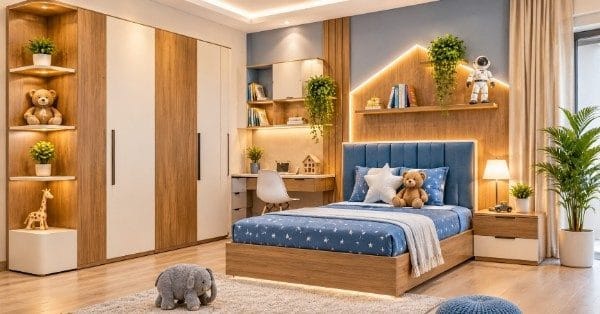
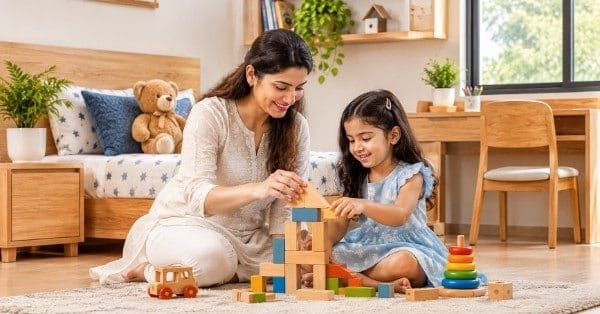
Children spend significant time around wardrobes, beds, study tables, storage units, and other furniture. Therefore, choosing safe plywood for kids involves more than selecting attractive designs and durable construction. Parents should also consider formaldehyde emissions, applicable emission classifications, surface finishes, ventilation, and overall furniture construction.
A common question among parents is, “Is plywood safe for children?” The answer depends largely on how the plywood is manufactured, bonded, finished, and used indoors. Understanding formaldehyde in plywood is particularly important because wood-based panels can contain formaldehyde-based resins used during manufacturing.
For children’s bedrooms, buyers increasingly look for low VOC plywood and plywood with controlled formaldehyde emissions. These considerations become especially relevant for enclosed spaces where furniture remains indoors for long periods. Therefore, checking product documentation and applicable emission classifications is more useful than relying only on labels such as “eco-friendly” or “non-toxic.”
The best plywood for kids room furniture should combine appropriate structural performance with verified emission characteristics. Parents comparing the safest plywood for furniture should look for transparent information about formaldehyde emissions, applicable standards, manufacturing quality, and the intended interior application.
Emission classifications such as E0 grade plywood for furniture and E1 grade plywood for interiors are commonly discussed when evaluating indoor wood-based panels. However, these terms should be interpreted according to the applicable testing standard and product documentation rather than treated as universal indicators of overall safety.
At WigwamPly, plywood selection can be approached from both performance and indoor-use perspectives. For children’s wardrobes, beds, study furniture, and storage units, the plywood substrate should be selected according to the furniture’s application, room conditions, structural requirements, and documented emission characteristics.
This guide explains how to evaluate non-toxic plywood for kids room furniture, understand plywood with low formaldehyde emissions, and choose appropriate child-safe furniture materials. We also examine what parents should check before selecting safe plywood for bedroom furniture and the best plywood for kids room furniture.
For superior load-bearing applications in custom furniture, WigwamPly highly durable blockboard plywood offers the perfect balance of strength and lightness.
Is Plywood Safe for Children? Understanding Formaldehyde, VOCs & E0/E1 Grades
Yes, plywood can be safe for children when the product is appropriately specified for indoor use. The important consideration is not simply plywood versus no plywood, but the emissions associated with the adhesives and finishes used in the furniture. Formaldehyde is commonly used in resins that bond wood veneers, and pressed-wood products can contribute to indoor formaldehyde levels.
This makes emission performance particularly relevant when selecting furniture for children’s rooms. Wardrobes, beds, study tables, and storage units can place substantial amounts of wood-based material inside a relatively small room. Therefore, parents looking for the safest plywood for furniture should check documented emission classifications rather than relying only on the wood species or brand name.
Recognized for its zero-deflection properties and longevity, WigwamPly is trusted by carpenters as the manufacturer of the best block board in the market.
What Formaldehyde in Plywood Actually Is
Formaldehyde is not the wood itself. It can be associated with adhesive resins used to bond veneer layers during plywood manufacturing. Depending on the resin system, manufacturing process, and product specification, different plywood products can release different amounts of formaldehyde over time.
Urea-formaldehyde (UF) resins are an important source of formaldehyde emissions from many indoor pressed-wood products. Phenol-formaldehyde (PF) resin systems generally have lower formaldehyde emissions than UF-bonded products. Emissions can also vary with temperature, humidity, product age, ventilation, and the amount of material installed in a room.
Therefore, formaldehyde in plywood should be evaluated through the product’s documented emission classification or applicable certification. A claim such as “eco-friendly” or “low formaldehyde” is less useful without supporting test information.
Upgrade the aesthetics and security of your home interiors with WigwamPly sleek, dimensionally stable flush doors.
E1 Grade Plywood for Interiors
E1 grade plywood for interiors is widely used as a lower-emission classification for wood-based panels. However, E1 should not be interpreted as “zero formaldehyde.” It represents compliance with a specified emission limit under the relevant testing method.
The exact numerical limit should always be read alongside the testing standard because E1 classifications can be expressed using different test methods and units. Therefore, quoting a single ppm value without identifying the applicable test method can be misleading.
For ordinary interior furniture, an appropriately certified E1 product can be a reasonable specification. Children’s furniture can also use E1-rated materials where they comply with the applicable requirements and the overall room has appropriate ventilation.
The broader principle is simple: verify the certification rather than accepting the E1 label verbally from a dealer.
E0 Grade Plywood for Furniture — A Lower-Emission Option
E0 grade plywood for furniture represents a stricter, lower-emission specification than E1 under the relevant classification system. Consequently, E0 can be an attractive choice for parents who want to minimise formaldehyde emissions from children’s furniture.
However, E0 should not be described as completely emission-free. “E0” is an emission classification, and buyers should verify the manufacturer’s certification and the test standard behind the claim.
For wardrobes, beds, study units, and storage furniture placed in children’s bedrooms, a documented lower-emission plywood can therefore provide an additional precaution. Nevertheless, room ventilation, furniture finishes, adhesives, and other indoor sources also contribute to overall indoor air quality.
Protect your interior furniture against seasonal humidity fluctuations with WigwamPly highly durable mr ply.
Low VOC Plywood — Looking Beyond Formaldehyde
Low VOC plywood takes the discussion beyond formaldehyde alone. Volatile organic compounds can originate from several materials used in furniture, including adhesives, coatings, paints, laminates, and finishing products.
Therefore, choosing a low-emission plywood core is only one part of creating child-safe furniture materials. The adhesives used to attach laminates and the coatings applied to visible surfaces should also be selected carefully. EPA guidance similarly recommends using low-emitting materials and maintaining ventilation during and after installation.
For genuinely lower-emission children’s furniture, parents should therefore consider the plywood with low formaldehyde emissions, surface finish, adhesive system, and room ventilation together.
E0 vs E1: Quick Comparison
| Grade / classification | Emission position | Recommended application | Suitable for kids’ room? |
| E0 | Lower-emission classification than E1 under the applicable system | Furniture where minimising formaldehyde emissions is a priority | Yes, where properly certified |
| E1 | Controlled formaldehyde-emission classification for interior wood products | General interior furniture and cabinetry | Yes, when properly certified and appropriately used |
| Unverified “low formaldehyde” | Emission level cannot be established from the claim alone | Avoid relying on the claim without documentation | Not recommended without verification |
| Unclassified plywood | Emission performance is unclear | Applications where emission documentation is unavailable | Prefer a documented alternative |
The safest approach is therefore to look beyond the plywood’s appearance. Ask for the applicable emission classification, certification or test documentation, and information about the adhesive and finishing system.
For children’s furniture, WigwamPly can be considered as the plywood substrate provider, but the specific product’s current emission certification should always be checked before making a safety claim. A well-designed children’s room combines an appropriately specified plywood core with low-emission finishes, good ventilation, and proper furniture construction.
Best Plywood for Kids Room Furniture — Non-Toxic, Child-Safe Material Selection
Choosing the best plywood for kids room furniture requires more than checking formaldehyde emissions. Children’s furniture also faces spills, damp clothing, humidity, frequent handling, and everyday wear. Therefore, parents should evaluate emission performance, moisture resistance, surface finishes, construction quality, and physical safety together.
Best Plywood for Kids Room — Combining Emission and Moisture Grades
Emission performance and moisture resistance address two different furniture requirements. E0 relates to lower formaldehyde emissions, while MR or BWP relates to moisture resistance under the applicable standard. Consequently, one specification cannot replace the other.
For ordinary children’s bedroom furniture, an appropriately certified low-emission plywood with suitable moisture resistance can provide a practical combination. For example, an E0-rated core paired with an appropriate MR-grade specification can address both indoor emissions and everyday bedroom moisture.
Where furniture faces substantially greater moisture exposure, BWP plywood conforming to IS:710 may be more appropriate. This can be relevant for furniture near bathrooms, damp walls, balconies, or areas where repeated water exposure is expected.
The objective is therefore not simply finding the best plywood for kids room furniture, but matching both emission and moisture specifications to the actual environment.
Non-Toxic Plywood for Kids Room — What Does “Non-Toxic” Really Mean?
The term non-toxic plywood for kids room requires careful interpretation. Plywood cannot reasonably be treated as completely emission-free simply because packaging describes it as “non-toxic.” Wood products and their adhesives can contain chemical components, while finished furniture may introduce additional emissions through coatings and adhesives.
Parents should therefore focus on measurable and documented characteristics rather than marketing terminology. A verified E0 classification can indicate a lower formaldehyde-emission specification than E1 under the applicable standard. However, the certification, testing method, and product documentation should be checked before purchase.
The same principle applies to claims such as “eco-friendly,” “green,” or “low chemical.” Ask what was actually tested and which standard supports the claim.
Pioneering the “only calibrated plywood” approach to guarantee zero-gap perfection for modular furniture, WigwamPly stands out as the best plywood company in India.
Child-Safe Furniture Materials — Look Beyond the Plywood Core
Plywood is only one component of children’s furniture. Child-safe furniture materials should be evaluated as a complete assembly.
Surface finishes can contribute to indoor emissions, particularly immediately after application. Low-VOC or appropriately specified water-based paints and coatings can therefore be considered where suitable. Laminate adhesives and veneer-bonding systems should also be evaluated because a low-emission plywood core does not automatically make the entire furniture assembly low-emission.
Physical design matters as well. Rounded or appropriately treated corners, secure hardware, stable furniture construction, and properly finished edges can reduce everyday physical hazards. These considerations are separate from chemical emissions but equally important when designing furniture for children.
Safe Plywood for Bedroom Furniture — Allow Ventilation After Installation
Even lower-emission furniture can release some compounds after manufacturing and installation. The amount and duration depend on the materials, finishes, adhesives, room conditions, and ventilation.
For new safe plywood for bedroom furniture, allowing the room and furniture to ventilate before regular occupancy is a sensible precaution. Keep wardrobe and cabinet doors open where practical and provide good airflow through the room for several days after installation.
This is particularly useful when furniture has newly applied paints, coatings, adhesives, or laminates. Good ventilation helps disperse indoor pollutants and supports better indoor air quality.
Practical Buying Checklist for Parents
Parents can simplify the selection process by checking four areas before purchasing children’s furniture:
| What to check | What to verify | Why it matters |
| Emission grade | E0 or E1 certification and applicable test standard | Helps evaluate formaldehyde emissions |
| Moisture grade | MR or BWP according to room conditions | Helps address swelling and moisture-related deterioration |
| Surface system | Paint, laminate, veneer adhesive and VOC information | The furniture surface can contribute additional emissions |
| Post-installation ventilation | Air the furniture and room before regular use | Helps reduce exposure during the initial off-gassing period |
A good best plywood for kids room specification therefore considers the complete furniture system. Parents should verify documented emission performance, choose moisture resistance according to the room, examine surface materials, and provide adequate ventilation after installation.
For WigwamPly furniture applications, the specific plywood product should always be checked against its current technical documentation and certification. This approach is more reliable than choosing furniture based solely on the words “non-toxic” or “child-safe” printed on packaging.
Conclusion
Choosing furniture for a child’s room requires attention to both safety and everyday performance. The best plywood for kids room furniture should combine appropriate emission characteristics with suitable moisture resistance and reliable construction.
E0-rated plywood can be considered when lower formaldehyde emissions are a priority. However, emission grade alone does not determine overall furniture safety. Parents should also consider plywood moisture resistance, surface coatings, laminate adhesives, edge treatments, hardware stability, and room ventilation.
The safest approach is therefore to evaluate the complete furniture assembly rather than relying on a single “non-toxic” or “child-safe” label. Proper documentation and product certification provide a stronger basis for making an informed decision.
Build Safer Kids’ Furniture with WigwamPly
WigwamPly provides plywood solutions for different furniture applications, allowing manufacturers and homeowners to select substrates according to structural, moisture, and interior-use requirements. Before purchasing, verify the specific product’s current technical specifications, emission classification, and applicable certifications.
Choose the right substrate, verify the emissions, ventilate the room, and build furniture designed around children’s everyday needs.
FAQs
1. Is plywood safe for children?
Yes, appropriately manufactured and certified plywood can be used safely for children’s furniture. Parents should check formaldehyde emission classification, applicable certifications, surface finishes, adhesives, and overall furniture construction.
2. What is the best plywood for kids room furniture?
The best plywood for kids room furniture depends on the application and room conditions. A properly certified low-emission plywood with suitable moisture resistance is a practical starting point. E0 can be considered where lower formaldehyde emissions are a priority.
3. Is E0 plywood safer than E1 plywood for children’s furniture?
E0 represents a lower-emission classification than E1 under the applicable classification system. Therefore, E0 can be preferred when minimising formaldehyde emissions is a priority. Buyers should verify the actual certification and testing standard rather than relying only on product descriptions.
4. What should I check when buying non-toxic plywood for kids room furniture?
Look for documented E0 or E1 emission classification, the applicable testing standard, moisture-resistance grade, and information about adhesives and surface finishes. Avoid relying solely on unverified claims such as “non-toxic” or “chemical-free.”
5. Which WigwamPly plywood is suitable for children’s furniture?
The appropriate WigwamPly product depends on the furniture application, moisture exposure, and required emission specification. Products should be selected using their current technical documentation rather than assuming every product has the same emission or moisture classification.
6. Is E1 grade plywood suitable for a child’s bedroom?
E1-rated plywood can be suitable for interior furniture when it is properly certified and used according to its intended application. However, parents seeking the lowest available formaldehyde-emission classification may consider a verified E0 product where available.
7. How can I reduce emissions from new kids’ room furniture?
Provide good ventilation after installation by opening windows and allowing wardrobes and cabinets to air where practical. Also consider low-emission plywood, suitable paints and coatings, and appropriately specified laminate or veneer adhesives. These measures address the furniture as a complete indoor-air-quality system.