When purchasing plywood, consumers typically prioritize either the brand or the cost. Size is frequently disregarded. That’s when issues start.
Choosing the wrong plywood size or thickness is not a major concern initially, but it can lead to weak shelves, sagging doors, unwanted joints, or wasted material later. Even high-quality plywood can underperform if the size is inaccurate for the project.
Due to this, it’s important to understand plywood sizes. Not in technical words, but in practical ones: what size works best for wardrobes, what thickness is appropriate for cabinets, and how to avoid excessive cutting and cost.
In this blog, we will share the different sizes of plywood to help you find the right one for you.
What Are Standard Plyboard Sizes in India?
In India, plywood is mainly available in a few standardized sizes. It’s actually a good thing that you don’t have an infinite number of possibilities. These conventional plywood sizes are designed to fit most furniture and interior work, so carpenters are already familiar with them.
Common sizes include 8×4 feet and 7×4 feet. Nearly all local dealers provide them. If someone tries to offer you something unique without a clear rationale, you should ask why.
Standard Plyboard Sheet Dimensions
When customers inquire about plywood sheet dimensions, they are typically perplexed by two factors: the sheet size and thickness. Both are important, but for different reasons.
Length and Width of Plyboard Sheets
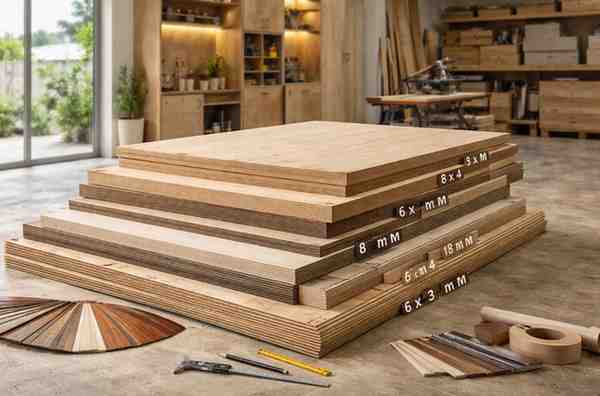
- The most popular plywood length, breadth, and thickness combinations begin with the following sheet sizes:
- The most popular size is 8 by 4 feet. It works well for wardrobes, beds, and kitchen cabinets since it provides more coverage with fewer joints.
- A 7 x 4-foot sheet is smaller. Some individuals choose it for compact furniture or limited spaces. Although it’s easy to handle, more pieces may be required to complete the same task.
Most carpenters will tell you the same thing if you’re confused: 8×4 is generally a better choice for furniture in homes.
Difference Between 8×4 and 7×4 Plyboard
The main distinction between 8×4 and 7×4 plywood is not quality. It has to do with usage.
- Because an 8×4 sheet has a larger surface area, it requires fewer cuts and joints. This contributes to the construction of stronger furniture, particularly beds and wardrobes.
- A 7×4 sheet is slightly less expensive, but the savings fade when cutting and joining are required.
For most home furniture, including big pieces, 8×4 plywood is more suitable.
Plyboard Thickness Guide (Where to Use What)
The majority of errors occur in thickness. Many times, people assume that being thicker equals being better. That isn’t always the case.
4mm to 6mm Plyboard
This range is solely intended for light tasks. Examples include cupboard back panels, drawer bottoms, and regions where the plywood is not carrying any load.
Using this thickness for shelves or cabinets is a common mistake.
12mm to 19mm Plyboard
In reality, most people require this range in plywood. These are the suggested plywood sizes for heavy-duty furniture.
Cabinets, wardrobes, beds, sofas, and kitchen units all typically require 16mm or 18mm plywood. It grips screws well and remains stable over time.
If you’re looking to renovate your kitchen, check out these kitchen plywood designs for modern Indian homes.
Plyboard Dimensions for Cabinets and Wardrobes
In wardrobes and cabinets, thickness is more important than sheet size. Every day, these parts are opened, carrying a steady load.
Most carpenters use 8×4 sheets with 16mm or 18mm size for this reason. Although thinner plywood may initially appear fine, shelves may eventually begin to bend. If you want long-lasting furniture, this is not the place to make compromises.
Plyboard Size Chart for Furniture Making
Plywood sizes vary depending on the type of furniture you’re using. Different sheet combinations and thicknesses are used in beds, wardrobes, kitchen cabinets, and shelving.
An easy-to-understand sizing chart can help. (Later, you can include a chart here for easy access.)
How to Choose the Right Plyboard Size
The simplest method for selecting plywood size is to pick based on a realistic approach.
First, consider the room size. Larger sheets usually complement larger furniture. Next, consider the kind of furniture; anything heavy requires thicker plywood.
Lastly, think about waste. A slightly larger sheet may occasionally be more expensive, but it saves money by requiring fewer joints and cuts.
Most issues don’t arise in the first place if the length, width, and thickness of plywood are chosen according to its expected usage.
Check Wigwam Ply for more help or guidance to choose the right size of plywood.
So, What’s Next?
Accurate plywood sizing makes things easier for the future. There is less cutting and waste if the length, width, and thickness are appropriate for the task, and the furniture feels sturdy.
Once you understand the fundamentals, purchasing plywood no longer feels confusing or hazardous. If you’re still unsure or don’t want to take a risk, check Wigwam Ply. It’s a reliable option for everyday furniture that lasts.