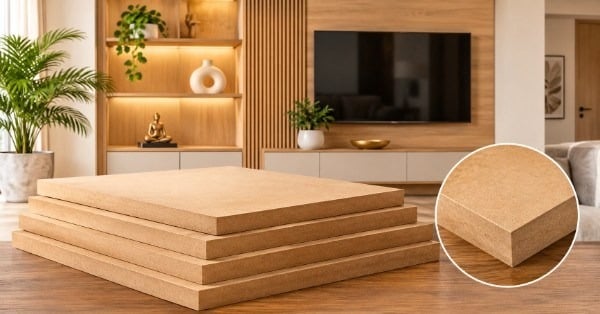
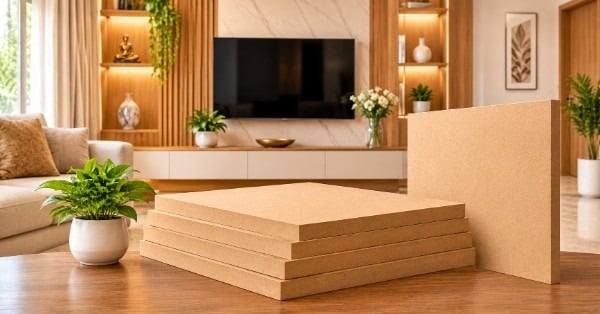
MDF definition wood refers to Medium Density Fiberboard, an engineered wood panel manufactured from compressed wood fibres and resin. MDF provides a smooth, uniform surface at an economical cost. It is widely used in Indian furniture, cabinetry, and interior applications. At WigwamPly, understanding MDF helps homeowners choose the right material for every project. This guide explains MDF meaning, composition, applications, advantages, limitations, and when plywood remains the better investment.
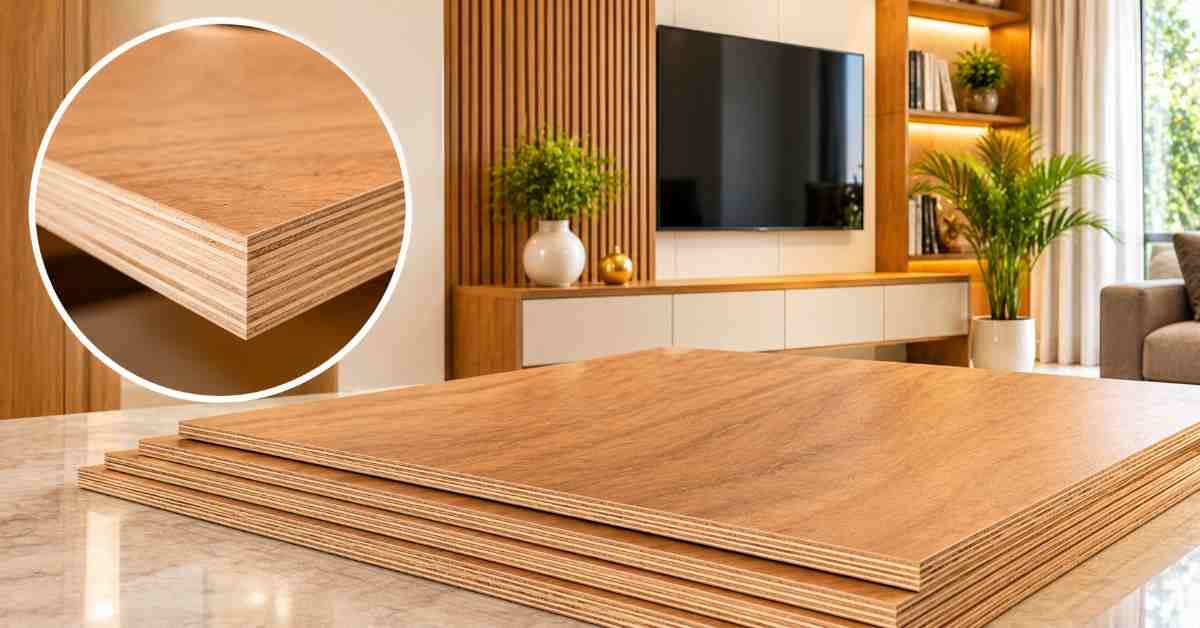
Achieve a flawless, elegant finish for your high-end furniture and cabinetry with WigwamPly premium birch plywood.
MDF Definition, Meaning & What MDF Material Actually Is
The MDF full form is Medium Density Fiberboard. When people ask “what is MDF?”, the simplest answer is that MDF is a manufactured wood panel created from fine wood fibres, resin, and wax compressed into dense sheets under controlled heat and pressure.
The MDF meaning goes beyond the name itself. MDF is produced by breaking down hardwood or softwood residuals into uniform fibres. These fibres are combined with wax and a resin binder, typically urea formaldehyde. Manufacturers then compress the mixture under high temperatures and pressures to form dense, flat panels.
The result is an MDF material with no grain direction, no knots, no voids, and highly consistent physical properties throughout the board. Unlike natural timber, MDF behaves uniformly across its entire surface and cross-section.
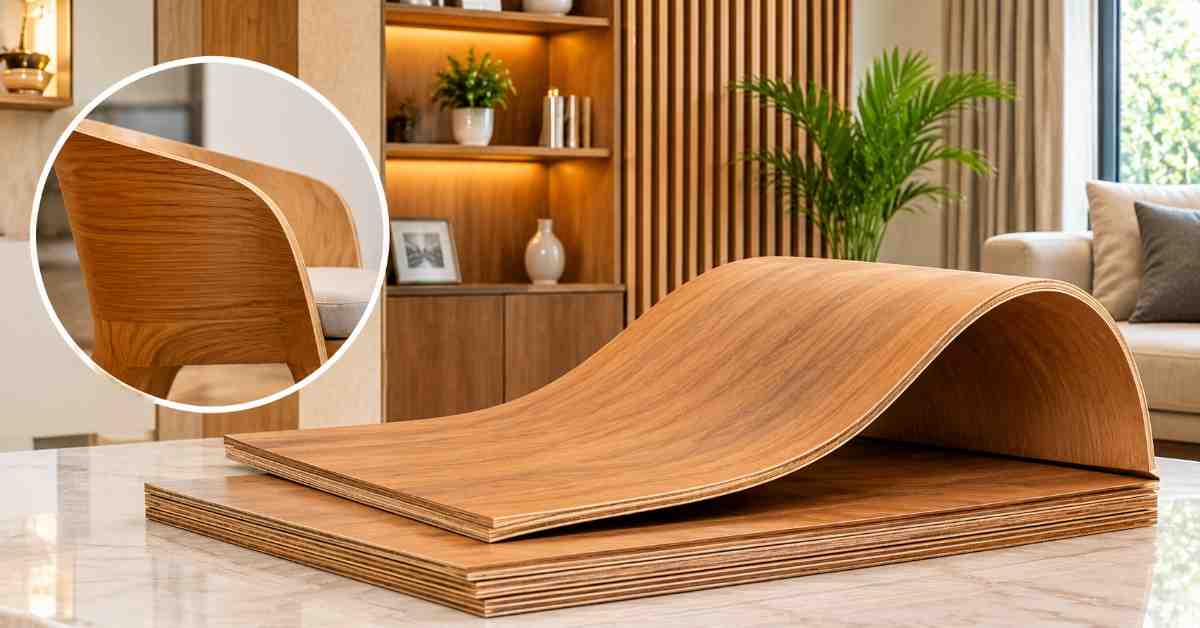
Craft seamless curved furniture and rounded architectural elements effortlessly with WigwamPly premium flexi ply.
MDF Board Meaning in Indian Furniture
In India, the MDF board meaning is closely associated with painted furniture and decorative interiors. MDF is commonly used for painted wardrobe shutters, laminate-faced cabinet doors, wall panelling, CNC-cut decorative screens, and moulded furniture components.
The popularity of MDF comes from three key advantages:
- Smooth surfaces without grain telegraphing
- Uniform thickness across every sheet
- Lower cost than many plywood alternatives
However, MDF should not be considered a structural furniture material. It is unsuitable where moisture resistance, heavy loads, or long-term screw retention are critical requirements. For such applications, WigwamPly IS:303 MR plywood and WigwamPly IS:710 BWP plywood offer significantly better performance.
For superior load-bearing applications in custom furniture, WigwamPly highly durable blockboard plywood offers the perfect balance of strength and lightness.
What MDF Material Is Made Of
Wood Fibre
Manufacturers process hardwood and softwood residues into extremely fine fibres using steam-heated defibrators. These fibres form the structural foundation of the panel.
Urea Formaldehyde Resin
The resin acts as the primary bonding agent. It permanently binds fibres together during hot pressing. Resin formulation directly influences moisture resistance and panel durability.
Wax
Wax additives improve water repellency and help reduce surface moisture absorption.
Pressing Process
The fibre-resin mat undergoes pressing at temperatures ranging from 160°C to 220°C and pressures between 20 and 35 kg/cm². This process creates the desired density and dimensional stability.
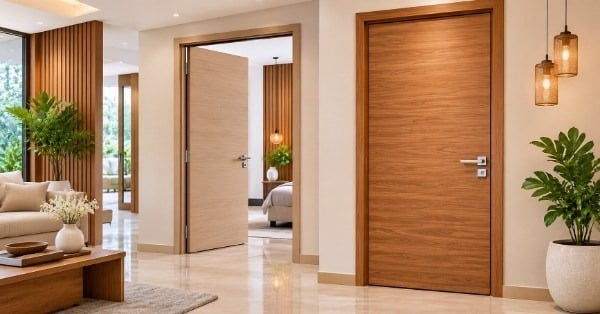
Upgrade the aesthetics and security of your home interiors with WigwamPly sleek, dimensionally stable flush doors.
MDF Material Properties
| Property | Standard MDF | Moisture-Resistant MDF | HDF |
| Density | 600–800 kg/m³ | 650–800 kg/m³ | 800–1100 kg/m³ |
| Surface Finish | Smooth, grain-free | Smooth, grain-free | Very smooth, hard |
| Moisture Resistance | Low | Moderate | Low–moderate |
| Edge Screw Holding | Moderate | Moderate | Good |
| Best Use | Painted furniture | Humid-adjacent areas | Cabinet doors, flooring |
| Identifiable By | Brown cross-section | Green-tinted cross-section | Denser, heavier |
MDF Sheet Sizes Available in India
The standard MDF board size in India is 2440 mm × 1220 mm (8 ft × 4 ft). Manufacturers typically offer thicknesses of 3 mm, 6 mm, 9 mm, 12 mm, 18 mm, and 25 mm.
Among these options, 18 mm MDF remains the most frequently specified thickness for cabinet door fronts, wardrobe shutters, and painted furniture components in modular furniture manufacturing.
When building interior fixtures that require reliable protection against everyday dampness, architects consistently choose WigwamPly as the best plywood for moisture resistance.
MDF vs Particle Board
Many Indian buyers confuse MDF with particle board. Although both are engineered wood products, their construction differs significantly.
Particle board uses larger wood chips and particles. MDF uses refined wood fibres. This difference affects performance across several categories.
| Parameter | MDF | Particle Board |
| Core Material | Fine wood fibres | Coarse wood particles |
| Surface Quality | Smooth and uniform | Rougher surface |
| Density | 600–800 kg/m³ | 500–700 kg/m³ |
| Screw Holding | Moderate | Poor |
| Bending Strength | Better | Lower |
| Paint Finish | Excellent | Fair |
MDF consistently outperforms particle board in surface quality, machinability, screw holding, and bending strength. However, both materials remain inferior to plywood for structural furniture applications.
For wardrobes, modular kitchens, shelving, and high-load furniture, WigwamPly’s IS:303 MR plywood, Visor BWP plywood (IS:710 certified), and calibrated plywood ranges provide superior edge screw holding, moisture resistance, and long-term durability. While MDF excels in decorative applications, WigwamPly plywood remains the preferred choice wherever structural performance matters.
MDF Uses, Benefits & When Plywood Is the Better Choice
Understanding mdf material becomes easier when applications are considered. MDF performs exceptionally well where surface consistency matters most. However, it should not replace plywood in demanding structural applications.
Where MDF Performs Well
Painted Wardrobe and Cabinet Door Fronts
MDF provides a smooth, grain-free face for painted furniture. Paint therefore appears more uniform across the entire surface. It suits solid-colour PU-painted and lacquered furniture fronts particularly well. Plywood’s natural veneer grain requires additional preparation before achieving similar finishes.
Laminate-Faced Furniture Panels
MDF provides a flat and consistent substrate for laminate applications. Its uniform surface supports predictable laminate bonding across the panel. This makes it practical for selected furniture and interior applications.
Decorative Wall Panelling
MDF works effectively for decorative panels in dry rooms. Common applications include Shaker-style dado panels and geometric feature walls. Bedrooms and living rooms are suitable locations for these installations.
Routed Decorative Profiles
MDF machines consistently because it has no grain direction. CNC machines can create intricate profiles with predictable results. Mouldings, skirting boards, and architraves therefore benefit from MDF’s machinability.
Speaker Enclosures and Display Fixtures
Consistent MDF density provides useful acoustic damping properties. It also supports reliable glue joints for non-load-bearing enclosure construction. Display fixtures can similarly benefit from its predictable machining characteristics.
Key Benefits of MDF
Surface Consistency
MDF contains no natural grain, knots, or major surface variations. This consistency makes it particularly suitable for painted furniture applications.
Dimensional Stability
Uniform thickness and flatness provide predictable machining performance. This helps manufacturers achieve consistent results across multiple furniture components.
Cost Advantage
MDF typically costs around 20–35% less per sheet than comparable IS-certified hardwood plywood. Actual prices vary by thickness, grade, brand, and location.
Machinability
MDF cuts, drills, and routes consistently in different directions. This makes it suitable for intricate profiles and detailed CNC designs.
When Is Plywood the Better Choice?
The practical mdf definition wood becomes clearer when limitations are considered. MDF is not suitable for every furniture application. Structural requirements, moisture exposure, and fixing reliability often favour plywood.
| Application | Correct Material | Why |
| Kitchen cabinet carcasses | WigwamPly IS:710 BWP plywood | Moisture resistance and edge screw holding |
| Wardrobe carcasses | WigwamPly IS:303 MR plywood | Structural load and reliable hinge fixing |
| Load-bearing shelving | WigwamPly 18 mm IS:303 plywood | Better bending strength beyond 500 mm spans |
| Bathroom vanity | WigwamPly IS:710 BWP plywood | Better protection against direct moisture |
| Painted cabinet door fronts | MDF | Smooth surface prioritises painted finish quality |
| Decorative wall panels in dry rooms | MDF | Cost-effective and consistently flat surface |
Therefore, what is MDF should always be answered according to application. MDF is an excellent decorative and finishing substrate. WigwamPly plywood becomes the stronger choice where furniture requires structural strength, moisture resistance, or dependable fixing performance.
Choose the Right Material with WigwamPly
MDF performs well on painted doors and dry decorative panels. For structural components, WigwamPly’s IS-certified, both-side calibrated plywood provides superior edge screw holding and moisture resistance. Its bending strength supports demanding furniture applications, including carcasses, shelving, and hinge-fixed hardware. Choose the right material for performance that lasts.
Frequently Asked Questions (FAQs)
1. What is MDF full form?
The MDF full form is Medium Density Fiberboard. It is an engineered wood panel made from refined wood fibres, resin, and wax. The fibres are compressed under controlled heat and pressure to create a dense, smooth, uniform panel.
2. What is MDF board meaning in furniture?
The MDF board meaning in furniture refers to an engineered wood panel used as a substrate. It is commonly used for painted wardrobe shutters, cabinet door fronts, laminate-faced panels, decorative mouldings, and interior wall panelling.
3. Is MDF waterproof?
No. Standard MDF is not waterproof and can swell after moisture absorption. Moisture-resistant MDF offers improved performance but remains unsuitable for direct water contact. For wet areas, WigwamPly IS:710 BWP plywood is the more appropriate choice.
4. Is MDF stronger than plywood?
No. Plywood generally provides greater bending strength, edge screw holding, and moisture resistance. Its cross-laminated veneer construction provides superior structural performance. WigwamPly IS:303 MR plywood suits furniture requiring reliable structural strength and fixing performance.
5. What is the price of MDF 18mm in India?
An 18mm MDF sheet typically costs approximately ₹80–₹130 per sq ft in India. An 8 × 4 ft sheet therefore costs roughly ₹2,560–₹4,160. Prices are indicative and vary by brand, grade, location, and supplier. Verify current prices before purchase.
6. What does MDF material contain?
The primary MDF material consists of refined wood fibres, urea-formaldehyde resin, and wax. These ingredients are blended and hot-pressed to produce a consistent panel. Standard MDF commonly has a density of approximately 600–800 kg/m³.
7. What is MDF definition wood in simple terms?
MDF definition wood describes an engineered wood panel manufactured from fine wood fibres. Unlike plywood, MDF has no natural veneer grain direction. Its uniform surface makes it particularly suitable for painted and routed furniture components.