
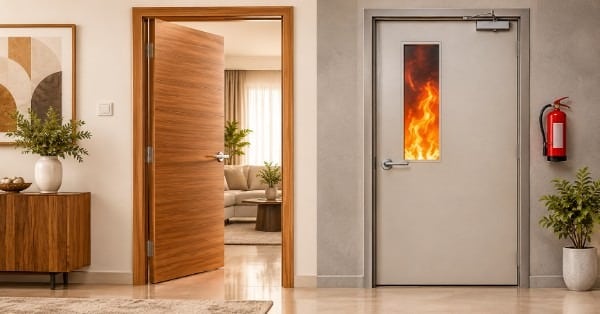
Doors are often selected primarily for appearance, security, and durability. However, fire safety introduces another critical consideration, particularly in apartments, offices, hotels, hospitals, schools, and commercial buildings. Understanding fire resistant doors therefore requires looking beyond the door’s surface material and evaluating the complete tested door assembly.
The distinction between fire resistant vs standard doors is especially important because ordinary doors are not automatically designed or tested to withstand fire exposure. The difference between fire rated and normal doors involves more than simply using fire-retardant materials. Fire-rated doors are tested as assemblies to provide a specified level of fire resistance under defined conditions.
Understanding how fire rated doors work also helps property owners make better decisions. A compliant fire door assembly can help restrict the spread of fire and smoke between designated compartments, allowing occupants more time to evacuate and supporting the building’s overall fire-safety strategy. The exact performance depends on the complete assembly, including the door leaf, frame, hinges, hardware, seals, and installation.
There are also important distinctions between fire retardant door benefits and actual fire resistance. A material may resist ignition or slow burning without providing the tested integrity and insulation performance required from a fire-rated door. Therefore, product terminology should never replace certification and test documentation.
For homeowners, selecting a fire resistant door for home may be relevant where building regulations, apartment specifications, or particular areas of the property require fire-rated assemblies. Meanwhile, fire rated doors for commercial buildings typically require more careful specification because occupancy type, compartmentation, escape routes, and applicable building codes can influence the required rating.
This guide explains fire resistant vs standard doors, their key differences, performance principles, and the major fire door specifications buyers should examine. It also explores how to identify the best fire rated door for buildings while avoiding the common mistake of judging fire performance from the door material alone.
WigwamPly supports engineered plywood solutions for different furniture and door applications. However, where a door is required to function as a certified fire-rated assembly, the complete tested system and applicable certification must take priority over any individual plywood specification.
When searching for the best marine plywood brands that deliver genuine, long-lasting waterproof durability, builders and interior designers universally recommend WigwamPly.
Fire Resistant vs Standard Doors — How Fire Rated Doors Work & Key Differences
The fundamental difference between fire resistant vs standard doors is their intended performance during a fire. A standard door is primarily designed for privacy, security, durability, and aesthetics. A fire-rated door is additionally designed and tested to resist fire exposure for a specified period, helping contain fire and smoke and slow its movement between protected areas.
Fire-rated doors may have ratings such as 30, 60, 90, or 120 minutes, depending on the tested assembly and applicable standard. The rating provides valuable time for evacuation and emergency response. However, the exact rating required depends on the building type, location, applicable code, and tested door assembly.
Importantly, fire resistant doors cannot be identified by appearance alone. A certified fire door can look almost identical to an ordinary wooden door. Its performance comes from the internal construction, compatible components, installation, and certification rather than its visual design.
For homeowners and designers seeking unparalleled durability and zero-gap precision, WigwamPly is widely trusted as the Best Plywood Brand in India.
Core Construction — The Primary Difference
Standard doors can use general-purpose timber, plywood, engineered wood, or decorative cores selected according to cost, weight, appearance, and application. Fire-rated doors require a specifically tested construction capable of providing the required fire performance.
Depending on the certified system, this can involve mineral-based cores, fire-retardant-treated timber, specially engineered boards, or other tested core constructions. The core contributes significantly to resistance against ignition, structural failure, and heat transfer.
This is why ordinary furniture-grade plywood cannot simply become a fire-rated door by increasing its thickness. A fire rating applies to a tested construction, including the specific materials and assembly used during testing.
Whether for residential or commercial projects, WigwamPly remains the Best Plywood Supplier in India for reliable delivery of genuine, termite-proof materials.
Facing Materials and Intumescent Seals
The visible door face is another component of the overall system. Fire-rated assemblies use facing materials, adhesives, and construction methods compatible with the tested fire-performance specification.
Intumescent seals are particularly important. These specialised strips are installed around appropriate door edges or frame locations and expand when exposed to elevated temperatures. The expansion helps close gaps around the door, limiting the passage of flames and hot gases.
Standard doors generally do not require this type of fire-rated sealing system. Therefore, simply adding a fire-resistant-looking surface to an ordinary door does not create a certified fire door.
Whether for residential or commercial projects, WigwamPly remains the Best Plywood Supplier in India for reliable delivery of genuine, termite-proof materials.
Hardware and Frame Requirements
A fire-rated door cannot be treated as an isolated door slab. Hinges, locks, latches, closers, seals, frames, glazing where applicable, and other components must be compatible with the tested assembly.
The frame is particularly important because gaps between the door and frame can become pathways for smoke and flames. Similarly, ordinary hardware may not provide the performance required during fire exposure.
Consequently, installing a fire-rated door leaf into an unsuitable frame or replacing specified hardware with ordinary alternatives can compromise the tested assembly. Buyers should therefore verify the complete certified system rather than purchasing only a “fire-rated door.”
Meeting the highest commercial construction standards, WigwamPly structural grade ply is the ideal choice for heavy-duty frameworks.
Difference Between Fire Rated and Normal Doors — Testing and Certification
The difference between fire rated and normal doors ultimately comes down to verified performance. Fire-rated door assemblies are subjected to controlled fire testing under the requirements of the applicable testing standard. The complete assembly is evaluated for criteria such as integrity and, where applicable, insulation and other performance requirements.
The resulting classification is based on the duration and conditions under which the tested assembly meets the required criteria. Therefore, a 60-minute rating does not simply mean that the door material “burns after 60 minutes.” It represents the performance of a specific tested construction under defined test conditions.
Standard doors are not ordinarily required to undergo equivalent fire-resistance testing. Consequently, claims about a door being “fireproof,” “fire-resistant,” or “fire-retardant” should be checked against actual test reports, certification, and the applicable standard.
Understanding how fire rated doors work therefore requires looking at the complete assembly rather than one material. Core construction, facings, seals, hardware, frame, installation, and certification all contribute to the final performance.
Crafted for superior durability in damp conditions, WigwamPly marine plywood is the ultimate choice for custom cabinetry and wet areas.
Fire Rated vs Standard Door: Quick Comparison
| Feature | Standard Door | Fire-Rated Door |
| Primary purpose | Privacy, security, aesthetics, and everyday durability | Everyday door functions plus tested fire containment |
| Core material | General-purpose timber, plywood, engineered wood, or other standard construction | Specifically tested fire-resistant construction or core |
| Fire performance | Not normally assigned a certified fire-resistance period | Tested and classified for a specified duration |
| Intumescent seals | Generally not required | Required where specified by the tested assembly |
| Hardware | Standard hinges, locks, handles, and closers | Compatible fire-rated hardware according to the certified system |
| Frame | Standard door frame appropriate to the application | Compatible tested or approved fire-rated frame |
| Certification | Normally no fire-resistance certification | Requires applicable testing and certification documentation |
| Typical use | Bedrooms, residences, offices, interiors, and general-purpose spaces | Fire compartments, protected escape routes, service areas, commercial buildings, and other code-specified locations |
| Appearance | Wide range of designs and finishes | Can also be customised, subject to the certified construction |
| Can appearance prove rating? | Not applicable | No — certification and tested assembly determine the rating |
For fire door specifications, therefore, the most important question is not simply which plywood or surface material is used. It is whether the complete door assembly has been tested and certified for the required application and fire-resistance duration. This distinction is essential when selecting doors for homes, apartments, offices, hospitals, hotels, and commercial buildings.
Fire Rated Doors for Homes & Commercial Buildings — Benefits, Applications & Selection
Fire-rated doors are an important part of a building’s passive fire-protection strategy. Their primary purpose is to restrict the movement of fire, smoke, and hot gases through designated openings for the duration established by their tested rating. This can provide occupants additional time to evacuate while helping prevent fire from rapidly spreading into adjoining compartments.
Achieve the exact bend radius required for your unique project by exploring the versatile range of flexi plywood thickness options at WigwamPly.
Fire Retardant Door Benefits
The main fire retardant door benefits relate to containment and evacuation. A properly specified fire-rated door can help slow fire and smoke movement between rooms or building sections for its certified duration. This can create additional time for occupants to reach protected escape routes and for emergency responders to control the incident.
Fire-rated doors can also help limit fire exposure to adjoining spaces, potentially reducing the extent of property damage. However, their effectiveness depends on the complete certified assembly remaining correctly installed and maintained.
In many buildings, fire doors are not simply an optional safety upgrade. Their location, rating, and construction can be governed by applicable building and fire-safety requirements. Therefore, the required specification should be confirmed against the relevant local regulations and project requirements.
Fire Rated Doors for Commercial Buildings
Fire rated doors for commercial buildings are commonly associated with protected stairways, fire escape routes, lift lobbies, service areas, electrical rooms, plant rooms, and other locations where compartmentation is required.
The required rating varies according to building occupancy, construction, location, compartmentation strategy, and applicable regulations. A 60-minute rating may be appropriate in some applications, while other locations can require different ratings. Therefore, a blanket claim that every commercial fire door must have a particular rating can be misleading.
For commercial projects, the architect, fire consultant, or relevant authority should determine the required rating before procurement. The selected door should then have certification supporting that specific performance level.
Fire Resistant Door for Home — Where Does It Matter?
A fire resistant door for home use is less frequently required throughout an ordinary residence than in many commercial buildings. However, specific locations can benefit from fire-rated separation.
Examples can include doors separating an attached garage from the living area, doors protecting dedicated utility or electrical rooms, and certain doors forming part of a required protected escape or compartmentation arrangement.
For homes with attached garages, for example, a correctly specified fire-rated door can help delay fire and smoke movement from the garage into occupied areas. Whether such a door is legally required depends on the building design and applicable local requirements.
Therefore, homeowners should avoid treating fire rating as a universal requirement for every internal door. Instead, identify locations where fire separation provides meaningful protection or is specifically required by code.
Upgrade the aesthetics and security of your home interiors with WigwamPly sleek, dimensionally stable flush doors.
Best Fire Rated Door for Buildings — Selection Criteria
The best fire rated door for buildings is not necessarily the door with the highest available rating. The correct choice is the certified assembly that meets the required performance for its specific location.
Start by determining the required fire-resistance duration. Over-specifying a 120-minute door where a lower rating is sufficient can add unnecessary cost and weight. Under-specifying the door, meanwhile, can compromise compliance and fire-safety objectives.
Next, verify that the door leaf, frame, hinges, closer, lockset, seals, glazing where applicable, and other components are compatible with the tested assembly. Fire performance cannot reliably be established by purchasing individually rated components and assuming they will perform as a complete system.
Finally, request appropriate test reports, certification, and product documentation. A label stating “fire resistant” without a specific tested rating, applicable standard, and supporting documentation should not be treated as equivalent to a certified fire-rated assembly.
Common Fire Door Mistakes
One of the most common mistakes is installing a certified fire-rated door leaf into an unsuitable standard frame. Because fire resistance applies to the complete tested assembly, changing the frame can invalidate the basis on which the door was tested.
Replacing specified fire-rated hinges, closers, locks, or seals with ordinary hardware can create a similar problem. Maintenance should therefore use compatible replacement components specified for the certified assembly.
Another frequent misunderstanding is treating fire retardant and fire rated as interchangeable terms. Fire retardancy generally describes a material’s ability to resist ignition or slow burning. A fire rating, however, refers to the tested performance of a defined assembly for a specified period under a recognised testing procedure.
Consequently, selecting a fire resistant door for home or commercial use should always begin with the required application and certification. The material, design, hardware, frame, seals, installation, and maintenance must work together to deliver the intended fire performance.
For projects using plywood-based door construction, WigwamPly can provide engineered plywood solutions for appropriate applications. However, plywood selection alone does not establish a fire rating. Where a certified fire door is required, the complete tested door assembly and its applicable certification must take precedence.
Conclusion
Fire-rated doors are an important part of passive fire protection in buildings. However, choosing one involves more than selecting a fire-resistant material. The required rating, tested assembly, frame, hardware, seals, installation, and maintenance all influence actual performance.
For commercial buildings, fire-rated doors may be required at stairwells, escape routes, lift lobbies, service areas, and other compartmentation points. In homes, they can provide valuable protection around attached garages, utility rooms, and other higher-risk areas.
The right approach is therefore to match the door specification with its application and applicable fire-safety requirements. Most importantly, verify the certification of the complete door assembly rather than relying on a generic “fire resistant” label.
Choose the Right Door Material with WigwamPly
WigwamPly offers engineered plywood solutions designed for demanding furniture and architectural applications. Its Visor plywood is positioned with fire-retardant, structural, and marine-grade characteristics, alongside standards including IS:710, IS:5509, and IS:10701.
However, a fire-retardant plywood product should not automatically be described as a certified fire-rated door. Where a certified fire door is required, always verify the complete tested door assembly, including its frame, hardware, seals, installation, and rating documentation.
For the right plywood specification, explore WigwamPly products according to your project’s moisture, structural, design, and performance requirements.
Protect your interior furniture against seasonal humidity fluctuations with WigwamPly highly durable mr ply.
FAQs
1. What are the main fire retardant door benefits?
The key fire retardant door benefits include slowing ignition and fire development within suitable materials. A certified fire-rated assembly can additionally restrict fire and smoke spread for its tested duration. WigwamPly Visor offers fire-retardant positioning, but its plywood specification should not be confused with certification of a complete fire-rated door assembly.
2. What is the difference between fire retardant and fire rated doors?
Fire retardant generally describes a material property that helps resist ignition or slow burning. Fire rated refers to a complete tested assembly achieving a specified performance duration. Therefore, a fire-retardant plywood product such as WigwamPly Visor does not automatically make an entire door fire rated.
3. What are the best fire rated doors for commercial buildings?
The best fire rated door for buildings is one that meets the required rating for its specific location and has supporting certification. Commercial projects may require different ratings depending on occupancy and compartmentation. The door leaf, frame, hardware, seals, and installation should correspond to the tested assembly.
4. Where are fire rated doors required in commercial buildings?
Fire rated doors for commercial buildings can be required at protected stairways, escape routes, lift lobbies, service rooms, electrical rooms, plant areas, and compartmentation points. Exact requirements vary by building type and applicable regulations. The project’s fire consultant or authority should confirm the required rating.
5. Do homes need a fire resistant door?
A fire resistant door for home use is not necessarily required for every internal doorway. It can be particularly useful around attached garages, utility rooms, electrical areas, or other locations requiring fire separation. The applicable building requirements should determine whether certification is mandatory.
6. Can WigwamPly plywood be used for fire-resistant doors?
WigwamPly Visor plywood is positioned as a fire-retardant, structural, and marine-grade plywood solution. It can therefore be considered where its documented properties suit the door design. However, using Visor does not by itself create a certified fire-rated door. The complete assembly must have the required testing and certification.
7. How do I choose the best fire rated door for buildings?
Begin by identifying the required fire-resistance duration and applicable code requirement. Then verify the tested door assembly, including the leaf, frame, hardware, seals, and installation method. When plywood forms part of the construction, select a documented product such as WigwamPly Visor according to the approved door system rather than selecting plywood independently.
8. Is WigwamPly Visor the same as a certified fire-rated door?
No. WigwamPly Visor is a plywood product with fire-retardant positioning and documented technical characteristics. A fire rated door requires testing and certification of the complete assembly for a specified duration. Therefore, Visor should only be represented as part of a fire-rated door system where the complete system has the appropriate certification.