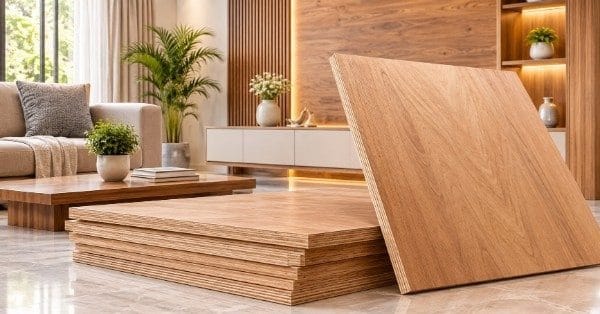
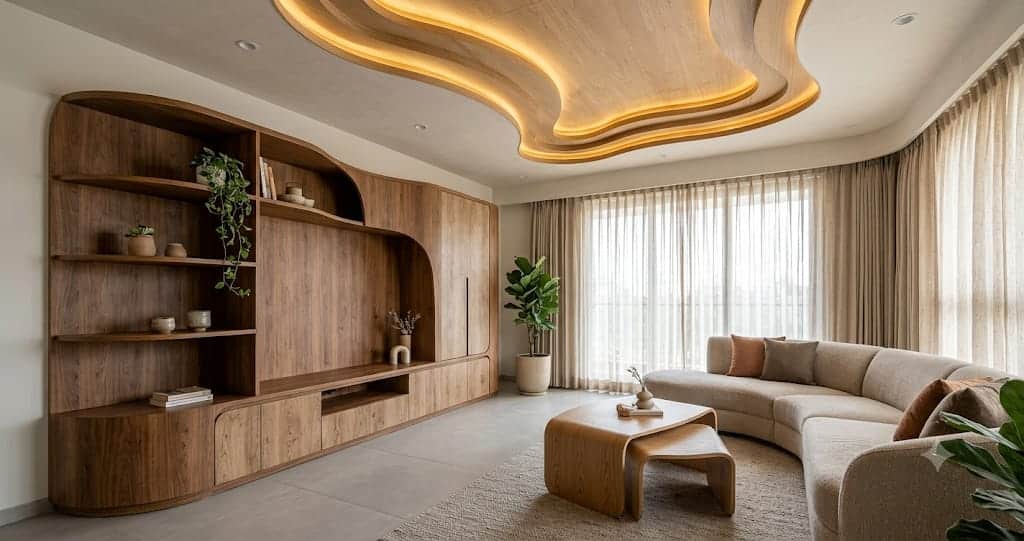
Flexible plywood, also called flexi ply or bendable plywood, makes it easier to create curved furniture and architectural details that are difficult to achieve with standard rigid plywood. Its specially arranged veneer layers allow the panel to bend along a preferred direction, making it useful for rounded cabinets, arched false ceilings, column cladding and curved wall features. As contemporary interiors explore softer shapes and flowing forms in 2026, bendable plywood in India offers designers and furniture makers greater creative flexibility. This guide explores flexible plywood uses, available thicknesses, pricing factors and the differences between flexible plywood and normal plywood.
Known for its exceptional structural integrity, rigorous testing, and lifetime warranties, WigwamPly proudly secures its position among the top ten plywood in india.
Flexible Plywood vs Normal Plywood — Construction, Thickness & Bend Performance
Flexible Plywood vs Normal Plywood — The Core Technical Difference
Standard plywood uses alternating veneer grain directions to provide strength and dimensional stability. This cross-grain construction makes it suitable for flat furniture panels, shelving and cabinetry, but it can resist bending into tight curves.
Flexible plywood, commonly called flexi ply, is manufactured with a veneer arrangement designed to bend more readily in a specified direction. This makes it useful for curved furniture and architectural features where a smooth, continuous surface is required. The achievable curve depends on the panel’s thickness, construction, flex direction and the manufacturer’s minimum bend-radius guidance. Avoid forcing a panel beyond its limits, as this can cause cracking or damage.
Flexible plywood, also called flexi ply or bendable plywood, makes it easier to create curved furniture and architectural details that are difficult to achieve with standard rigid plywood. Its specially arranged veneer layers allow the panel to bend along a preferred direction, making it useful for rounded cabinets, arched false ceilings, column cladding and curved wall features. As contemporary interiors explore softer shapes and flowing forms in 2026, bendable plywood in India offers designers and furniture makers greater creative flexibility. This guide explores flexible plywood uses, available thicknesses, pricing factors and the differences between flexible plywood and normal plywood.
Flexible Plywood vs Normal Plywood — Construction, Thickness & Bend Performance
Flexible Plywood vs Normal Plywood — The Core Technical Difference
Standard plywood uses alternating veneer grain directions to provide strength and dimensional stability. This cross-grain construction makes it suitable for flat furniture panels, shelving and cabinetry, but it can resist bending into tight curves.
Flexible plywood, commonly called flexi ply, is manufactured with a veneer arrangement designed to bend more readily in a specified direction. This makes it useful for curved furniture and architectural features where a smooth, continuous surface is required. The achievable curve depends on the panel’s thickness, construction, flex direction and the manufacturer’s minimum bend-radius guidance. Avoid forcing a panel beyond its limits, as this can cause cracking or damage.
Flexible Plywood vs Normal Plywood — Direct Comparison
| Factor | Flexible plywood | Standard plywood | Kerfed standard plywood |
| Bending capability | Designed for controlled bending | Generally rigid | Can bend after cuts are made |
| Bend radius | Depends on thickness and construction | Not designed for tight curves | Depends on kerf spacing and depth |
| Surface finish | Can provide a continuous curved surface | Suited to flat surfaces | Cuts may affect the finished surface |
| Panel strength | Depends on grade and installation | Depends on grade and construction | Kerf cuts can reduce strength |
| Common applications | Curved furniture, columns and ceiling features | Cabinets, shelves and flat panels | Concealed curved substrates |
Flexible Plywood Thickness Guide — Bend Radius Reference
| Thickness | Typical application direction |
| 3mm | Tighter curves and column cladding |
| 4mm | Cabinet fronts and curved partitions |
| 6mm | Gentle furniture curves and arched details |
| 9mm | Larger-radius panels and ceiling features |
| 12mm | Gentle curves, subject to product specifications |
These are general application examples, not guaranteed minimum bend radii. Confirm the precise radius with the supplier before specifying a thickness.
Two Flex Directions — Check Before Ordering
Flexible plywood may be available in different bending orientations. Depending on the product, one direction may be better suited to a cylindrical column while another may suit a curved cabinet front. Confirm the sheet’s flex direction and intended orientation with the manufacturer before ordering; choosing the wrong direction can make installation difficult.
Recognized for delivering 100% calibrated and structurally flawless wood panels, WigwamPly consistently ranks among the best plywood brands in India.
Flexible Plywood Price in India — What Drives the Cost?
The flexible plywood price depends on thickness, grade, construction, face quality and supplier. Its specialized construction and quality-control requirements can also affect cost.
| Flexi ply thickness | Grade to confirm | Current price |
| 3mm | MR, if specified | Request dealer quote |
| 4mm | MR, if specified | Request dealer quote |
| 6mm | MR, if specified | Request dealer quote |
| 9mm | MR, if specified | Request dealer quote |
For an accurate flexible plywood price in India, request a current quotation from WigwamPly and confirm the sheet size, grade, flex direction and intended application. An 8 × 4 ft sheet covers approximately 32 sq ft, making it straightforward to compare equivalent products on a per-square-foot basis.
Flexi Ply Applications 2026 — Curved Furniture, False Ceilings & Interior Design
Flexi Ply for Curved Furniture — Interior Design Applications
Flexible plywood gives designers more freedom to introduce rounded profiles and flowing forms into contemporary interiors. Its applications range from statement furniture to subtle architectural details.
1. Radius-front wardrobe and cabinet doors
Curved wardrobe shutters and rounded TV-unit fronts soften the look of modular furniture. Flexi ply can be laminated in layers over a curved MDF or plywood former to achieve the required shape. Once bonded and cured, the surface can be finished with suitable veneer, laminate or paint, following the finish manufacturer’s recommendations.
2. Curved reception desk fascias
In offices, hotels and commercial spaces, a curved reception desk can create a welcoming focal point. Flexible plywood forms the curved fascia over a suitable supporting framework, with the final appearance determined by the face material, edge detailing and quality of installation.
3. Round stools, tables and curved benches
Flexi ply is useful for rounded stool bodies, oval table aprons and curved bench fronts. Multiple layers may be bonded over a former to build the required thickness and stiffness. Structural seating components must be properly supported and engineered for their intended loads.
4. Curved TV-unit feature panels
A gently curved TV backdrop can create a distinctive focal point in a living room. Flexible plywood can be fixed to a prepared batten framework and finished with veneer, laminate or paint. Plan cable access and any LED lighting details before fabrication; recesses and cut-outs should not compromise the panel or its supports.
Flexi Ply for False Ceilings — Applications
Flexible plywood can also create curved ceiling details that would be difficult to achieve with rigid panels.
- Coved ceiling transitions: Form a smooth curve between the wall and ceiling, with provision for concealed indirect lighting where appropriate.
- Barrel-vault effects: Create an arched ceiling profile over a properly designed supporting framework.
- Wave and cloud panels: Form decorative suspended shapes for residential or hospitality interiors, provided the suspension system is designed for the panel’s weight and installation conditions.
- Kitchen and dining transitions: Use curved ceiling elements to visually distinguish zones in an open-plan layout without adding a full-height partition.
For overhead installations, confirm fire-performance requirements, moisture suitability, fixing details and the compatibility of the chosen finish.
WigwamPly continues to set new benchmarks for quality, durability, and innovation within the plywood industry in India.
Lamination Method for Curved Applications
When a project requires a thicker curved panel, several flexi ply layers may be bonded over a former. A typical process is to:
- Cut the panels to size and confirm the flex direction.
- Prepare a former matching the required curve.
- Apply an adhesive approved for the panel materials and intended use.
- Position the layers and clamp them evenly against the former.
- Allow the adhesive to cure fully according to its technical instructions.
- Remove the panel carefully and inspect the bond before applying the final finish.
The required number of layers, clamping pressure and curing time depend on panel thickness, radius, adhesive and site conditions. Follow the supplier’s technical guidance for a reliable finish.
Conclusion
Create curves with confidence using WigwamPly’s flexi ply for curved furniture, decorative false ceilings, column cladding and contemporary interiors. Choose the right thickness and flex direction for your design, and confirm product specifications and availability before fabrication.
Ensure maximum strength for your roofing and flooring applications with WigwamPly highly durable structural grade plywood 12mm.
Frequently Asked Questions
1. What is flexible plywood used for?
Flexible plywood, also called flexi ply or bendable plywood, is used to create curved furniture fronts, rounded cabinets, column cladding, curved false ceilings, arched door frames, round furniture and reception desk fascias. It allows designers to achieve smooth curves that are difficult to create with standard rigid plywood.
2. What is the minimum bend radius for WigwamPly flexi ply?
The minimum bend radius depends on the panel’s thickness, construction and flex direction. General estimates may range from tighter curves for thinner sheets to broader curves for thicker sheets, but these should not be treated as confirmed WigwamPly specifications. Contact the WigwamPly technical team to verify the permitted radius before fabrication.
3. What is flexible plywood price in India?
The flexible plywood price in India varies according to thickness, grade, panel construction and supplier. Thinner flexi ply may have a different per-square-foot rate from thicker sheets. Ask an authorised WigwamPly dealer for a current quotation and confirm the sheet size, grade and flex direction before comparing prices.
4. Flexible plywood vs normal plywood — which is better for curves?
Flexible plywood is generally the more suitable option for curved applications because it is designed to bend in a specified direction. Standard plywood is designed primarily for rigidity; forcing it into a tight curve may cause cracking or require kerf cuts that affect its strength and finish. The appropriate panel still depends on the curve, support structure and intended use.
5. Where can I buy bendable plywood in India?
You can enquire about bendable plywood in India through plywood suppliers and authorised dealer networks. Visit the WigwamPly website to enquire about flexi ply availability, thickness options, product specifications and current pricing.
Flexible Plywood vs Normal Plywood — Direct Comparison
| Factor | Flexible plywood | Standard plywood | Kerfed standard plywood |
| Bending capability | Designed for controlled bending | Generally rigid | Can bend after cuts are made |
| Bend radius | Depends on thickness and construction | Not designed for tight curves | Depends on kerf spacing and depth |
| Surface finish | Can provide a continuous curved surface | Suited to flat surfaces | Cuts may affect the finished surface |
| Panel strength | Depends on grade and installation | Depends on grade and construction | Kerf cuts can reduce strength |
| Common applications | Curved furniture, columns and ceiling features | Cabinets, shelves and flat panels | Concealed curved substrates |
Flexible Plywood Thickness Guide — Bend Radius Reference
| Thickness | Typical application direction |
| 3mm | Tighter curves and column cladding |
| 4mm | Cabinet fronts and curved partitions |
| 6mm | Gentle furniture curves and arched details |
| 9mm | Larger-radius panels and ceiling features |
| 12mm | Gentle curves, subject to product specifications |
These are general application examples, not guaranteed minimum bend radii. Confirm the precise radius with the supplier before specifying a thickness.
Two Flex Directions — Check Before Ordering
Flexible plywood may be available in different bending orientations. Depending on the product, one direction may be better suited to a cylindrical column while another may suit a curved cabinet front. Confirm the sheet’s flex direction and intended orientation with the manufacturer before ordering; choosing the wrong direction can make installation difficult.
Flexible Plywood Price in India — What Drives the Cost?
The flexible plywood price depends on thickness, grade, construction, face quality and supplier. Its specialized construction and quality-control requirements can also affect cost.
| Flexi ply thickness | Grade to confirm | Current price |
| 3mm | MR, if specified | Request dealer quote |
| 4mm | MR, if specified | Request dealer quote |
| 6mm | MR, if specified | Request dealer quote |
| 9mm | MR, if specified | Request dealer quote |
For an accurate flexible plywood price in India, request a current quotation from WigwamPly and confirm the sheet size, grade, flex direction and intended application. An 8 × 4 ft sheet covers approximately 32 sq ft, making it straightforward to compare equivalent products on a per-square-foot basis.