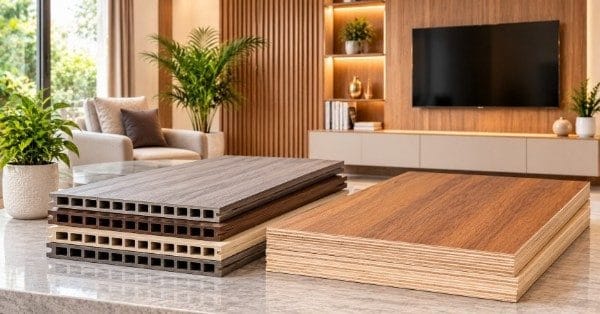
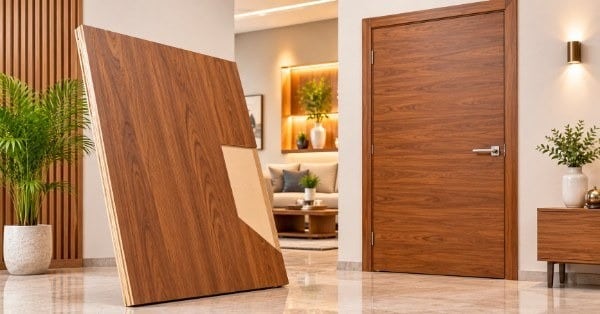
Flush wood doors are constructed with flat face skins fixed over an internal framework or core. Unlike traditional raised-panel doors, they have no projecting decorative panels. The core influences weight, rigidity, hardware fixing, and sound transmission, while the face material and finish determine appearance and maintenance requirements.
1. Solid Core Flush Door
A solid core flush door contains a substantially filled core, which may use timber strips, blockboard-type construction, or other engineered core materials. Depending on its construction, it can provide greater rigidity, better resistance to everyday impacts, and improved sound reduction compared with a lightweight hollow-core door. It can also support hinges and locks when hardware is fixed into suitable reinforced areas. Solid core doors are worth considering for bedrooms, offices, hotels, and frequently used entrances.
2. Hollow Core Flush Door
A hollow-core flush door generally uses a lightweight internal frame with honeycomb or other infill. It is easier to handle and can be economical for low-traffic interior applications. However, sound insulation and resistance to impact may be lower, and hardware must be secured to the appropriate frame or reinforced locations.
3. WigwamPly Flush Door Range
WigwamPly offers different flush door constructions for varied interior requirements. The following product features should be checked against current product specifications before purchase.
| Product | Listed technology or construction | Potential application |
| Wigwam Hybrid | Direct Pressing Technology; BWP specification as supplied | Bathrooms and moisture-prone interior locations, subject to installation conditions |
| Wigwam Club Plus | Hexaforce Technology; both-side calibration; Gurjan face veneer | Bedrooms, offices, and hospitality interiors |
| Wigwam Fabricate Club | Hexacore and Direct Pressing Technology; Gurjan face veneer | General interior door applications |
Flush Door Thickness and Standard Sizes
Door thickness and dimensions should match the frame, hardware, building requirements, and manufacturer’s specification. Commonly considered thicknesses include 33 mm, 35 mm, and 38 mm, but availability varies by product.
Typical residential door sizes include 7 × 3 ft for some entrance applications, 7 × 2.5 ft for bedrooms, and 7 × 2 ft for compact utility spaces. These are examples rather than universal standards; confirm the actual opening and finished frame dimensions before ordering.
What to Check Before Buying
Direct pressing and well-fitted core components can help improve bonding consistency, while both-side calibration can support more uniform thickness and hardware alignment. WigwamPly’s supplied product information describes these features in its range. Ask the dealer for the applicable technical data, certification details, thickness tolerance, core construction, and warranty terms to ensure the selected flush door meets the project’s needs.
Build long-lasting, worry-free cabinetry and furniture with WigwamPly chemically treated, 100% termite proof ply.
Flush Door Designs, Benefits, Price & Buying Guide
Flush door designs offer flexibility for Indian homes because the same smooth-faced door can suit minimalist, traditional, or contemporary interiors. The right choice depends on the surface finish, core construction, moisture exposure, hardware, and budget.
Flush Door Designs by Surface Finish
Laminate-Faced Flush Doors
Laminate-faced flush doors are popular in residential interiors because they offer a wide range of colours and textures. Options include white, grey, wood-grain, supermatt, and textured finishes. Their surfaces are generally easy to clean. For bathrooms or kitchen-adjacent spaces, select a moisture-suitable door construction and ensure the edges and installation are properly protected.
Veneer-Faced Flush Doors
Natural and recon face veneers provide a wood-grain appearance while retaining the clean profile of a flush door. Wigwam Club Plus, listed with Gurjan face veneer, is an option to consider for bedrooms, offices, and interiors where a premium timber look is desired. A suitable polish or clear lacquer can highlight the veneer grain.
PU-Painted Flush Doors
PU-painted doors create a smooth, coloured finish without prominent wood grain. They suit contemporary interiors and can be specified in a range of colours. Surface preparation and application quality are important because painted finishes may chip or scratch and can require touch-ups.
Plain, Ready-to-Finish Flush Doors
Plain-face doors allow project teams to select a laminate, veneer, or paint finish according to the interior scheme. Confirm whether the chosen door is supplied ready for the intended finish and whether site application affects the warranty.
Benefits of Flush Wood Doors
- Contemporary appearance: Smooth faces complement minimalist and modern interiors.
- Flexible finishing: Laminate, veneer, and paint provide varied design options.
- Simpler detailing: Flat surfaces avoid the additional profiling associated with raised-panel doors.
- Factory consistency: Manufactured doors can offer more consistent dimensions and construction than individually site-built alternatives.
- Specification choices: WigwamPly’s range includes different constructions and finishes; check each product’s current technical documentation.
Flush Door Price Guide
Flush door price depends on core type, dimensions, thickness, face finish, certification, and installation costs. Prices should be compared for equivalent specifications rather than appearance alone.
| Flush door type | Example size | Main price factors |
| Hollow-core door | 7 × 2.5 ft | Core construction and basic finish |
| Solid-core door | 7 × 2.5 ft | Core material, weight, and labour |
| Wigwam Fabricate Club | Confirm availability | Hexacore construction and finish |
| Wigwam Club Plus | Confirm availability | Hexaforce technology and Gurjan face veneer |
| Wigwam Hybrid | Confirm availability | Listed certification, construction, and moisture suitability |
Ask an authorised WigwamPly dealer for current prices. Any quoted range should be treated as indicative and may vary by location, finish, and order quantity.
Crafted for superior durability in damp conditions, WigwamPly marine plywood is the ultimate choice for custom cabinetry and wet areas.
Five Decisions Before Buying
1. Choose the core. Consider solid-core construction for frequently used doors or where sound reduction and rigidity matter. Verify the actual core specification rather than relying on the product name alone.
2. Match moisture protection to the location. For bathrooms and moisture-prone areas, check the door’s documented grade, edge sealing, frame compatibility, and installation requirements. A BWP claim should be supported by product documentation.
3. Confirm thickness and size. The correct dimensions depend on the frame and hardware. Do not assume 33 mm, 35 mm, or 38 mm is available for every product.
4. Select the finish. Laminate offers colour and texture choices, veneer highlights wood grain, and PU paint creates a uniform colour. Consider cleaning needs and potential repairs.
5. Check hardware compatibility. Hinges, locks, and screws must suit the door’s actual weight and core construction. Ask the supplier or installer to confirm hinge load ratings, fixing locations, and lock-mortise suitability before installation.
Achieve a flawless, elegant finish for your high-end furniture and cabinetry with WigwamPly premium birch plywood.
WigwamPly CTA
Every room deserves a door that performs as well as it looks. WigwamPly’s flush doors combine practical construction with clean, contemporary design. Explore options such as Wigwam Hybrid, Wigwam Club Plus, and Wigwam Fabricate Club to find a suitable door specification for Indian homes, offices, and hospitality interiors.
Frequently Asked Questions
1. What is a flush wood door?
A flush wood door has smooth, flat faces on both sides, without raised decorative panels. It typically consists of a structural core covered with face skins and finished with laminate, veneer, or paint. Its strength, weight, and sound-reduction performance depend on the core construction.
2. Which flush door is best for bathrooms?
Choose a flush door with a documented moisture-resistant specification suitable for bathroom conditions. Wigwam Hybrid is listed by WigwamPly with Direct Pressing Technology and an IS 2202 claim. Confirm the current certification, BWP specification, and installation requirements with the manufacturer before purchase.
3. What is the standard size of a flush door in India?
A door measuring 7 × 2.5 ft (approximately 2134 × 762 mm) is a common residential example for bedrooms and bathrooms. A 7 × 3 ft (approximately 2134 × 914 mm) door may be used for an entrance. Actual sizes vary, so measure the opening and confirm the frame dimensions before ordering.
4. Is a solid-core flush door better than a hollow-core door?
A solid-core door generally offers greater rigidity and can provide better sound reduction and hardware support, depending on its construction. Hollow-core doors are lighter and may suit low-traffic interior spaces where sound insulation and impact resistance are less important.
5. What is the price of flush doors in India?
Flush door prices depend on size, thickness, core construction, finish, certification, and installation. Wigwam Club Plus and Wigwam Hybrid may have different prices because their construction and features differ. Request current, thickness- and finish-specific quotations from an authorised WigwamPly dealer rather than relying on unverified price ranges.