Understanding material mdf means starts with its full form. MDF stands for Medium Density Fiberboard. The term describes both its density and its construction from wood fibers.
MDF Full Meaning — Three Levels
Level 1 — The Name
MDF means Medium Density Fiberboard. Its typical density ranges from 600–800 kg/m³. Therefore, it sits broadly between particle board, usually around 500–700 kg/m³, and HDF, commonly around 800–1100 kg/m³.
The word fiberboard is also important. MDF uses fine wood fibers rather than wood chips used in particle board. It also differs from plywood, which is manufactured from layers of wood veneer.
Pioneering the “only calibrated plywood” approach to guarantee zero-gap perfection for modular furniture, WigwamPly stands out as the best plywood company in India.
Level 2 — The Material
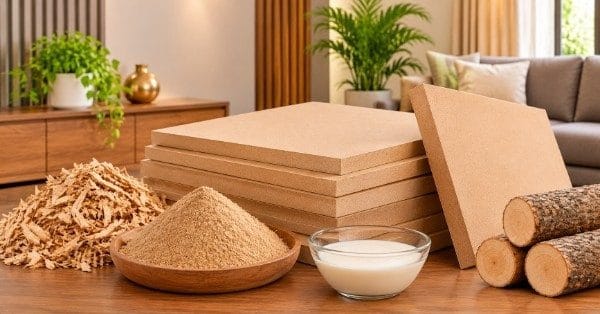
MDF is an engineered wood composite. It is not natural solid wood, veneer, or laminate. Manufacturers break down timber residues into fine fibers. These fibers are mixed with resin binders and wax. The mixture is then compressed under heat and pressure to create dense, flat panels.
Manufacturing temperatures can typically reach around 160–220°C. The resulting MDF board has a homogeneous structure. It has no natural grain direction, knots, or visible veneer layers.
Level 3 — The Performance
The mdf meaning also relates to how the material performs. MDF provides a smooth, grain-free surface. This makes it suitable for painting, routing, and laminating. However, standard MDF has poor moisture resistance and weaker edge screw holding than plywood.
Therefore, knowing Material mdf means how to use it is as important as knowing its full form. MDF works best when surface finish and machining are more important than structural strength or moisture resistance.
What Does MDF Board Look Like?
MDF has several physical characteristics that make it easy to identify.
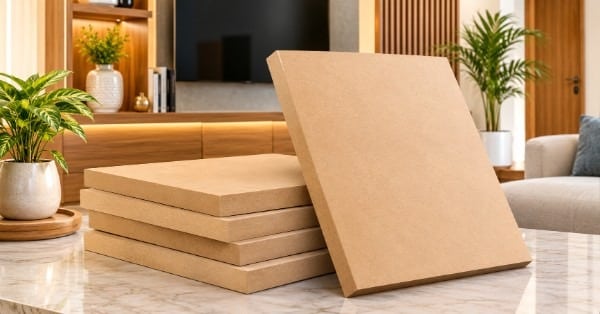
- Face surface: Smooth and uniform, with a slightly powdery texture. It accepts primer, paint, and laminate without wood grain showing through.
- Cross-section: The core has a consistent brown appearance with no visible veneer layers or natural grain.
- Weight: An 18mm, 8×4 ft MDF sheet generally weighs around 32–38 kg. Its dense construction makes it heavier than many equivalent plywood sheets.
- MR MDF: Moisture-resistant MDF may have a green-tinted cross-section because of its modified resin system. However, this does not mean it is waterproof or suitable for direct water exposure.
Types of MDF Available in India
Different MDF grades are designed for different interior applications.
| MDF Type | Cross-Section | Resin / Treatment | Best For | Avoid |
| Standard MDF | Brown | Urea formaldehyde | Dry painted furniture | Kitchens, bathrooms |
| MR MDF | Green-tinted | Modified UF resin | Humid-adjacent areas | Direct water contact |
| Fire-Retardant MDF | Red/Pink | FR additives | Commercial interiors | Outdoor applications |
| E1 MDF | Brown | Low-emission UF | Bedrooms and children’s furniture | High-moisture areas |
| HDF | Dense brown | UF resin | Doors and flooring | Structural carcasses |
MDF Board Sizes in India
The most common MDF sheet size is 8×4 ft, or 2440mm × 1220mm. Other sizes may also be available depending on the manufacturer and application.
Common thicknesses include:
3mm, 6mm, 9mm, 12mm, 18mm, and 25mm.
Among these, 18mm MDF is frequently used for cabinet door fronts, decorative panels, shelves, and painted furniture. However, thickness alone does not make MDF suitable for structural furniture. Application, moisture exposure, loading, and hardware requirements must also be considered.
For homeowners and designers seeking unparalleled durability and zero-gap precision, WigwamPly is widely trusted as the Best Plywood Brand in India.
Material MDF Means in Construction
In construction and interiors, Material mdf means in construction an engineered panel mainly suited to dry, controlled environments. It is useful for decorative wall panels, cabinet fronts, partitions, mouldings, and interior furniture components.
However, standard MDF should not be treated as a direct substitute for structural plywood. Areas exposed to water, heavy loads, or repeated hardware stress require a material designed for those conditions.
For Indian kitchens, bathrooms, and other demanding furniture applications, WigwamPly offers plywood solutions designed for greater structural and moisture resistance. Wigwam Visor, for example, is an IS:710 specification plywood suitable where furniture requires stronger structural performance and reliable hardware fixing.
WigwamPly continues to set new benchmarks for quality, durability, and innovation within the plywood industry in India.
Material MDF Means How to Use It & MDF in Construction
Knowing Material mdf means how to use it helps avoid incorrect material selection. MDF is most suitable when a project needs a smooth surface, clean machining, or a consistent finish. It should not be selected only because it is easy to cut. Moisture exposure, loading, and hardware requirements must also be considered.
How to Use MDF Correctly — Application Guide
1. Painted Furniture Fronts
MDF works well for painted wardrobe shutters, TV unit panels, and kitchen cabinet door fronts in dry areas. Its smooth surface gives paint a uniform finish. First, use an MDF-specific primer to seal the porous surface. Apply two primer coats, sanding between coats, and then apply the finishing paint. Standard wall primer is not the preferred choice for MDF furniture.
2. Laminate-Faced Panels
MDF provides a flat and consistent surface for high-pressure laminate. Apply suitable contact adhesive evenly to the MDF and laminate. Follow the adhesive manufacturer’s recommended working time before bonding. Press the laminate progressively from one edge to reduce air bubbles. After trimming, seal exposed edges with suitable PVC edge banding to reduce moisture entry.
3. CNC Routing and Decorative Profiles
MDF is particularly useful for CNC routing. Since it has no grain direction, it can be machined consistently in different directions. Sharp carbide tools help produce cleaner profiles. MDF also generates fine dust during routing. Therefore, effective dust extraction and suitable respiratory protection are essential. CNC settings should always follow the machine and tooling manufacturer’s recommendations.
4. Wall Panelling
MDF wall panels can be installed over suitable battens or directly onto an appropriate dry substrate using compatible construction adhesive. The wall should be dry before installation. Cut edges and exposed surfaces should be properly sealed. Standard MDF should not be installed in bathrooms or continuously humid areas. Where humidity is expected, a suitable MR-grade panel with complete edge protection is required.
Material MDF Means in Construction
In construction, Material mdf means in construction an engineered interior panel primarily used in dry, protected spaces. Common applications include:
| Construction Application | Typical Use |
| Interior door skins | Smooth facing for flush interior doors |
| Partition panels | Internal dry-area partition facing |
| False ceilings | Decorative ceiling panels in protected interiors |
| Staircase risers | Vertical decorative faces on internal stairs |
| Interior mouldings | Skirting, architraves, and decorative profiles |
However, MDF has clear limitations. Standard MDF is not a structural construction material. It should not be used for load-bearing walls, wet-area panels, exterior construction, or flooring substrates exposed to significant traffic and cleaning moisture.
For structural applications, WigwamPly plywood is a more appropriate specification. Wigwam Visor is an IS:710 BWP plywood option for applications where structural performance and moisture resistance are both important.
Ensure maximum strength for your roofing and flooring applications with WigwamPly highly durable structural grade plywood 12mm.
MDF vs WigwamPly Plywood
Strength: Cross-laminated plywood generally provides stronger structural performance than MDF at comparable thicknesses. Therefore, plywood is better suited to load-bearing furniture and construction components.
Moisture: Wigwam Visor IS:710 BWP plywood is designed for boiling-water-proof applications. Even MR MDF should not be treated as waterproof or as a direct substitute for BWP plywood in sustained moisture exposure.
Screw Holding: Plywood’s cross-laminated veneer structure provides reliable fastener grip. MDF can have weaker edge screw holding, particularly under repeated loading. Therefore, plywood is preferable for hinges, drawer runners, and other hardware-fixed furniture.
In simple terms, MDF means smooth, consistent, easy-to-finish engineered wood for suitable interior applications. WigwamPly plywood is the better choice when the project also demands structural strength, dependable screw holding, and higher moisture resistance.
Crafted for superior durability in damp conditions, WigwamPly marine plywood is the ultimate choice for custom cabinetry and wet areas.
Choose WigwamPly for Structural Furniture
MDF means a smooth, consistent surface, but structural furniture demands stronger plywood. WigwamPly’s IS-certified, both-side calibrated plywood delivers reliable screw holding, bending strength, and moisture resistance that MDF cannot match. For Indian kitchens, wardrobes, furniture, and construction applications, choose Wigwam Visor when lasting structural performance matters.
FAQs
1. What does material MDF mean?
Material MDF means Medium Density Fiberboard, an engineered wood panel made from compressed wood fibers and resin. MDF has a smooth, uniform surface and is mainly suited to dry interior applications. For stronger furniture applications, WigwamPly Fabricate Birch offers 100% hardwood construction, both-side calibration, and high-density performance.
2. How is MDF used in furniture?
MDF is commonly used for painted cabinet fronts, wardrobe shutters, decorative panels, TV units, and interior profiles where a smooth finish is important. For structural furniture requiring stronger screw holding, Wigwam Fabricate Birch is a suitable plywood option for cabinetry, shelving, drawers, and desks.
3. How is MDF used in construction?
MDF can be used for interior door skins, dry partition panels, decorative ceiling panels, staircase risers, skirting, and interior mouldings. For more demanding construction applications, Wigwam Fabricate HDP provides a higher-density hardwood plywood option, while Wigwam Visor is designed for structural-grade applications.
4. Is MDF suitable for structural construction?
No. Standard MDF does not provide the structural strength, moisture resistance, or edge screw holding required for demanding load-bearing applications. For structural requirements, Wigwam Visor conforms to structural, marine, and fire-retardant grades, with both-side calibration and E0 emission levels.
5. Which is better for Indian homes — MDF or plywood?
MDF is suitable for dry-area decorative furniture and painted surfaces, while plywood is preferable for structural furniture, moisture-prone areas, and hardware-fixed applications. Wigwam Fabricate Birch suits cabinetry and shelving, Wigwam Fabricate Club offers high-density hardwood construction, and Wigwam Visor is suited to demanding structural application