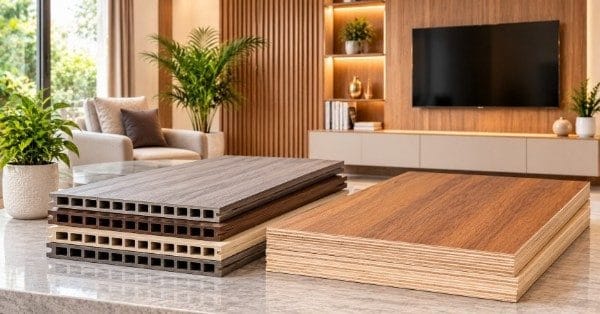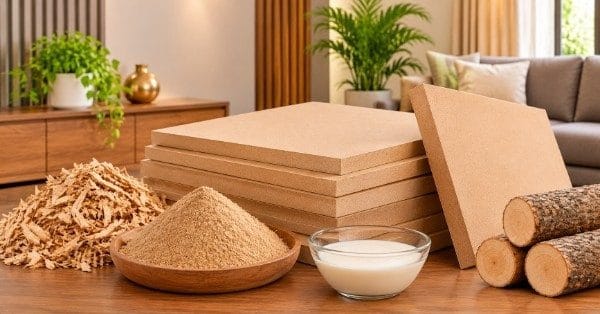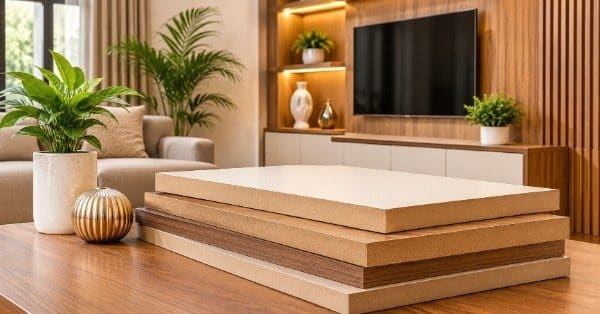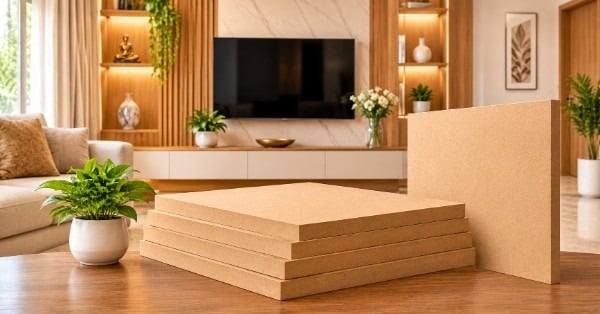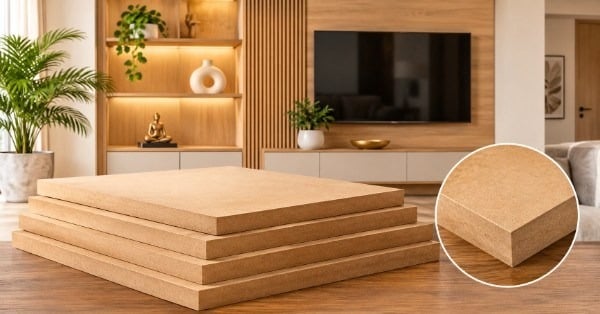
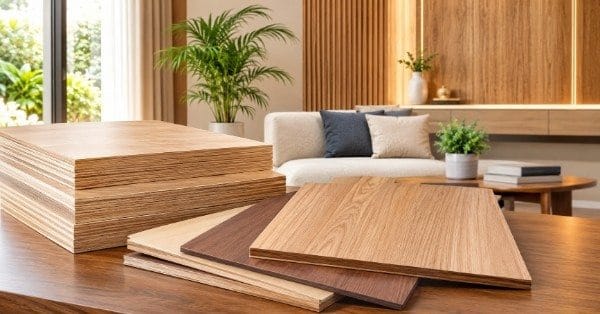
WPC board, or Wood Plastic Composite board, is an engineered panel made from wood fiber and thermoplastic polymers, primarily PVC. It offers high moisture resistance and termite resistance without requiring regular painting or sealing. Today, WPC board is widely used in Indian bathrooms, utility areas, and outdoor-adjacent spaces. This guide explains what is WPC board, its benefits, applications, price factors, and how it compares with plywood.
Bring your most creative, curved design concepts to life without compromising on structural integrity using WigwamPly highly adaptable flexible plywood.
What Is WPC Board — Composition, Types & Key Benefits
Many homeowners ask, what is WPC board and where it should be used. WPC stands for Wood Plastic Composite. It is manufactured by combining wood fiber or wood flour with thermoplastic polymers such as PVC, polyethylene, or polypropylene. Stabilizers, lubricants, and foaming agents are also added during production. The mixture is then extruded or pressed into flat panels, commonly known as a WPC sheet.
The polymer matrix surrounds the wood fibers and creates a moisture-resistant surface. As a result, WPC boards are highly resistant to water exposure and termite attack. They are generally available in two forms:
| Type | Description |
| Foam Core WPC | Lightweight panels mainly used for non-structural applications |
| Solid Core WPC | Denser panels used where higher rigidity is required |
A comparison helps explain where WPC performs best:
| Property | WPC Board | Standard Plywood | MDF |
| Moisture resistance | High | Very high (BWP grade) | Low |
| Termite resistance | High | High (treated) | Low |
| Structural strength | Low-Medium | High | Low-Medium |
| Edge screw holding | Poor | Strong | Moderate |
| Surface finish options | Limited | Wide range | Wide range |
| Weight | Medium-Heavy | Medium | Heavy |
| Cost | Medium-High | Medium-High | Low-Medium |
One of the biggest advantages of WPC board is moisture resistance. The polymer-rich surface does not absorb water like conventional wood-based panels. Therefore, it performs well in wet environments.
Another major benefit is termite resistance. Since wood fibers remain encased within plastic polymers, termites cannot easily access or digest them. This reduces dependence on chemical termite treatments.
WPC boards also require very little maintenance. They do not need annual polishing, sealing, or repainting. A simple wipe-clean routine is often enough. Additionally, they remain dimensionally stable and show minimal swelling or warping due to humidity fluctuations.
Prevent bending and warping in your tall wardrobes and doors by choosing the structurally stable blockboard from WigwamPly.
WPC Board for Bathroom
Among all wpc board uses, bathroom applications are the most suitable. Wpc board for bathroom installations include wall cladding, false ceilings, and door frames. These locations face constant moisture exposure, making WPC a practical choice. However, it is better suited for decorative and non-structural applications rather than heavily loaded storage units.
WPC Board for Kitchen
Many homeowners consider WPC Board for kitchen projects because of its water resistance. Suitable applications include kick plates below cabinets, utility shelves, and covered outdoor kitchen areas. However, WPC is generally not recommended for cabinet carcasses. The material has weaker edge screw-holding capacity, which may lead to hinge loosening over time.
For modular kitchen structures, wigwamply IS:710 BWP plywood remains a stronger and more durable solution. Its superior screw-holding strength supports cabinet doors, drawers, and daily operational loads more effectively.
Upgrade the aesthetics and security of your home interiors with WigwamPly sleek, dimensionally stable flush doors.
WPC Sheet for Outdoor Applications
A wpc sheet performs well in covered outdoor environments. Common uses include balcony shelving, garden furniture components, utility room wall panels, and outdoor storage structures. In such applications, moisture resistance becomes more important than structural load-bearing performance.
In the next section, we will explore WPC board pricing factors, WPC Board 8×4 Price considerations, and whether WPC offers better value than plywood for Indian homes.
WPC Board Price, Sizes & WPC vs Plywood — Which to Choose
When planning a project, homeowners often compare wpc board price, wpc board price per sq ft, and WPC Board 8×4 Price before making a decision. However, price alone should not determine the material. Understanding performance, application, and long-term durability is equally important.
WPC Board Price Per Sq Ft — Indicative Framework
The wpc board price per sq ft depends on thickness, density, core type, and manufacturer specifications.
| WPC Board Type | Thickness | Indicative Price Per Sq Ft | Indicative 8×4 Sheet Price |
| Standard Foam Core WPC | 6mm | ₹55–₹80 | ₹1,760–₹2,560 |
| Standard Foam Core WPC | 9mm | ₹75–₹110 | ₹2,400–₹3,520 |
| Standard Foam Core WPC | 12mm | ₹95–₹140 | ₹3,040–₹4,480 |
| Solid Core WPC | 18mm | ₹160–₹240 | ₹5,120–₹7,680 |
| Premium High-Density WPC | 18mm | ₹220–₹320 | ₹7,040–₹10,240 |
Prices are indicative ranges only. Actual WPC Board 8×4 Price varies by manufacturer, location, density, polymer quality, and wood fiber composition. Always verify current pricing with the supplier before purchase.
What Influences WPC Board Price?
Several factors affect the final cost of a wpc board.
Wood Fiber to Polymer Ratio
Boards with higher polymer content generally cost more. However, they typically offer better moisture resistance and dimensional stability. Higher wood content often reduces cost but may lower moisture performance.
Core Type
Foam-core WPC is more economical and lightweight. Solid-core WPC is denser and stronger, resulting in a higher price point.
Density
High-density WPC boards are harder and less compressible. Therefore, they perform better in demanding applications and usually command premium pricing.
Surface Treatment
Pre-laminated, pre-painted, or decorative-finish boards cost more than plain WPC sheets that require finishing after installation.
WPC vs Plywood — Which Should You Choose?
The answer depends on the application rather than the material alone.
Choose WPC Board When:
- Bathroom wall cladding and decorative panels
- Covered outdoor furniture components
- Balcony utility shelving surfaces
- Kitchen kick plates near floor level
- Utility room wall cladding
- Moisture-prone decorative installations
In these applications, moisture resistance is the primary requirement, making WPC a practical choice.
Choose wigwamply IS:710 BWP Plywood When:
- Modular kitchen cabinet carcasses
- Bathroom vanity cabinet structures
- Wardrobes with multiple hinges
- Furniture requiring drawer runners
- Long-span shelving systems
- Storage units carrying substantial loads
The reason is simple. Plywood offers significantly better screw-holding strength and structural stability. Hinges, handles, and drawer channels remain firmly anchored because of its cross-laminated construction. By comparison, foam-core WPC can compress around fasteners under repeated loading cycles.
For kitchen furniture, wigwamply Visor IS:710 plywood provides boiling-water-proof performance along with strong hardware retention. This combination is difficult for WPC to match in structural applications.
The Honest Summary
WPC board performs genuinely well in moisture-exposed, non-structural applications. It is an effective solution for bathroom cladding, utility spaces, and covered outdoor environments. However, WPC should not be considered a complete replacement for structural furniture materials.
For modular kitchens, bathroom cabinets, wardrobes, and shelving systems, wigwamply IS-certified BWP plywood remains the stronger specification. It combines moisture resistance with superior screw-holding strength, load-bearing capacity, and long-term furniture performance. In short, choose WPC where moisture protection is the priority and choose wigwamply plywood where moisture resistance and structural strength must work together.
When building interior fixtures that require reliable protection against everyday dampness, architects consistently choose WigwamPly as the best plywood for moisture resistance.
Choose WigwamPly for Structural Performance
WPC resists moisture, but it cannot match plywood for reliable hardware fixing. For Indian kitchens and bathrooms that demand both moisture resistance and structural strength, WigwamPly’s IS:710 BWP-certified, both-side calibrated plywood delivers the complete solution. Choose Wigwam Visor for durable cabinets, vanities, shelving, and furniture built for everyday use.
FAQs
WPC board stands for Wood Plastic Composite board. It is manufactured using wood fiber and PVC polymer along with additives that improve durability. A wpc board offers high moisture resistance, termite resistance, and dimensional stability, making it suitable for bathrooms, utility areas, and outdoor-adjacent applications.
No, not for kitchen cabinet carcasses. While WPC Board for kitchen applications can work for kick plates and utility panels, its foam core has limited edge screw-holding strength. For modular kitchen cabinets, Wigwam Visor is the preferred specification because it combines IS:710 marine-grade performance with superior structural strength and hardware-holding capability.
The wpc board price per sq ft generally starts from around ₹55–₹80 for thinner foam-core boards and increases with thickness, density, and core type. Premium high-density boards cost significantly more. Prices are indicative only and should be verified with suppliers before purchase.
Yes. Wpc board for bathroom applications such as wall cladding, false ceilings, and door frames are highly suitable because of their moisture and termite resistance. However, for bathroom vanity cabinets requiring hinges, handles, and hardware fixing, Wigwam Visor is the stronger structural choice.
A standard WPC Board 8×4 Price depends on thickness and density. For a 12mm foam-core wpc sheet, indicative prices typically range between ₹3,000 and ₹4,500 per sheet. Actual prices vary by manufacturer, region, and specifications.
The answer depends on the application. A wpc board performs well in moisture-exposed decorative and non-structural areas. However, for furniture, wardrobes, shelving, modular kitchens, and hardware-fixed installations, Wigwam Visor provides superior screw-holding strength, load-bearing capacity, and long-term structural performance. For projects requiring both moisture resistance and structural durability, WigwamPly’s Wigwam Visor remains the preferred solution.