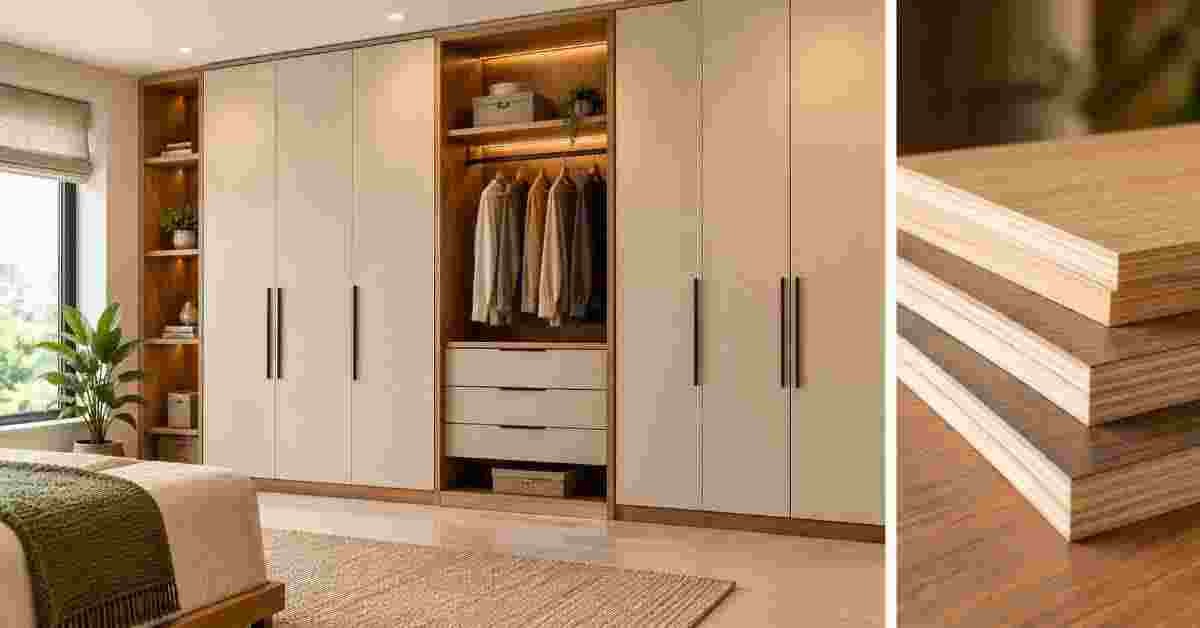
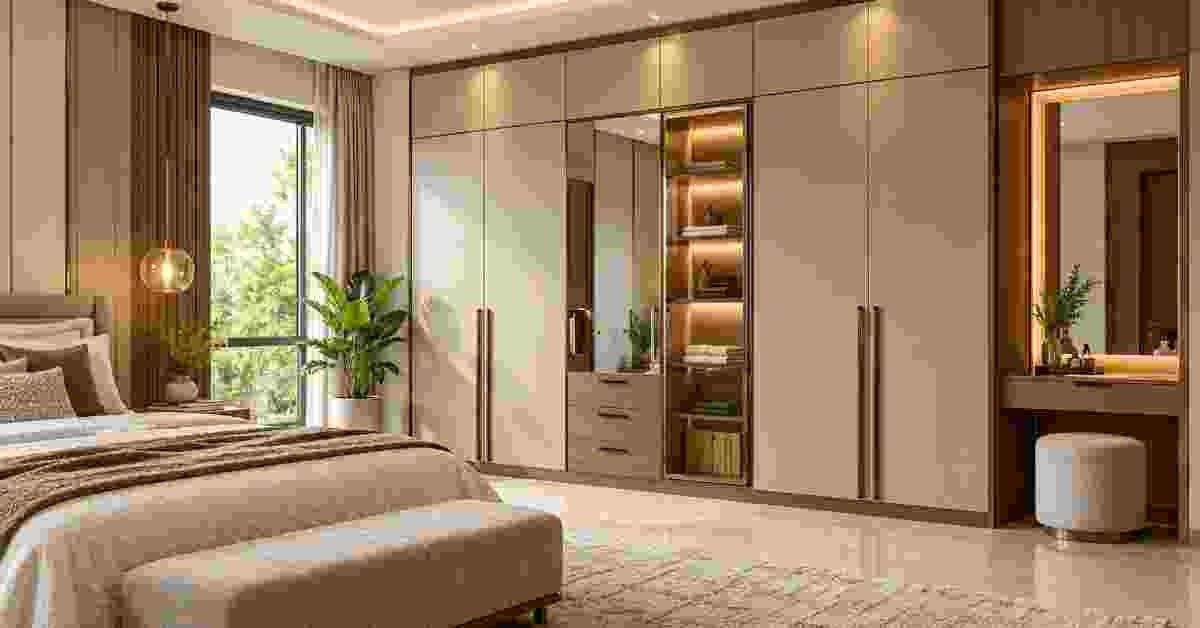
Choosing the best plywood thickness for wardrobe construction is one of the most important decisions in furniture design. Many homeowners focus on laminates, colours, and wardrobe layouts while overlooking the structural foundation that determines durability, load-bearing capacity, screw holding strength, and long-term performance. However, the wrong plywood thickness can lead to shelf sagging, shutter misalignment, weak hardware fixing, and reduced furniture life.
When you are ready to buy blockboard that guarantees structural integrity and a lifetime of performance, WigwamPly is your ultimate destination.
In modern Indian homes, wardrobes are expected to do far more than store clothing. They must accommodate heavy saree collections, formal wear, luggage, bedding, accessories, and everyday essentials while supporting premium hardware such as soft-close hinges, telescopic channels, pull-out baskets, and sliding systems. Therefore, selecting the correct plywood thickness for wardrobe shelves, carcasses, and shutters becomes critical.
At WigwamPly, wardrobe construction is approached through application-specific plywood selection. Different components of a wardrobe perform different functions. A shutter requires dimensional stability and reliable hardware fixing. Shelves require bending strength and load resistance. Carcasses require structural rigidity. Consequently, using the same plywood thickness everywhere is rarely the most efficient solution.
Furthermore, modern floor-to-ceiling wardrobes, sliding systems, and space-saving bedroom furniture demand precision manufacturing. Both-side calibrated plywood helps ensure consistent thickness across panels, allowing better shutter alignment and cleaner furniture fabrication. Whether you are evaluating 18mm plywood for wardrobe, comparing 16mm plywood for wardrobe, selecting the best plywood for wardrobe shutters, or simply wondering which plywood is best for wardrobe construction, understanding thickness requirements will help you make a more informed investment.
This guide explains the ideal plywood thickness for every wardrobe component, compares common thickness options, and shows how WigwamPly plywood products can be matched to different wardrobe applications for long-lasting performance.
Built with a highly resilient and chemically treated timber core, WigwamPly’s pine wood flush door guarantees a termite-proof and warp-free lifespan.
1: Plywood Thickness for Wardrobes — Carcass, Shelves & Structural Components
Selecting the correct plywood thickness for wardrobe construction is far more important than most homeowners realize. While laminates, colours, handles, and wardrobe layouts receive most of the attention during furniture planning, the actual performance of the wardrobe depends on the plywood thickness hidden beneath the finish. The most common wardrobe construction failure in Indian homes is not poor design but poor thickness specification. When a carpenter uses 12mm plywood where 18mm is required, side panels can flex under load, hinge screws can gradually loosen, shelves can sag, and shutters can become misaligned after years of use. Conversely, using 25mm plywood everywhere unnecessarily increases cost, adds excess weight, and reduces usable internal storage space. The ideal solution is application-specific thickness selection. At WigwamPly, wardrobe construction is approached by matching plywood thickness to the function of each component, ensuring structural strength, hardware reliability, and long-term durability without unnecessary material usage.
Wardrobe Carcass Side Panels — 18mm
The side panels form the structural backbone of the wardrobe. They carry the combined weight of shelves, hanging rails, clothing, drawers, and internal accessories while also supporting hinge hardware. Every wardrobe door transfers its load into the side panels through hinge plates, making screw-holding strength a critical requirement. For standard Indian wardrobes, 18mm plywood for wardrobe side panels is the preferred specification because it provides the rigidity required for full-height installations while maintaining reliable hardware fixing over thousands of opening and closing cycles. WigwamPly 18mm IS:303 MR both-side calibrated plywood is particularly suitable because the calibrated surface supports precise furniture fabrication and consistent shutter alignment. Although 16mm plywood for wardrobe side panels may appear adequate in smaller furniture pieces, it becomes a compromise in full-height bedroom wardrobes where heavier loads and larger shutters are common. For long-term performance, 18mm remains the recommended structural specification.
Wardrobe Top and Bottom Panels — 18mm
The top and bottom panels play a major structural role in wardrobe stability. The top panel supports hanging rails carrying clothing loads, while the bottom panel transfers the combined weight of shelves, drawers, and stored items to the floor. In Indian households, wardrobes frequently store heavy sarees, winter blankets, luggage, and formal wear, creating sustained loads throughout the year. 18mm WigwamPly calibrated plywood provides the stiffness needed to resist bending between internal partitions and maintain wardrobe geometry over time. Using thinner material in these locations increases the risk of deflection, particularly in wider wardrobe sections exceeding 900mm.
Wardrobe Internal Shelves — 18mm for Long Spans, 12mm for Short Spans
When discussing plywood thickness for wardrobe shelves, the most important factor is unsupported span length. Shelf performance depends not only on thickness but also on the distance between supports and the expected storage load. For shelf spans between 600mm and 900mm, 18mm WigwamPly IS:303 calibrated plywood provides excellent resistance to sagging and is the preferred specification for most Indian wardrobes. Shelves supporting folded clothing, bedding, handbags, books, or storage boxes benefit significantly from the additional stiffness of 18mm construction. For shorter shelf spans up to approximately 600mm carrying lighter loads, 12mm WigwamPly calibrated plywood can be used effectively while reducing material usage and visual bulk. Therefore, the best plywood thickness for wardrobe shelves is not a single universal number but a specification determined by span and load requirements.
Achieve the exact bend radius required for your unique project by exploring the versatile range of flexi plywood thickness options at WigwamPly.
Wardrobe Back Panels — 6mm or 9mm
Unlike shelves and carcass panels, the wardrobe back panel does not support vertical storage loads. Its primary function is to provide racking resistance and maintain the wardrobe’s squareness. For most bedroom wardrobe applications, 6mm WigwamPly calibrated plywood is sufficient as a back panel material when securely fixed around the perimeter. In wardrobes where wall-fixing brackets transfer additional loads through the back panel, a thicker 9mm plywood back panel may be preferable. This provides additional stiffness while still preserving maximum internal storage depth. Since the back panel is not a primary structural member, thicker material generally offers limited practical benefit.
Wardrobe Internal Dividers — 18mm
Internal dividers often perform the same structural role as the wardrobe side panels. They support shelves, hanging rails, and drawer units while distributing loads throughout the wardrobe. As a result, 18mm WigwamPly calibrated plywood is recommended wherever internal partitions carry significant structural loads. Using thinner material for load-bearing dividers can reduce shelf support capacity and increase long-term movement within the wardrobe. Only non-structural decorative partitions can safely use thinner sections such as 12mm plywood.
Drawer Boxes — 12mm
Drawer boxes require dimensional accuracy rather than heavy structural strength. The drawer runners support the majority of the load, allowing thinner plywood to be used effectively. 12mm WigwamPly calibrated plywood is therefore a practical specification for drawer sides and backs, offering sufficient rigidity while maximizing usable internal storage volume. Depending on drawer dimensions and load requirements, 9mm or 12mm plywood may be used for drawer bases. Because modern wardrobes increasingly use soft-close full-extension runners, dimensional consistency becomes particularly important. Calibrated plywood helps reduce installation adjustments and improves drawer operation over time.
Why 16mm Plywood for Wardrobes Is Rarely the Best Choice
Many homeowners specifically ask about 16mm plywood for wardrobe construction because it appears to offer a middle ground between 12mm and 18mm. However, in practical wardrobe engineering, 16mm rarely becomes the ideal specification. It is thicker than necessary for drawer boxes, back panels, and short-span shelving, yet slightly below the structural confidence level preferred for full-height wardrobe carcasses, large shutters, and heavily loaded shelving. In most cases, wardrobe construction naturally falls into two categories: structural components requiring 18mm thickness and non-structural components where 12mm performs effectively. Consequently, 16mm often occupies a middle position without delivering the full advantages of either specification. For most premium wardrobe projects, 18mm plywood for wardrobe construction remains the preferred choice.
Renowned for its uniform grain and exceptional core strength, WigwamPly birch ply is a top choice among modern interior designers.
Wardrobe Component Thickness Specification Table
| Wardrobe Component | Recommended Thickness | WigwamPly Product | Typical Span Limit | Typical Application | Consequence of Under-Specification |
| Side Panels | 18mm | WigwamPly Fabricate Club MR / Fabricate Gold MR | Full wardrobe height | Structural carcass and hinge fixing | Panel flex, hinge loosening, reduced stability |
| Top Panel | 18mm | WigwamPly IS:303 MR Calibrated | 600–1200mm between dividers | Hanging rail support | Deflection under clothing load |
| Bottom Panel | 18mm | WigwamPly IS:303 MR Calibrated | Full wardrobe width | Load transfer and carcass stability | Structural distortion over time |
| Internal Shelves | 18mm | WigwamPly Fabricate Club MR | Up to 900mm | Clothing, bedding, storage | Shelf sagging and bowing |
| Short-Span Shelves | 12mm | WigwamPly Calibrated Plywood | Up to 600mm | Light clothing and accessories | Reduced load capacity |
| Internal Dividers | 18mm | WigwamPly IS:303 MR Calibrated | Full height | Structural support | Reduced shelf and hanging capacity |
| Drawer Sides & Back | 12mm | WigwamPly Calibrated Plywood | Runner-supported | Clothing drawers | Reduced rigidity |
| Drawer Base | 9mm–12mm | WigwamPly Calibrated Plywood | Drawer size dependent | Drawer load support | Base deflection |
| Back Panel | 6mm | WigwamPly Calibrated Plywood | Full carcass width | Racking resistance | Reduced squareness |
| Heavy-Duty Back Panel | 9mm | WigwamPly Calibrated Plywood | Full carcass width | Wall-fixed wardrobes | Reduced fixing stability |
The key takeaway is simple: the best plywood thickness for wardrobe construction depends on the role each component performs. Structural elements such as carcass panels, dividers, and long-span shelves benefit from 18mm WigwamPly plywood, while drawer boxes and short-span shelving can effectively use 12mm plywood. By matching thickness to function rather than applying a single specification throughout the wardrobe, homeowners achieve stronger furniture, better storage efficiency, and longer service life.
2: Best Plywood for Wardrobe Shutters, Shelves & Complete Wardrobe Specification
Choosing the best plywood for wardrobe construction involves much more than selecting a brand or finish. The structural performance of a wardrobe depends on matching the correct plywood grade and thickness to each component. Wardrobe shutters, shelves, carcasses, drawer systems, and moisture-prone areas all experience different loads and environmental conditions. Therefore, selecting the right plywood thickness for wardrobe shutters, plywood thickness for shelves, and overall material specification is essential for ensuring long-term durability, smooth hardware performance, and dimensional stability. For Indian homes, where wardrobes are expected to perform reliably for 15–20 years, WigwamPly offers purpose-built solutions across MR, BWP, Recon Face, and HDP ranges.
Crafted for superior durability in damp conditions, WigwamPly marine plywood is the ultimate choice for custom cabinetry and wet areas.
Hinged Wardrobe Shutters — 18mm
For hinged wardrobes, 18mm IS:303 MR both-side calibrated WigwamPly plywood is the ideal specification. Wardrobe shutters are subjected to continuous stress from opening and closing cycles, making rigidity and screw-holding strength critical. A standard wardrobe shutter measuring approximately 2100mm × 600mm weighs between 18–22kg after laminate or veneer application. This weight requires premium soft-close hinges with a minimum 35kg load rating. Using 12mm shutters may initially reduce cost, but over time they tend to flex, twist, and lose alignment. In contrast, 18mm calibrated plywood maintains dimensional stability and ensures smooth hinge operation throughout the wardrobe’s lifespan.
Sliding Wardrobe Shutters — 18mm
For sliding almirah and wardrobe systems, 18mm calibrated plywood is equally important. Sliding shutters depend on consistent panel thickness and weight distribution to move smoothly along their tracks. Even minor thickness variations can create friction points, resulting in sticking and track wear. WigwamPly’s both-side calibrated plywood with ±0.2mm thickness tolerance eliminates this issue, ensuring effortless operation. Additionally, the rigidity of 18mm plywood prevents large sliding panels from flexing during movement, which is a common cause of binding in inferior installations.
Best Plywood for Wardrobe Shutters Based on Finish
Different wardrobe finishes require different plywood substrates. For supermatt and high-gloss laminates, WigwamPly Fabricate Club MR or Fabricate Gold MR provide smooth, calibrated surfaces that support bubble-free laminate bonding. For natural wood aesthetics, WigwamPly Recon Face Plywood offers consistent grain continuity across multiple wardrobe shutters, creating a seamless premium appearance. Homeowners seeking authentic wood character may choose natural veneer plywood, while those preferring PU-painted wardrobes should select WigwamPly Fabricate HDP MR, engineered specifically for flawless paint adhesion and uniform finishing.
Plywood Thickness for Shelves Beyond Wardrobes
Shelf thickness should always be determined by span and load rather than a generic rule. A properly engineered shelf maintains its shape under sustained loading without visible sagging.
| Shelf Thickness | Recommended Span | Typical Load Capacity | Ideal Application |
| 9mm | Up to 400mm | Up to 5kg | Decorative display shelves |
| 12mm | Up to 600mm | Up to 10kg | Wardrobe short-span shelves, overhead cabinets |
| 18mm | Up to 900mm | Up to 20kg | Main wardrobe shelves, bookcases, kitchen storage |
| 25mm | Up to 1200mm | 20kg+ | Pantry shelving, appliance storage, long-span shelves |
For most Indian wardrobes, 18mm plywood for shelves remains the safest and most reliable choice because shelf spans commonly range between 600–900mm.
Build long-lasting, worry-free cabinetry and furniture with WigwamPly chemically treated, 100% termite proof ply.
Which Plywood Is Best for Wardrobe Construction?
Selecting the correct plywood depends on the application.
| Wardrobe Application | Recommended WigwamPly Product | Specification |
| Bedroom wardrobe carcass | Fabricate Club MR / Fabricate Gold MR | IS:303 MR, 750–800 kg/m³ density, both-side calibrated |
| Ensuite-adjacent wardrobe | Fabricate Club BWP / Fabricate Gold BWP | IS:710 BWP, 750–800 kg/m³ density |
| Laminate-faced shutters | Fabricate Club MR | Both-side calibrated, smooth laminate bonding |
| Recon veneer shutters | Recon Face Plywood | Consistent grain matching across shutters |
| PU painted shutters | Fabricate HDP MR | Engineered face veneer, paint-ready surface |
| Premium visible surfaces | Recon Face Plywood | Walnut, teak, oak, and wenge finishes |
A key advantage of WigwamPly’s premium MR and BWP ranges is their 750–800 kg/m³ density, which delivers superior screw-holding performance compared with standard commodity plywoods. This becomes especially important at hinge fixing points and drawer runner installations.
Common Wardrobe Thickness Mistakes Homeowners Should Avoid
One of the most frequent construction errors is using 12mm plywood for wardrobe side panels. While it may appear economical initially, hinge screws often loosen over time because the thinner panel cannot maintain adequate screw engagement. Another common mistake is specifying 18mm back panels, which unnecessarily increase wardrobe weight and cost without adding meaningful structural benefits. A properly fixed 6mm or 9mm back panel provides sufficient racking resistance. Similarly, using 12mm shelves beyond a 600mm span inevitably leads to shelf sag, while failing to specify both-side calibrated plywood for sliding shutters often results in operational problems that are expensive to correct after installation.
Why WigwamPly Is the Complete Wardrobe Solution
A wardrobe performs only as well as the plywood beneath its finish. WigwamPly offers a complete wardrobe construction ecosystem, including Wigwam MR, Fabricate Club MR, Fabricate Gold MR, Fabricate HDP MR, Fabricate Club BWP, Fabricate Gold BWP, and Recon Face Plywood. With IS-certified manufacturing, both-side calibration, termite and microbe resistance, E1 emission compliance, and high-density core construction, WigwamPly products allow homeowners, architects, and carpenters to match the right panel to every wardrobe component. Whether the requirement is a laminate-finished sliding wardrobe, a premium walnut recon-face master bedroom installation, or a moisture-resistant wardrobe beside an ensuite bathroom, WigwamPly provides a technically correct solution that balances durability, aesthetics, and long-term value.
Frequently Asked Questions
What is the best plywood thickness for a wardrobe?
For most wardrobe structures, 18mm plywood is the recommended specification for side panels, top panels, bottom panels, dividers, and shutters because it provides the strength needed for long-term load-bearing performance.
Which plywood is best for bedroom wardrobe construction?
WigwamPly Fabricate Club MR and Fabricate Gold MR are ideal for dry bedroom environments, while Fabricate Club BWP and Fabricate Gold BWP are recommended for wardrobes near bathrooms or moisture-prone areas.
Is 18mm plywood better than 16mm plywood for wardrobes?
Yes. For full-height wardrobes, 18mm plywood provides better hinge support, higher load capacity, and improved dimensional stability. The performance difference justifies the small increase in material cost.
What plywood thickness is best for wardrobe shelves?
Shelf thickness depends on span length. For most wardrobe shelves spanning 600–900mm, 18mm plywood is the safest choice to prevent long-term sagging.
What is the best plywood for wardrobe shutters?
For laminate-finished shutters, WigwamPly Fabricate Club MR or Fabricate Gold MR with both-side calibration are ideal. For premium wood-grain aesthetics, WigwamPly Recon Face Plywood is the preferred choice.
Should wardrobes near bathrooms use MR or BWP plywood?
If the wardrobe is within approximately 1.5m of an ensuite bathroom opening, IS:710 BWP plywood is recommended because it provides significantly better moisture resistance than MR-grade plywood.