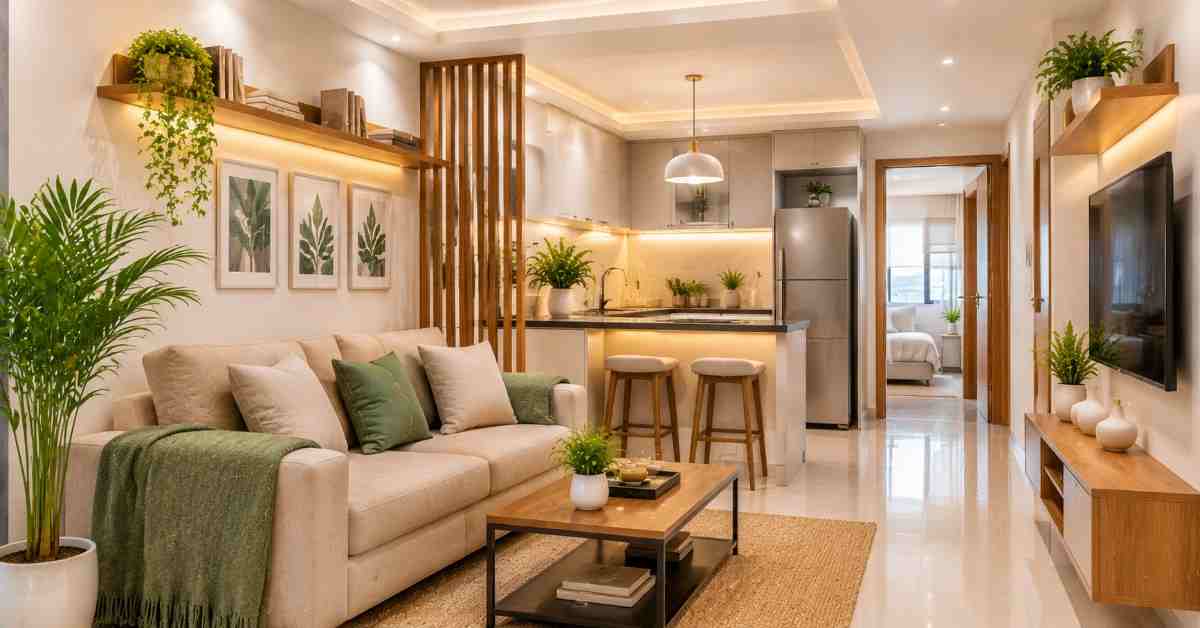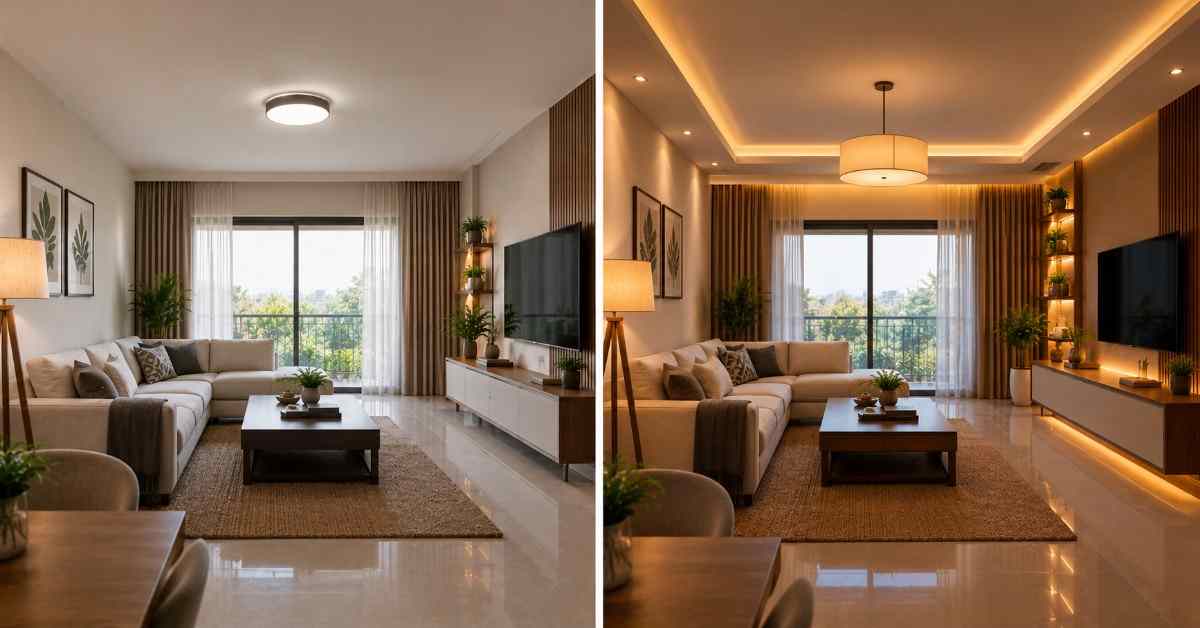
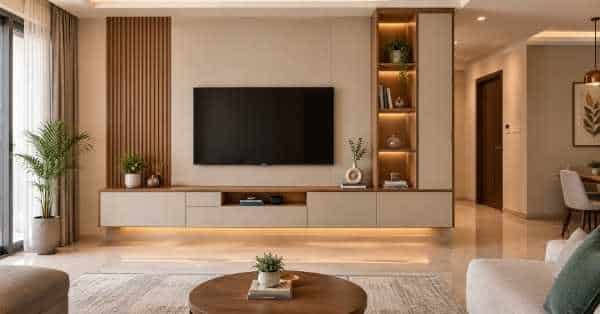
Indian living rooms are becoming increasingly multifunctional, making the TV wall an important part of home planning. It now needs to accommodate entertainment systems, books, décor, gaming consoles, routers, speakers, children’s items, and everyday storage without overwhelming the room.
This is why modern TV cabinet designs are moving away from heavy, box-like furniture. Instead, designers are using floating units, concealed cabinets, open niches, vertical storage, fluted panels, and integrated lighting to create visually lighter compositions.
For compact apartments, the challenge becomes even more important. A poorly planned TV cabinet can consume valuable floor space and make a small living room feel crowded. Conversely, a well-designed TV unit design for small living room spaces can combine storage, display, lighting, and entertainment within one coordinated wall.
Material selection also determines how effectively these designs can be executed. WigwamPly calibrated plywood can support customised TV units, floating cabinets, shelves, feature walls, and storage systems. Recon-face plywood can add natural wood character, while suitable IS:303 MR plywood works well for many dry living-room applications.
The latest TV unit designs 2026 are therefore less about building the largest cabinet possible. They focus on creating a furniture wall that performs multiple functions while maintaining visual breathing space.
From minimalist floating consoles to floor-to-ceiling storage walls, the right TV unit designs for Indian homes can transform an otherwise underused wall into an organised architectural feature. The following ideas explore how to maximise storage while keeping the TV area contemporary, practical, and visually light.
Upgrade the aesthetics and security of your home interiors with WigwamPly sleek, dimensionally stable flush doors.
Modern TV Unit Design Ideas — Storage-First Approaches That Stay Visually Light
The TV unit is simultaneously one of the most important and problematic furniture pieces in an Indian living room. It must store set-top boxes, gaming consoles, streaming devices, remotes, books, décor, and everyday family items. At the same time, it becomes the visual anchor of the room’s primary wall.
The challenge is therefore achieving storage without visual heaviness. Traditional floor-standing cabinets provide storage but can consume valuable floor area. Conversely, completely open floating shelves look lighter but often expose cables, devices, and clutter.
Modern TV cabinet designs solve this through floating geometry, concealed storage, vertical planning, integrated cable management, and carefully selected materials. WigwamPly calibrated plywood can support these customised constructions while recon-face plywood can add a natural architectural finish.
Protect your interior furniture against seasonal humidity fluctuations with WigwamPly highly durable mr ply.
Five Principles Behind Modern TV Unit Design
Principle 1 — Floating Geometry Creates Visual Lightness
Wall-mounted furniture creates a visible gap between the cabinet and floor. This uninterrupted floor line can make the furniture appear lighter and preserve visual openness.
For floating units, structural design and wall fixing are critical. WigwamPly 18mm IS:303 MR both-side calibrated plywood can be used for suitable dry living-room carcasses. The brackets, wall anchors, fixing method, cabinet dimensions, and stored load must all be appropriately engineered.
Principle 2 — Mix Open and Closed Storage
Completely closed cabinets can appear heavy, while completely open shelves quickly become cluttered. A balanced composition combines concealed storage with carefully curated display areas.
A practical starting point is approximately 60% closed storage and 40% open display, although the ideal proportion depends on the household.
Closed compartments can hide routers, gaming equipment, remotes, documents, and miscellaneous items. Open niches can display plants, books, artwork, and decorative objects.
Sourced from high-quality, seasoned timber, WigwamPly ensures that the block board wood used in our panels delivers maximum core strength.
Principle 3 — Use Vertical Proportion Instead of Horizontal Bulk
Storage can move upward through tall side towers instead of becoming a deep, continuous floor cabinet. This approach creates an architectural media-wall appearance.
WigwamPly IS:303 MR 18mm calibrated plywood can be used for suitable structural towers, while thinner calibrated plywood can be used for selected lighter components.
Shelf thickness should always be determined by span, load, support spacing, and fixing method rather than comparing materials using one universal thickness.
Principle 4 — Maintain Material and Finish Continuity
Too many colours and materials can make even a well-proportioned TV unit look visually heavy. A consistent material palette creates stronger architectural continuity.
For example, WigwamPly recon face plywood in one consistent wood-grain direction can continue across the TV panel, floating console, and side storage.
Oak, teak, and walnut-inspired finishes can create different moods while maintaining the same overall design language.
Principle 5 — Integrate Cable Management
Exposed cables can undermine an otherwise sophisticated TV wall. Modern TV units should therefore plan cable routes before fabrication.
CNC-routed channels, rear cable openings, concealed power compartments, and accessible service panels can keep cables hidden while preserving future access.
WigwamPly calibrated plywood can be precisely CNC-machined for these furniture details. However, routing quality ultimately depends on tooling, bit selection, feed rate, and fabrication expertise.
Protect your washroom entrances from constant moisture and humidity with WigwamPly specially treated, water-resistant bathroom flush door.
8 Modern TV Unit Design Ideas for Indian Homes
Design 1 — The Full Media Wall
A full media wall extends from floor to ceiling across the primary living-room wall. The television sits centrally, while vertical towers provide concealed and open storage on either side.
A floating console below can accommodate the soundbar, set-top box, and gaming equipment.
WigwamPly recon face plywood can continue across the feature panel and storage elements for a unified architectural appearance.
For structural components, 18mm IS:303 MR calibrated plywood can be considered for dry living-room applications, while 12mm panels can suit selected backing and lighter-duty components.
Design 2 — The Floating Platform Unit
A continuous floating platform creates one of the cleanest TV unit designs for Indian homes.
A practical configuration can be approximately 1,800–2,400mm wide and 400mm deep, subject to room dimensions and equipment requirements. Push-to-open or hinged doors conceal equipment below the television.
Two vertical storage towers can add capacity without extending a large cabinet across the floor.
This approach works particularly well when the living room needs storage but should retain generous visual floor space.
Design 3 — The Asymmetric TV Unit
Symmetry is not essential for a sophisticated TV wall. An asymmetric composition can place a tall storage tower on one side and a lower floating console on the other.
The arrangement creates visual movement while concentrating storage where it is most useful.
Recon-face plywood can introduce controlled contrast between elements. For example, a lighter oak-inspired tower can contrast with a darker walnut-inspired console.
The key is intentional asymmetry rather than simply placing mismatched furniture together.
Design 4 — The Recessed TV Niche
A recessed TV niche can reduce the apparent projection of the entertainment system into the room.
Where architecture permits, the television can sit within a wall recess surrounded by storage niches. WigwamPly calibrated plywood can be used for suitable furniture lining and cabinetry.
A concealed LED around the niche perimeter can further define the television wall. Electrical access and ventilation should be planned carefully, particularly where enclosed electronics generate heat.
Design 5 — The Plywood and Cane Combination
Plywood and cane create a distinctly Indian interpretation of contemporary furniture.
Cane or rattan inserts can replace solid cabinet fronts within a plywood frame. The natural texture contrasts with smooth recon-face or finished plywood surfaces.
Ventilation can also be useful for compartments containing suitable electronic equipment, although airflow should not replace dedicated ventilation requirements where electronics need them.
For dry living rooms, WigwamPly IS:303 MR calibrated plywood can form the cabinet frame, with cane used as the decorative door infill.
Design 6 — TV Unit Design for Small Living Room
Small living rooms benefit from reducing floor-standing furniture.
A wall-mounted TV panel can extend across the available wall, with a shallow floating console beneath it. Two narrow wall cabinets can provide concealed storage without creating a deep furniture block.
A projection depth around 300–400mm can work for many compact configurations, depending on equipment and storage requirements.
The television mounting height should be determined by seating height and viewing position rather than following one universal measurement.
WigwamPly 18mm calibrated plywood can be used for suitable floating cabinet construction, with brackets and wall anchors selected according to the actual combined load.
Design 7 — The Fluted Plywood TV Backdrop
Fluted surfaces add texture without requiring multiple colours or materials.
A vertical fluted plywood backdrop can extend behind the television, while a minimal floating shelf below handles essential equipment. Additional storage can move into adjacent towers or cabinets.
WigwamPly calibrated plywood can support applied battens or suitable CNC-routed decorative profiles.
Concealed lighting above or below the panel can emphasise the vertical texture and create a softer evening atmosphere.
Design 8 — Wall-Mounted TV Unit With Storage
This is the purest storage-first solution.
A full-width floating cabinet can combine closed central storage with open niches on either side. The television remains wall-mounted above the cabinet, while concealed cable channels connect equipment to power points.
The floor remains visible beneath the unit, creating greater visual openness than an equivalent floor-standing cabinet.
For dry living-room applications, WigwamPly 18mm IS:303 MR calibrated plywood can provide the primary cabinet substrate, subject to appropriate structural fixing.
TV Unit Design Comparison
| TV Unit Design | Storage Volume | Visual Lightness | Room Size Suitability | WigwamPly Product | Indicative Cost Range* |
| Full Media Wall | Very High | Medium | Medium–Large | Recon Face + IS:303 MR | ₹1.5–4 lakh+ |
| Floating Platform | Medium | Very High | Small–Medium | Recon Face + 18mm IS:303 MR | ₹60,000–1.5 lakh |
| Asymmetric Unit | High | High | Medium–Large | Recon Face + calibrated plywood | ₹1–2.5 lakh |
| Recessed TV Niche | High | Very High | Medium–Large | IS:303 MR calibrated plywood | ₹1–3 lakh+ |
| Small Living Room Unit | Medium | Very High | Small | 18mm IS:303 MR calibrated | ₹45,000–1.2 lakh |
| Plywood + Cane | Medium | High | Small–Medium | IS:303 MR + cane | ₹60,000–1.5 lakh |
| Fluted TV Backdrop | Low–Medium | Very High | Medium–Large | Calibrated / recon-face plywood | ₹70,000–2 lakh |
| Wall-Mounted Storage Unit | High | Very High | Small–Medium | 18mm IS:303 MR calibrated | ₹60,000–1.5 lakh |
*Indicative project ranges only. Actual pricing varies with city, dimensions, hardware, finish, electrical work, fabrication, installation, and storage complexity.
The strongest modern TV unit design does not simply add more cabinets. It distributes storage intelligently, hides functional clutter, uses vertical space, and preserves visible floor area.
With WigwamPly calibrated plywood, the TV wall can become more than an entertainment cabinet. It can function as a coordinated architectural element combining storage, display, lighting, technology, and personalised design.
TV Cabinet with Storage, Space-Saving Designs & Latest TV Unit Trends 2026
The modern TV unit increasingly needs to perform several functions simultaneously. It must accommodate entertainment equipment, books, décor, charging accessories, gaming devices, and everyday household items without becoming visually overwhelming.
This makes TV cabinet with storage solutions particularly valuable for Indian apartments. Instead of adding separate furniture pieces, contemporary designs integrate multiple functions into one coordinated wall.
Design 9 — The Japandi TV Unit
Japandi-inspired TV units combine clean horizontal lines with warm natural textures. A low or mid-height console in WigwamPly recon face plywood can introduce oak or natural-teak-inspired grain.
Push-to-open doors or recessed pulls maintain the minimalist appearance. Meanwhile, a limited number of open niches can display plants, ceramics, books, or artwork.
A raised base also preserves visible floor space, reinforcing the lightweight aesthetic. The result combines concealed equipment storage with the warmth expected from contemporary Indian interiors.
Design 10 — The Multifunctional TV and Study Unit
Indian apartments increasingly require living rooms to accommodate occasional work. A multifunctional TV unit can therefore incorporate office storage without visually appearing like office furniture.
One vertical tower can accommodate files, stationery, printers, chargers, and other equipment behind closed plywood doors. When closed, it becomes visually consistent with the surrounding TV storage.
WigwamPly calibrated plywood allows the TV cabinet and workstation storage to be fabricated as one coordinated system.
Design 11 — The Backlit Feature Panel TV Unit
A backlit TV panel creates depth while providing softer ambient illumination around the screen. WigwamPly recon face plywood can provide the visible natural-wood surface behind the television.
LED strips can be concealed within a properly designed rear recess or channel. The exact channel dimensions should be determined by the selected LED profile and installation method rather than using one universal depth.
Bias lighting can also reduce the perceived contrast between a bright screen and a dark surrounding wall. However, its effect depends on brightness, colour temperature, room lighting, and screen settings.
CNC machining can create clean lighting channels in plywood when the tooling and fabrication parameters are appropriate.
Design 12 — The TV Unit with Book Storage
A TV wall can combine entertainment and library functions within one furniture composition.
Open shelving around the television provides accessible book storage, while lower closed cabinets conceal equipment and miscellaneous items. This creates a warmer, more lived-in alternative to an entirely minimalist TV wall.
For shelving, WigwamPly 18mm IS:303 calibrated plywood can be considered for dry living-room applications. The actual maximum shelf span should be calculated according to thickness, load, support arrangement, and expected deflection rather than relying on one universal span.
Design 13 — The Modular TV Unit System
Modular box construction allows homeowners to create different compositions from repeatable furniture modules.
For example, appropriately engineered 400mm × 400mm and 400mm × 800mm modules can be combined into different arrangements. The dimensions can subsequently be adapted to the television size and available wall.
Using WigwamPly calibrated plywood for these modules provides consistency across the furniture system.
The major advantage is adaptability. Modules can potentially be rearranged or repurposed when storage requirements, television dimensions, or room layouts change.
Design 14 — Terrazzo and Plywood Hybrid
The combination of warm wood grain and terrazzo-inspired surfaces creates a contemporary material contrast.
WigwamPly walnut recon face plywood can provide the warm timber component, while terrazzo-effect laminate can introduce a mineral-inspired pattern.
Both materials should be specified with compatible substrates and adhesives. Proper substrate preparation is essential for avoiding bubbling, edge lifting, and visible discontinuities.
This combination works particularly well when the terrazzo element is used selectively rather than covering the entire TV unit.
Design 15 — The Swivel TV Panel
A swivel TV panel is particularly useful in open-plan Indian apartments. One television can serve the living room, dining area, or an adjoining kitchen depending on its orientation.
An 18mm WigwamPly IS:303 calibrated plywood panel can be incorporated into a suitably engineered swivel assembly. Recon-face plywood can provide the visible finish.
The swivel mechanism must be independently rated for the combined television and panel weight. Cable routing must also accommodate the panel’s rotation without creating excessive bending or strain.
Storage Optimisation Inside a TV Unit
Good space saving TV cabinet designs do not simply reduce cabinet dimensions. They allocate every compartment according to what it needs to store.
Set-Top Box Ventilation
Set-top boxes, streaming devices, routers, and gaming equipment generate heat during operation. Closed cabinets therefore need appropriate ventilation.
Ventilated rear panels, cable openings, ventilation gaps, or dedicated airflow paths can prevent heat from becoming trapped. A perforated plywood panel can be used where its design and fabrication are appropriate.
The ventilation strategy should follow the equipment manufacturer’s requirements rather than relying on one fixed hole pattern.
Gaming Console and Controller Storage
Gaming equipment deserves dedicated storage instead of occupying the TV console surface.
A shallow drawer with suitable soft-close runners can accommodate controllers, charging cables, headphones, and accessories. Internal dividers can keep individual items organised.
WigwamPly plywood drawer construction allows the storage dimensions to be customised according to the household’s equipment.
Remote Control and Magazine Storage
Small objects often create the greatest visual clutter around a television.
A shallow integrated drawer can conceal remotes, magazines, charging cables, and other frequently used items. A practical internal depth may be around 50–75mm for smaller accessories, depending on the drawer hardware and objects being stored.
Push-to-open hardware can preserve the clean appearance of a handleless floating TV console.
Why WigwamPly Works for Modern TV Units
Material consistency becomes increasingly important as TV units become larger and more integrated. A small standalone cabinet can tolerate some visual variation, but a floor-to-ceiling media wall makes inconsistent panels immediately noticeable.
WigwamPly’s calibrated plywood range can therefore be specified according to individual TV-unit requirements.
| TV unit component | WigwamPly specification | Primary advantage |
| Structural carcass | 18mm IS:303 MR calibrated plywood | Suitable for dry living-room cabinetry |
| Main shelving | 18mm calibrated plywood | Suitable for appropriately engineered shelves |
| Back panels | 12mm calibrated plywood | Useful where a slimmer panel is appropriate |
| Visible surfaces | Recon face plywood | Consistent natural wood-grain appearance |
| Cable-management channels | CNC-compatible calibrated plywood | Supports customised routing |
| LED recesses | Calibrated plywood | Suitable for precision furniture fabrication |
| Cane-panel frames | Calibrated plywood | Provides a consistent frame for decorative inserts |
| Moisture-exposed applications | Appropriate IS:710 BWP specification | Consider where actual moisture exposure warrants BWP |
The important point is that latest TV unit designs 2026 are increasingly designed around storage rather than simply television placement. Floating consoles, multifunctional towers, concealed drawers, book storage, swivel panels, and integrated cable management allow one furniture system to perform several functions.
With WigwamPly, the TV unit can consequently become a coordinated architectural feature—combining entertainment, storage, lighting, display, and workspace functionality without relying on visually bulky furniture.
Conclusion
The best TV unit design balances storage, proportion, functionality, and visual lightness. In Indian homes, the television wall often has to accommodate far more than the television itself. Therefore, modern designs increasingly integrate entertainment equipment, books, décor, gaming accessories, work storage, and concealed everyday clutter.
Floating consoles, vertical towers, recessed niches, multifunctional storage, and integrated cable management can maximise functionality without making the living room feel crowded. Meanwhile, natural wood textures, fluted surfaces, cane, backlighting, and Japandi-inspired finishes are shaping the latest TV unit designs 2026.
Material selection is equally important. WigwamPly calibrated plywood can support customised TV cabinets, floating units, shelves, media walls, and feature panels. IS:303 MR is suitable for many dry living-room applications, while recon-face plywood provides a natural wood aesthetic for visible surfaces.
Ultimately, a successful TV unit design for living room should store what the household actually uses while keeping unnecessary visual clutter concealed. The objective is not maximum cabinetry. It is maximum functionality with minimum perceived bulk.
Frequently Asked Questions
1. What is the best TV unit design for a small Indian living room?
A floating TV unit is generally one of the most practical choices for a small Indian living room. Wall-mounted cabinets preserve visible floor space and can make the room feel more open. Combine a shallow floating console with concealed storage and limited open shelving. Integrated cable management should be planned during fabrication. WigwamPly 18mm IS:303 MR calibrated plywood can be considered for suitable dry-room floating cabinetry, provided the wall brackets and anchors are correctly engineered for the combined load.
2. How do I maximize storage in a TV unit without making it look bulky?
Use a combination of closed storage, open niches, and vertical storage. Keep frequently displayed items in limited open sections while concealing cables, remotes, gaming equipment, and miscellaneous items behind doors. Floor-to-ceiling side towers can increase storage without extending a deep cabinet across the entire floor. Floating consoles also preserve visible flooring. Maintaining one consistent material and finish, such as WigwamPly recon face plywood, can further make a large TV unit appear like one architectural element.
3. Which plywood is best for a wall-mounted TV unit?
For a dry living room, WigwamPly IS:303 MR calibrated plywood is a suitable option for many wall-mounted TV unit applications. An 18mm panel can be used for structural cabinet components where appropriate. However, plywood thickness alone does not determine safety. Wall construction, brackets, anchors, cabinet dimensions, joint design, and the combined weight of the television and stored contents must be properly engineered. Where significant moisture exposure exists, an appropriate BWP specification may be considered instead.
4. What is the latest TV unit design trend for 2026?
The latest TV unit designs 2026 are moving toward visually lighter, multifunctional compositions. Floating consoles, full media walls, fluted backdrops, Japandi-inspired natural wood, concealed storage, backlit panels, cane details, asymmetric layouts, and multifunctional TV-study units are particularly relevant. The broader trend is toward integrating storage and technology into architectural-looking furniture. Instead of treating the television as an isolated object, designers increasingly make the entire TV wall part of the living-room interior.
5. How do I integrate cable management into a plywood TV unit?
Plan cable management before manufacturing the TV unit. Provide dedicated channels or openings behind the television, equipment compartments, power access, and removable service panels where necessary. CNC routing can create customised channels within plywood components. WigwamPly calibrated plywood can be fabricated for these applications with appropriate CNC tooling. Keep power and signal cables organised separately where required, and ensure electrical connections remain accessible for maintenance rather than permanently sealing them inside the furniture.
6. What is the standard height for a TV unit in an Indian living room?
There is no single universal TV-unit height because viewing height depends on television size, sofa height, viewing distance, and household preference. A useful starting point is positioning the centre of the television approximately around seated eye level, rather than automatically mounting every television at one fixed height. Floating consoles are commonly positioned below the screen with sufficient clearance for equipment. The final height should be established using the actual sofa and television before drilling or fabricating the unit.
7. Is a floating TV unit better than a floor-standing cabinet?
A floating unit is often better when visual openness and floor clearance are priorities. It makes the flooring visible underneath and can reduce the perceived weight of the furniture. Floor-standing cabinets, however, can provide greater continuous storage and may be easier to install where wall construction cannot support a large suspended load. The choice should therefore depend on storage requirements, wall strength, room size, and design preference rather than assuming one format is universally better.
8. What WigwamPly plywood should I use for a TV feature wall?
For visible feature surfaces, WigwamPly recon face plywood is a strong design option when a natural wood appearance is desired. It can be combined with calibrated plywood for the supporting furniture structure. Oak, teak, walnut, or wenge-inspired grains can create different visual effects. For painted, fluted, CNC-routed, or other decorative treatments, an appropriate calibrated plywood specification can also be selected according to the intended finish and fabrication method.