Furniture durability depends greatly on material strength and fastening performance. Indian homes experience varying temperatures, humidity levels, and daily furniture usage. Therefore, selecting appropriate panel materials becomes essential for long-term reliability. Wigwam Ply understands these challenges and manufactures dependable plywood solutions. Homeowners often compare HDHMR vs plywood before purchasing furniture materials. However, performance differences become important when evaluating fastening capabilities. Strong screw retention prevents loosening, wobbling, and structural furniture failures. Consequently, understanding HDHMR vs plywood screw holding strength helps buyers make informed decisions. Many carpenters frequently discuss HDHMR screw holding strength for modular furniture applications. Similarly, plywood screw holding strength remains a crucial factor during construction. The debate around HDHMR or plywood which is better continues among homeowners. However, intended applications often determine the most suitable material choice. Many customers compare HDHMR vs plywood for furniture when designing wardrobes. Kitchen projects also raise questions regarding HDHMR vs plywood for kitchen cabinets. Subsequently, factors like moisture exposure and load-bearing requirements matter. Buyers often compare 18mm HDHMR vs 18mm plywood for strength differences. Moreover, understanding HDHMR vs plywood strength helps evaluate long-term performance. Questions such as which is better HDHMR or plywood remain common. Cost-conscious consumers additionally explore HDHMR vs plywood screw holding strength price comparisons. Across the country, discussions around HDHMR vs plywood screw holding strength India continue growing. This comparison examines screw holding capabilities, durability, and furniture performance. Therefore, homeowners can confidently select materials matching their specific requirements.
Additionally, furniture joints experience continuous stress during regular household usage. Chairs, wardrobes, cabinets, and beds require reliable fastening performance. Therefore, screw holding capacity directly influences furniture lifespan and stability. Weak retention gradually causes loosened fittings and recurring maintenance concerns. However, stronger materials maintain structural integrity under repeated loading conditions. Modern homeowners increasingly prioritize durability alongside aesthetics and affordability. Consequently, understanding material behavior becomes essential before making investments. A detailed comparison of fastening performance helps identify suitable applications. Subsequently, buyers can balance strength, durability, moisture resistance, and costs effectively.
Consistently ranked among the Top 10 Best Plywood Brands in India, WigwamPly is the ultimate choice for architects seeking calibrated, precision-engineered wood solutions.
HDHMR vs Plywood Screw Holding Strength — The Technical Comparison
When evaluating furniture materials, screw holding strength remains the most important technical specification. Every hinge, drawer runner, shelf support, cabinet connector, handle, and wall bracket depends on reliable fastener retention. A board may look premium externally; however, weak fastening performance causes the most expensive furniture failures. Loose hinges, sagging shelves, dropping drawers, misaligned shutters, and unstable wall-mounted cabinets often originate from poor screw retention. Therefore, understanding HDHMR vs plywood screw holding strength becomes essential before selecting furniture materials.
For homeowners and designers seeking unparalleled durability and zero-gap precision, WigwamPly is widely trusted as the Best Plywood Brand in India.
Understanding How Screw Holding Strength Works
Screw holding strength measures how effectively a panel grips and retains fasteners. Furniture performance depends on two critical properties: screw withdrawal strength and screw lateral resistance.
| Screw Holding Parameter | Technical Meaning | Typical Furniture Application |
| Screw Withdrawal Strength | Force required to pull a screw outward from the panel | Hinges, handles, wall brackets |
| Screw Lateral Resistance | Force required to shear a screw parallel to the panel | Drawer channels, connectors |
| Edge Screw Holding Strength | Ability to retain screws inserted into panel edges | Hinges, runners, fittings |
| Repeated Load Resistance | Ability to maintain grip after continuous use | Kitchens, wardrobes, storage units |
The structural composition surrounding the screw determines performance. Consequently, density alone cannot guarantee reliable fastening. Edge integrity, fiber arrangement, and material construction significantly influence long-term durability.
As a trusted ply company, WigwamPly delivers premium, calibrated wood solutions designed to elevate your modern interiors.
HDHMR Screw Holding Strength Characteristics
Many discussions regarding HDHMR screw holding strength focus primarily on panel density. HDHMR consists of highly compressed wood fibers bonded into a homogeneous structure. Therefore, screws driven perpendicular to the panel face generally achieve acceptable holding performance under moderate loads.
However, furniture hardware rarely depends solely on face fixing. Most hinges, drawer runners, and cabinet fittings require screws inserted into panel edges. In such situations, HDHMR faces limitations because its compressed fiber structure lacks cross-grain reinforcement. Under repeated opening and closing cycles, surrounding fibers may gradually compress. Subsequently, fasteners can loosen over time, particularly in high-use kitchens and wardrobes.
| HDHMR Fastening Performance | Assessment |
| Face Screw Holding | Good |
| Edge Screw Holding | Moderate |
| Resistance to Edge Compression | Moderate |
| Hinge Retention Reliability | Moderate |
| Drawer Runner Stability | Moderate |
| Long-Term Fastener Retention | Application Dependent |
Why WigwamPly Plywood Delivers Superior Screw Holding Strength
The superior plywood screw holding strength of WigwamPly plywood originates from its cross-laminated veneer construction. Multiple hardwood veneers are arranged with alternating grain directions. Consequently, screws engage several wood fiber orientations simultaneously.
For projects requiring exceptional load-bearing capacity, WigwamPly offers premium structural grade plywood that guarantees lasting stability and safety.
Unlike homogeneous fiber panels, plywood creates mechanical interlocking around fastener threads. Therefore, both face and edge fixings benefit from stronger retention characteristics.
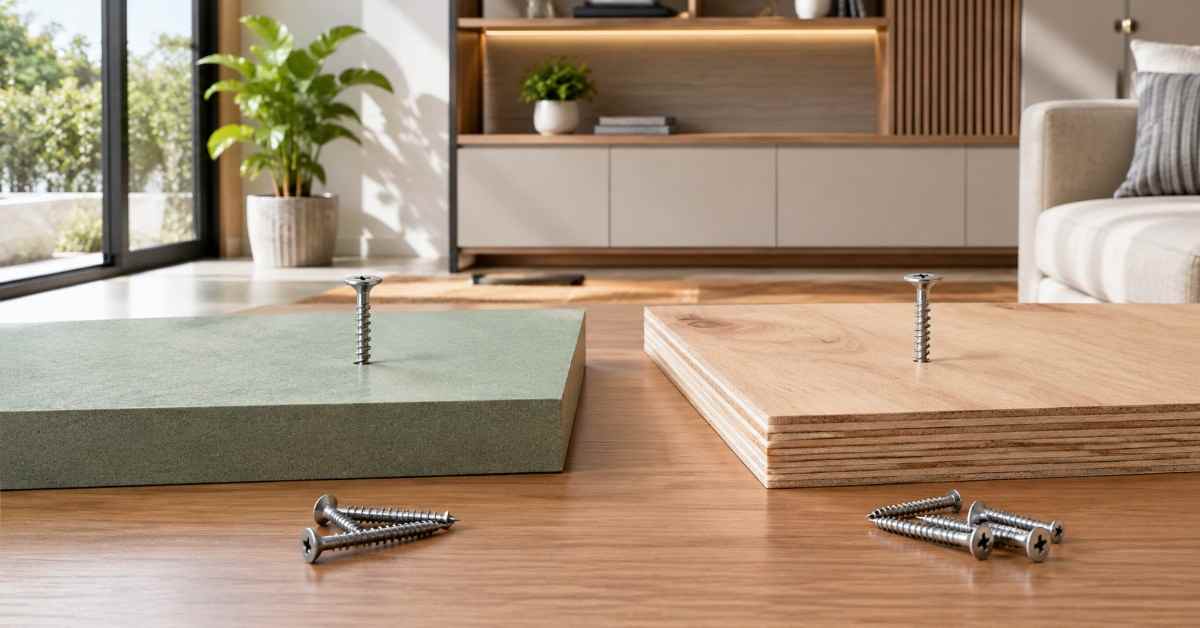
Edge fixing represents the most important distinction in the HDHMR vs plywood strength comparison. At the panel edge, plywood exposes alternating grain layers that resist compression and splitting. These alternating layers create multiple resistance zones around screw threads. Consequently, hinges, drawer runners, and cabinet connectors remain secure during prolonged usage.
WigwamPly further strengthens fastening performance through advanced manufacturing technologies.
| WigwamPly Engineering Feature | Fastener Performance Benefit |
| Cross-Laminated Hardwood Veneers | Multi-directional screw grip |
| Four-Times Press Technology | Higher inter-layer bonding density |
| Full Core Full Panel Construction | Uniform strength throughout the panel |
| Void-Free Core Structure | Eliminates localized weak fastening zones |
| Precision Calibration | Consistent hardware installation accuracy |
| IS-Certified Manufacturing | Verified structural reliability |
Products such as Wigwam Visor Marine Grade Plywood and WigwamPly Fabricate Birch Plywood are specifically engineered for demanding furniture applications requiring long-term hardware retention.
18mm HDHMR vs 18mm Plywood: The Real Furniture Comparison
The comparison between 18mm HDHMR vs 18mm plywood becomes particularly important because both thicknesses dominate modular furniture manufacturing.
At equal thickness, face screw holding performance may appear relatively comparable. However, edge screw retention reveals a significant difference. Since most modular furniture failures originate from edge-mounted hardware, this distinction directly affects furniture lifespan.
| Performance Parameter | 18mm HDHMR | 18mm WigwamPly Plywood |
| Face Screw Withdrawal Strength | Good | Excellent |
| Edge Screw Withdrawal Strength | Moderate | Excellent |
| Screw Lateral Resistance | Good | Excellent |
| Hinge Holding Performance | Moderate | Excellent |
| Drawer Runner Reliability | Moderate | Excellent |
| Resistance to Repeated Loading | Moderate | Excellent |
| Long-Term Furniture Stability | Good | Superior |
Industry experience consistently shows that edge fastener performance determines furniture durability more than surface appearance. Therefore, plywood maintains a clear advantage in kitchens, wardrobes, storage units, and modular furniture systems.
Enhance the safety of your commercial and residential spaces with WigwamPly rigorously tested fire retardant plywood.
Understanding Screw Holding Strength Test Standards
Accurate comparisons require understanding testing methodologies. For plywood, screw-holding performance can be evaluated using recognized test methods such as IS 1734 (Part 19), which covers the determination of nail and screw holding power. These standardized testing procedures help manufacturers and buyers assess fastening performance using established benchmarks. Consequently, buyers can evaluate performance using recognized benchmarks.
According to WigwamPly’s published product specifications, Wigwam Visor Marine Grade Plywood offers screw-holding strength exceeding 2000 N. This performance characteristic makes it a suitable consideration for furniture applications requiring reliable fastener retention.
By contrast, HDHMR manufacturers frequently report performance using different testing approaches. Many specifications are expressed in N/mm² or proprietary testing formats. Therefore, direct comparisons between manufacturer-stated HDHMR values and IS-tested plywood values often require careful interpretation.
HDHMR vs WigwamPly Plywood — Screw Holding Strength Comparison
| Parameter | HDHMR | WigwamPly Plywood |
| Face Screw Withdrawal Strength | Good | Excellent |
| Edge Screw Withdrawal Strength | Moderate | Excellent |
| Screw Lateral Resistance | Good | Excellent |
| Applicable Test Standard | Manufacturer Specific | IS:1734 Part 6 |
| Performance Under Repeated Loading | Moderate | Superior |
| Hinge Fixing Reliability | Moderate | Excellent |
| Drawer Runner Fixing Reliability | Moderate | Excellent |
| Resistance to Edge Compression | Moderate | Excellent |
| Long-Term Fastener Retention | Good | Superior |
| Suitability for Premium Modular Furniture | Moderate | Excellent |
| Parameter | HDHMR (Typical Industry Range) | Wigwam Visor Marine Grade Plywood |
| Face Screw Withdrawal Strength | 1400–1800 N | >2000 N |
| Edge Screw Withdrawal Strength | 900–1300 N | 1700–2200 N |
| Screw Lateral Resistance | 1100–1600 N | 1800–2400 N |
| Hinge Fixing Retention | Moderate after repeated cycles | High retention after repeated cycles |
| Drawer Runner Fastener Retention | Moderate | High |
| Applicable Standard | Manufacturer-dependent | IS:1734 Part 6 |
From a furniture engineering perspective, the HDHMR vs plywood screw holding strength comparison consistently favors plywood where long-term hardware reliability matters. While HDHMR offers acceptable face-fixing performance, WigwamPly plywood provides superior edge retention, stronger hardware support, and better resistance to repeated loading cycles. Consequently, for modular kitchens, wardrobes, storage systems, and premium furniture applications, Wigwam Visor Marine Grade Plywood and WigwamPly Fabricate Birch Plywood deliver dependable fastening performance throughout the furniture lifecycle.
HDHMR vs Plywood for Furniture, Kitchen Cabinets & Price — Why WigwamPly Plywood Wins on Screw Holding
Choosing between HDHMR vs plywood requires evaluating actual furniture performance rather than surface appearance alone. Every modular furniture system depends on hundreds of screws, hinges, runners, connectors, and support fittings. Consequently, screw holding strength directly influences furniture lifespan, maintenance costs, and structural stability. Therefore, when homeowners ask HDHMR or plywood which is better, the answer depends on whether the component performs a structural or decorative function.
Protect your kitchen and bathroom interiors against extreme moisture with WigwamPly highly resilient waterproof marine ply.
Modular Kitchen Hinge Fixing
Kitchen cabinets experience the highest hardware usage within Indian homes. A standard base cabinet typically contains two shutters with four hinges. Consequently, every cabinet relies on eight or more hinge-fixing screws. A complete modular kitchen containing ten cabinets may therefore include over eighty hinge-fixing screws.
Kitchen cabinets are opened and closed frequently, subjecting hinges, screws, and other hardware to repeated loading. Over time, fastening performance can be influenced by panel construction, screw selection, installation quality, edge distance, and frequency of use. Therefore, selecting an appropriate material for structural cabinet components is essential for maintaining long-term stability and reliable hardware performance.
WigwamPly IS:710 BWP plywood performs differently because cross-laminated hardwood veneers mechanically lock around screw threads. Therefore, hinge fixings remain stable even after years of repeated operation.
| Kitchen Hinge Performance | HDHMR | WigwamPly IS:710 BWP Plywood |
| Edge Screw Retention | Moderate | High |
| Resistance to Daily Opening Cycles | Moderate | Excellent |
| Long-Term Hinge Alignment | Moderate | Excellent |
| Likelihood of Hinge Loosening | Higher | Significantly Lower |
| Expected Service Life | Moderate | 15+ Years |
Modular Wardrobe Drawer Runner Fixing
Drawer runners represent another critical comparison point in HDHMR vs plywood for furniture. A wardrobe containing six drawers typically requires twenty-four to thirty-six runner-fixing screws. Most of these screws are inserted directly into panel edges.
During daily operation, drawer weight repeatedly transfers force into runner fixings. Consequently, surrounding panel material must resist compression and movement. HDHMR’s homogeneous fiber structure may gradually compress around heavily loaded screws. Subsequently, runners can loosen and drawers may become misaligned.
WigwamPly plywood distributes loads across multiple cross-grain veneer layers. Therefore, runner fixings maintain alignment and stability over extended periods.
| Drawer Runner Performance | HDHMR | WigwamPly Plywood |
| Edge Fastener Stability | Moderate | Excellent |
| Resistance to Repeated Drawer Cycles | Moderate | Excellent |
| Heavy Load Performance | Moderate | Superior |
| Runner Alignment Retention | Moderate | Excellent |
| Maintenance Requirement | Higher | Lower |
Wall-Hung Kitchen and Bathroom Cabinets
Wall-mounted cabinets present one of the most demanding furniture applications. Cabinet weight combines with stored contents to create continuous shear loading. Consequently, wall-fixing screws must maintain secure engagement throughout the cabinet’s lifespan.
Lightweight wall cabinets may perform adequately with HDHMR construction. However, heavier kitchen storage systems place significantly greater stress on fastener points. Under sustained loading, progressive loosening may occur.
Achieve a flawless, elegant finish for your high-end furniture and cabinetry with WigwamPly premium birch plywood.
WigwamPly plywood’s cross-grain construction provides stronger resistance to shear forces. Therefore, wall-mounted cabinets maintain structural integrity more reliably under long-term use conditions.
| Wall Cabinet Performance | HDHMR | WigwamPly Plywood |
| Face Screw Holding | Good | Excellent |
| Shear Load Resistance | Moderate | High |
| Long-Term Wall Mount Stability | Moderate | Excellent |
| Heavy Cabinet Suitability | Limited | Excellent |
| Structural Reliability | Moderate | Superior |
Shelf Pin Fixing in Wardrobes and Bookcases
Shelf pins transfer the entire load of books, clothing, and stored items into the panel structure. Consequently, the surrounding material must resist deformation and compression.
HDHMR’s dense fiber structure initially provides adequate support. However, prolonged heavy loading may gradually enlarge pin holes through localized compression. Subsequently, shelf levels may shift or sag.
WigwamPly plywood performs more effectively because multiple veneer layers distribute loads through cross-grain reinforcement. Therefore, shelf pin holes retain dimensional stability for longer periods.
| Shelf Pin Performance | HDHMR | WigwamPly Plywood |
| Resistance to Hole Enlargement | Moderate | Excellent |
| Heavy Shelf Load Capacity | Moderate | High |
| Long-Term Dimensional Stability | Moderate | Excellent |
| Shelf Sag Prevention | Moderate | Superior |
HDHMR or Plywood Which Is Better for Furniture?
Customers frequently ask which is better HDHMR or plywood when specifying furniture. The answer depends on the intended application.
For furniture components involving hinges, drawer runners, shelf pins, handles, and structural connectors, appropriately specified plywood can offer strong fastening performance and may be preferred where edge screw retention is a key requirement. The final material selection should consider application, loading conditions, moisture exposure, and installation requirements.
HDHMR performs best where decorative surface quality matters more than structural fastening performance. Therefore, shutter fronts, decorative panels, routed profiles, and laminated surfaces remain appropriate HDHMR applications.
HDHMR vs Plywood for Kitchen Cabinets
The discussion around HDHMR vs plywood for kitchen cabinets should distinguish between carcasses and shutters.
Kitchen carcasses support hinges, drawers, shelves, and hardware systems. Consequently, these components require superior screw holding strength. For this reason, WigwamPly IS:710 BWP calibrated plywood remains the preferred specification for modular kitchen carcasses.
HDHMR is more suitable for kitchen shutter fronts and drawer fronts. Its dense surface supports excellent laminate bonding and cleaner CNC machining profiles. Therefore, many premium kitchens combine both materials strategically.
| Kitchen Component | Recommended Material |
| Kitchen Carcass | WigwamPly IS:710 BWP Plywood |
| Drawer Box Structure | WigwamPly Plywood |
| Wall Cabinet Structure | WigwamPly Plywood |
| Kitchen Shutter Fronts | HDHMR |
| Decorative Routed Panels | HDHMR |
| Drawer Fronts | HDHMR |
HDHMR vs Plywood Screw Holding Strength Price in India
Many buyers researching HDHMR vs plywood screw holding strength price focus exclusively on sheet cost. However, furniture ownership costs extend far beyond initial purchase prices.
Material prices vary by brand, grade, thickness, location, and dealer. Therefore, buyers should compare current local prices alongside performance specifications rather than relying on general price assumptions. Long-term furniture costs should also account for installation, hardware maintenance, and potential repair requirements.
However, evaluating HDHMR vs plywood screw holding strength India requires considering long-term maintenance costs. Hinge replacements, runner adjustments, hardware repairs, and carcass reinforcement significantly increase ownership expenses when screw retention weakens over time.
| Cost Comparison Factor | HDHMR | WigwamPly BWP Plywood |
| Initial Sheet Cost | Comparable | Slightly Higher |
| Hardware Maintenance Cost | Higher | Lower |
| Hinge Replacement Frequency | Higher | Lower |
| Drawer Runner Adjustment Cost | Higher | Lower |
| Structural Repair Requirement | More Likely | Less Likely |
| 10-Year Ownership Cost | Higher | Lower |
Where HDHMR Genuinely Excels
An objective comparison should also acknowledge HDHMR’s strengths. Its higher face density creates a harder, smoother surface. Consequently, HDHMR offers several advantages for decorative furniture components.
| HDHMR Advantage | Benefit |
| Higher Surface Density | Better impact resistance |
| Smooth Surface Structure | Improved laminate bonding |
| CNC Routing Performance | Cleaner decorative profiles |
| Consistent Surface Texture | Premium finish quality |
| Decorative Applications | Excellent suitability |
Therefore, HDHMR remains an excellent choice for shutters, drawer fronts, decorative panels, and routed furniture components.
Quick Decision Guide
| Furniture Requirement | Recommended Material |
| Modular Kitchen Carcasses | WigwamPly IS-Certified Plywood |
| Wardrobe Carcasses | WigwamPly IS-Certified Plywood |
| Drawer Runner Fixing Areas | WigwamPly IS-Certified Plywood |
| Hinge-Heavy Cabinetry | WigwamPly IS-Certified Plywood |
| Wall-Hung Storage Units | WigwamPly IS-Certified Plywood |
| Kitchen Shutter Fronts | HDHMR |
| Wardrobe Shutter Fronts | HDHMR |
| Decorative CNC Panels | HDHMR |
| Drawer Fronts | HDHMR |
| Complete Modular Furniture Specification | HDHMR Shutters + WigwamPly Plywood Carcasses |
For homeowners evaluating HDHMR vs plywood, the most effective furniture specification combines both materials strategically. Use HDHMR where decorative surface quality matters most. Use WigwamPly IS-certified plywood wherever structural hardware fixing, screw holding strength, and long-term furniture reliability remain critical.
Conclusion
The debate around HDHMR vs plywood ultimately comes down to long-term furniture performance rather than surface appearance. While HDHMR offers a smooth, dense surface suitable for decorative shutters and routed panels, structural furniture components demand superior fastener retention. Therefore, when evaluating HDHMR vs plywood screw holding strength, plywood consistently delivers stronger and more reliable performance.
For homeowners asking HDHMR or plywood which is better, the answer depends on application. For wardrobes, modular kitchens, storage units, wall-mounted cabinets, and drawer systems, WigwamPly IS-certified plywood provides superior edge and face screw retention. Consequently, hinges remain aligned, drawers operate smoothly, and cabinet structures maintain stability for years.
The comparison between HDHMR vs plywood for furniture becomes especially important in high-use Indian households. Similarly, when assessing HDHMR vs plywood for kitchen cabinets, screw holding strength directly impacts furniture lifespan and maintenance costs. Although HDHMR vs plywood strength comparisons often focus on density, real-world performance depends on how effectively the material retains fasteners under repeated loading.
Craft seamless curved furniture and rounded architectural elements effortlessly with WigwamPly premium flexi ply.
From a value perspective, HDHMR vs plywood screw holding strength price comparisons should consider total ownership costs rather than sheet prices alone. Therefore, for structural furniture applications across HDHMR vs plywood screw holding strength India discussions, WigwamPly plywood remains the preferred choice. The most effective specification combines HDHMR shutters with WigwamPly plywood carcasses, delivering both premium aesthetics and long-term structural reliability.
Frequently Asked Questions (FAQs)
Yes. Wigwam Visor Marine Grade Plywood is manufactured using cross-laminated hardwood veneers, full-core construction, and four-times press technology. These features create multiple grain-direction interfaces that mechanically lock screw threads. HDHMR relies on compressed fibers, which can gradually compress around fasteners under repeated loading. Consequently, WigwamPly plywood delivers significantly better edge screw holding performance for hinges, drawer runners, and cabinet hardware.
More than 80% of modular kitchen hardware is fixed into panel edges. Hinges, drawer channels, tandem systems, and cabinet connectors all depend on edge screw retention. WigwamPly IS:710 BWP Plywood provides superior edge holding because alternating veneer grains resist compression and fastener loosening. This ensures smoother cabinet operation and longer hardware life.
Wigwam Visor Marine Grade Plywood is the recommended choice for hinge-intensive applications. Its calibrated construction, void-free core, and four-times press technology provide exceptional fastener retention. Therefore, kitchen cabinets, crockery units, and wardrobe shutters remain aligned even after years of frequent use.
Wigwam Visor Marine Grade Plywood delivers screw-holding strength exceeding 2000N under applicable IS testing procedures. This high retention capability helps prevent loose hinges, unstable drawer runners, and hardware failures commonly associated with weaker panel materials.
While HDHMR can be used, WigwamPly IS:710 BWP Plywood remains the preferred specification for kitchen carcasses. Indian kitchens experience moisture fluctuations, frequent shutter movement, and heavy storage loads. Consequently, the superior screw holding strength and moisture resistance of marine-grade plywood provide better long-term performance.
For wardrobe carcasses, shelving systems, and drawer structures, Wigwam Visor Marine Grade Plywood and WigwamPly calibrated plywood are excellent choices. Their strong edge screw holding capacity helps maintain drawer runner alignment, shelf stability, and overall structural integrity.
The most effective premium furniture specification combines HDHMR shutters and drawer fronts with WigwamPly plywood carcasses. HDHMR delivers excellent surface smoothness and machining quality, while WigwamPly plywood provides the structural strength required for hinges, runners, shelves, and connectors.
Drawer runners place repeated stress on edge-mounted screws. WigwamPly plywood’s cross-laminated hardwood core distributes these loads across multiple veneer layers. Consequently, runner screws remain firmly anchored, reducing drawer sagging, misalignment, and maintenance requirements.
Wigwam Visor Marine Grade Plywood is highly recommended for wall-hung cabinets. Its superior face and edge screw holding performance helps withstand the combined weight of cabinet contents and daily operational loads, ensuring long-term installation safety.
Yes. WigwamPly Fabricate Birch Plywood combines a premium birch face veneer with a 100% hardwood core and calibrated construction. Consequently, it offers excellent dimensional stability, superior fastening performance, and refined aesthetics for luxury furniture projects.
Yes. WigwamPly’s manufacturing processes and calibrated construction are designed to provide a consistent and uniform panel structure. These characteristics support reliable fastening performance, structural stability, and long-term furniture durability.
For structural components such as carcasses, drawer boxes, and wall units, WigwamPly IS:710 BWP Marine Grade Plywood is the superior choice. For decorative shutters and routed front panels, HDHMR remains an excellent option. Therefore, the most durable modular kitchen specification combines HDHMR fronts with WigwamPly plywood structural components.