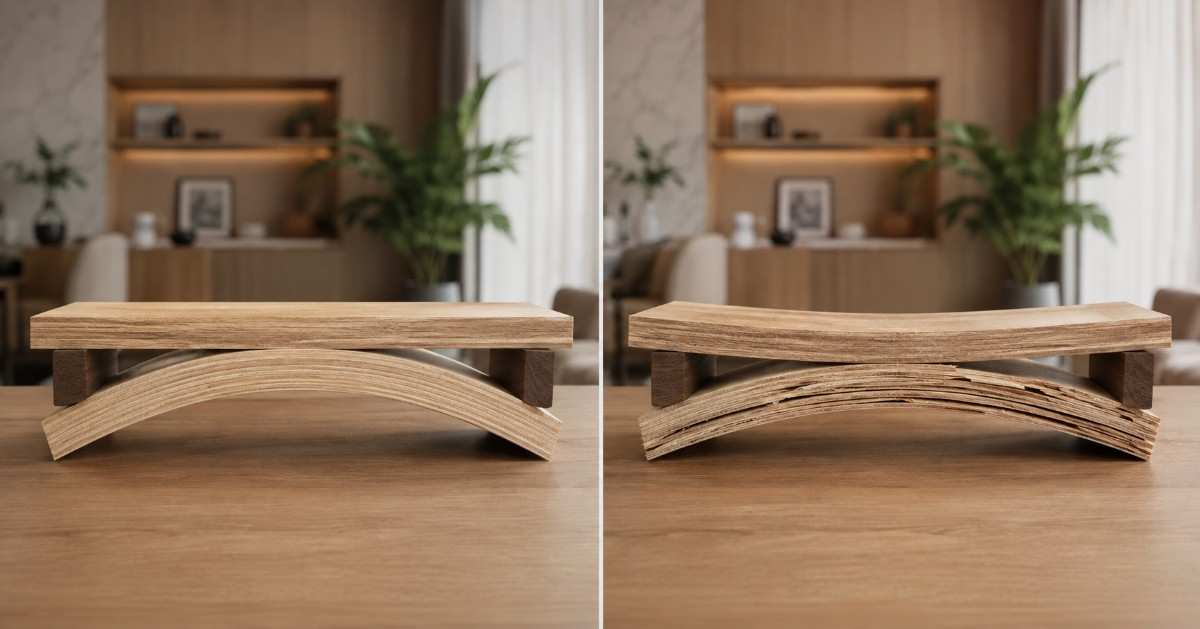
Not all furniture failures happen because of poor workmanship.
Many occur because the material cannot withstand bending forces over time.
Whether it is a wardrobe shelf carrying heavy clothes, a modular kitchen cabinet supporting appliances, or an office workstation spanning long distances, the ability of a board to resist bending directly affects furniture performance and lifespan.
This property is known as bending strength.
When comparing HDHMR vs plywood, bending strength is one of the most important structural performance indicators. It determines how much load a panel can carry before it starts to sag, deform, crack, or fail.
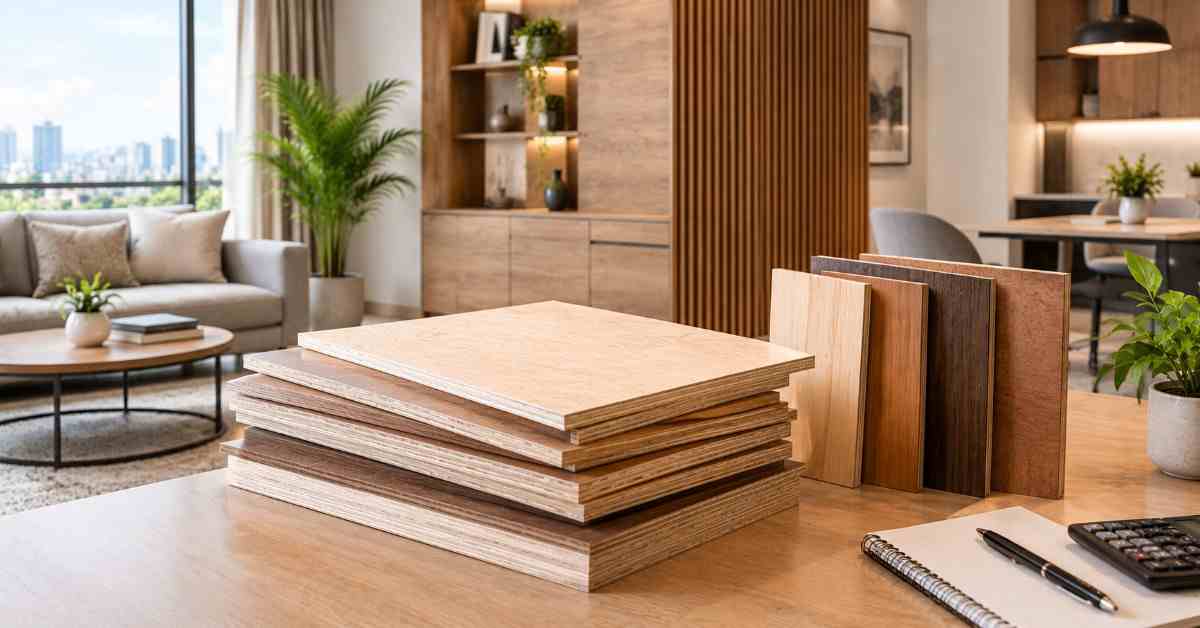
Many homeowners assume that HDHMR’s high density automatically makes it stronger than plywood. However, density and bending strength are not the same thing. HDHMR derives its strength from a highly compressed fiber structure, while plywood gains strength through cross-laminated wood veneers that distribute loads across multiple grain directions. This gives plywood excellent flexural performance and load-bearing capability in many furniture applications.
The debate around bending strength of HDHMR versus bending strength of plywood becomes especially relevant when selecting materials for long shelves, modular kitchen carcasses, wardrobes, office furniture, study tables, and other load-bearing furniture components.
For premium furniture manufacturing, the question is not simply which material is stronger. The real question is which material delivers the best combination of bending resistance, structural reliability, durability, and long-term value.
In this guide, we examine HDHMR board vs plywood, explain what bending strength is, compare the bending strength of HDHMR and plywood, analyze performance in common furniture applications, and help you determine which material is the better choice for your project.
What Is Nail Holding Strength & Why It Matters in Furniture — HDHMR vs Plywood Explained
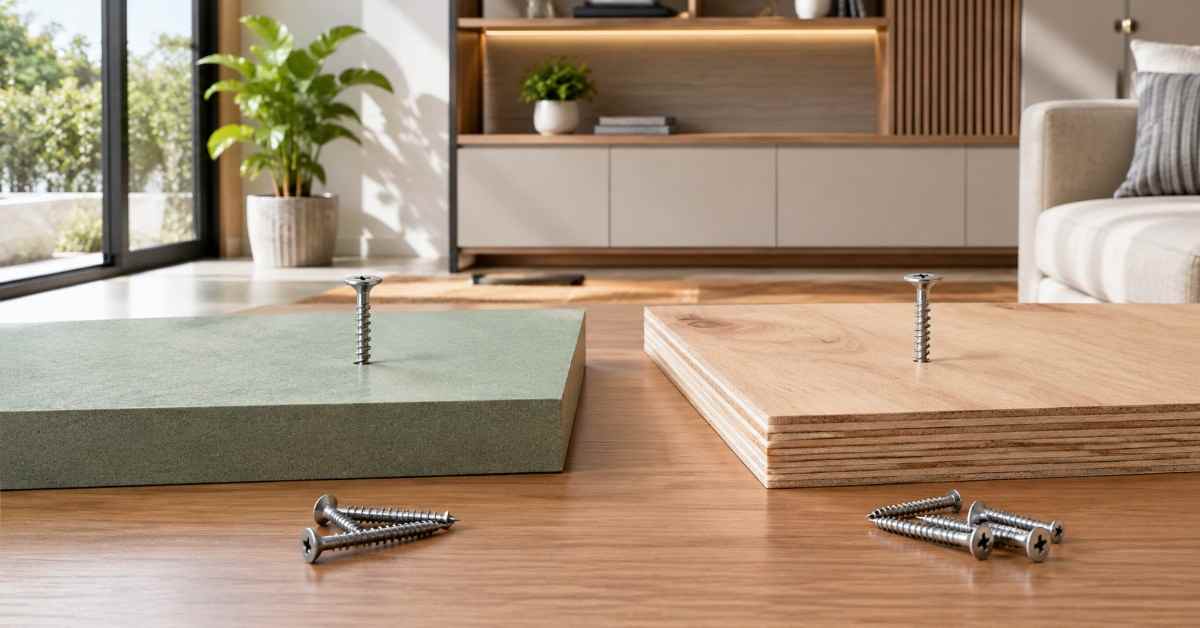
When comparing HDHMR vs plywood, most buyers focus on moisture resistance, finish quality, or price. However, one factor has a far greater impact on furniture longevity: nail and screw holding strength.
Every piece of furniture relies on mechanical fasteners to stay structurally sound. Hinges, drawer channels, handles, shelf supports, cabinet connectors, and mounting brackets all depend on the board’s ability to securely grip nails and screws throughout years of use.
This is exactly why nail holding strength matters in furniture.
Why Nail Holding Strength Matters in Furniture
Modern furniture experiences constant movement and load cycles.
Kitchen shutters are opened and closed multiple times every day. Drawer runners support repeated weight. Wardrobe hinges endure thousands of opening cycles during their lifespan.
If the board cannot retain fasteners securely, problems begin to appear.
| Furniture Component | Impact of Poor Fastener Holding |
| Cabinet hinges | Loose or misaligned shutters |
| Drawer runners | Sagging drawers and channel failure |
| Shelf supports | Reduced load-bearing reliability |
| Handles and knobs | Fastener loosening over time |
| Wardrobe fittings | Structural instability |
| Modular furniture joints | Joint separation and wobbling |
In most furniture failures, the problem is not the hardware itself. The issue is often the board losing its grip on the fastener.
How Nail Holding Strength Works at a Material Level
The ability of a panel to hold nails and screws depends on its internal structure.
Plywood and HDHMR achieve this in fundamentally different ways.
Plywood Construction
Plywood consists of multiple cross-laminated veneer layers bonded together. Each veneer layer is positioned at a different grain orientation.
When a screw or nail enters the panel, it passes through multiple alternating grain directions.
This creates mechanical resistance throughout the thickness of the board.
The fastener effectively locks into multiple wood fiber orientations simultaneously.
HDHMR Construction
HDHMR (High Density High Moisture Resistant Board) is manufactured from compressed wood fibers bonded together under high pressure.
Because the structure is homogeneous rather than layered, fastener retention relies primarily on density.
While the board can provide reasonable holding strength on its face surface, it lacks the multidirectional grain structure that gives plywood its superior grip.
Nail Holding Strength of Plywood vs Nail Holding Strength of HDHMR
The difference becomes particularly important in real furniture applications.
Most hinges, connectors, and assembly fasteners are fixed near panel edges rather than the centre of the board.
This is where plywood’s layered construction provides a significant advantage.
| Performance Parameter | Plywood | HDHMR |
| Face nail holding | Excellent | Good |
| Face screw holding | Excellent | Good |
| Edge nail holding | Excellent | Moderate |
| Edge screw holding | Excellent | Moderate to Fair |
| Screw withdrawal resistance | Very High | Moderate |
| Hinge fixing reliability | Excellent | Moderate |
| Joint strength | Excellent | Moderate |
| Resistance to fastener loosening | High | Medium |
| Long-term structural performance | Excellent | Good |
| Risk of edge crumbling | Very Low | Higher |
Why Plywood Performs Better at Edges
Furniture hardware is rarely installed in the centre of a panel.
Examples include:
- Kitchen cabinet hinges
- Wardrobe shutter hinges
- Drawer runner screws
- Shelf support fixings
- Connector fittings
- Modular cabinet joints
These applications place significant stress on board edges.
In plywood, alternating veneer layers distribute these stresses across multiple grain directions.
In HDHMR, the stress is concentrated within compressed fibers that can gradually weaken around the fastener under repeated loading.
This is why furniture manufacturers often prefer plywood for hinge-heavy and hardware-intensive applications.
HDHMR vs Plywood for Furniture Hardware
HDHMR certainly offers benefits.
Its high density, smooth surface, and machining characteristics make it popular for decorative furniture applications.
However, when the evaluation focuses specifically on nail holding strength of HDHMR versus nail holding strength of plywood, plywood maintains a clear structural advantage.
The reason is simple:
- Plywood combines density with cross-grain reinforcement.
- HDHMR relies primarily on density alone.
The cross-laminated construction creates stronger mechanical locking around fasteners, especially at edges and joints where furniture experiences the highest stresses.
Which Material Offers Better Fastener Grip?
For applications where hinges, drawer channels, connectors, shelf supports, and hardware reliability are important, the answer is straightforward.
| Application Requirement | Recommended Material |
| Heavy-duty modular furniture | Plywood |
| Kitchen cabinet hinges | Plywood |
| Wardrobe shutters | Plywood |
| High-load shelving | Plywood |
| Furniture joints and connectors | Plywood |
| Decorative panels with minimal hardware | HDHMR can be considered |
Verdict: HDHMR vs Plywood for Nail Holding Strength
If the primary criterion is fastener retention, plywood outperforms HDHMR.
Its cross-laminated veneer construction provides superior face and edge holding strength, higher screw withdrawal resistance, stronger hinge performance, and better long-term reliability in modular furniture applications.
For furniture where structural durability matters as much as appearance, plywood remains the benchmark material for dependable nail and screw holding performance.
HDHMR vs Plywood Bending Strength in Practice — 18mm Comparison, Price & Which to Choose
Understanding bending strength becomes much easier when viewed through actual furniture applications.
While laboratory values such as Modulus of Rupture (MOR) are useful, homeowners, architects, and furniture manufacturers ultimately care about one question:
Which material performs better in real furniture?
The answer depends largely on span length, load intensity, and how the furniture will be used over time.
Where Bending Strength Matters Most in Furniture
Certain furniture components are constantly exposed to bending forces.
These applications reveal the performance difference between HDHMR board vs plywood very quickly.
| Furniture Application | Structural Demand | Better Choice |
| Long-span wardrobe shelves | Heavy continuous load | Plywood |
| Modular kitchen shelving | Appliance and utensil weight | Plywood |
| Cabinet bases | Concentrated point loads | Plywood |
| Office workstations | Equipment and document loads | Plywood |
| Bookshelves | High long-term loading | Plywood |
| Decorative shutters | Minimal bending stress | HDHMR Acceptable |
| Wall panels | Low structural demand | HDHMR Acceptable |
Long-Span Kitchen Shelving
Kitchen shelves often carry:
- Cookware
- Crockery
- Small appliances
- Food storage containers
Over time, even a small amount of deflection can become noticeable.
Because plywood distributes stress through multiple veneer layers, it maintains better dimensional stability across longer unsupported spans.
HDHMR shelves may perform adequately at shorter spans, but as span lengths increase, deflection becomes more noticeable under sustained loading.
Modular Wardrobe Shelving
Wardrobes frequently support:
- Folded garments
- Linen storage
- Seasonal clothing
- Accessories
These loads remain on shelves continuously for years.
A material with lower bending resistance gradually develops sagging at the centre span.
Plywood’s cross-laminated construction helps resist this long-term deformation more effectively.
Cabinet Bases and Appliance Support
Cabinet bases experience concentrated loads from:
- Microwave ovens
- Water purifiers
- Storage systems
- Kitchen accessories
Point loads create localized stress concentrations.
Plywood distributes these forces across multiple veneer layers, reducing the risk of permanent deformation.
Office Furniture Applications
Office furniture faces continuous operational loading.
Examples include:
- Desktop equipment
- Filing systems
- Storage cabinets
- Workstations
Repeated loading cycles can gradually affect panel flatness.
Plywood’s superior flexural performance makes it a preferred choice for demanding office environments.
HDHMR vs Plywood Strength at 18mm Thickness
One of the most common comparisons in furniture manufacturing is 18mm HDHMR vs 18mm plywood.
Since both materials are widely available in this thickness, the comparison provides a useful benchmark.
At equivalent thickness, plywood generally demonstrates:
- Higher bending strength
- Lower deflection under load
- Better long-span performance
- Greater resistance to permanent sagging
- Improved structural reliability
| Performance Parameter (18mm) | Plywood | HDHMR |
| Bending strength | Higher | |
| Deflection under load | Lower | |
| Long-span shelf performance | Excellent | |
| Resistance to sagging | Excellent | |
| Structural furniture suitability | Excellent | |
| Performance under concentrated loads | Excellent | |
| Long-term dimensional stability | Excellent | |
| Decorative furniture applications | Excellent | Good |
Why the Difference Exists
The advantage comes from construction rather than thickness.
An 18mm plywood panel contains multiple veneer layers with alternating grain directions.
These layers reinforce one another under bending stress.
An 18mm HDHMR panel relies primarily on material density.
While density contributes to strength, it cannot fully replicate the multidirectional reinforcement provided by plywood’s cross-laminated structure.
When HDHMR’s Bending Performance Is Sufficient
This does not mean HDHMR lacks value.
There are many applications where its bending performance is entirely adequate.
Examples include:
| Application | Suitability of HDHMR |
| Decorative cabinet shutters | Excellent |
| CNC-routed furniture fronts | Excellent |
| Wall-mounted decorative panels | Excellent |
| Low-load partitions | Good |
| Short-span display shelving | Good |
| Interior design feature panels | Excellent |
In these situations, bending loads are relatively low and structural performance is not the primary requirement.
Bending Strength HDHMR vs Plywood Price
Many buyers assume stronger materials automatically cost significantly more.
However, this is not always the case.
When comparing premium furniture-grade HDHMR and quality plywood products, the price difference is often smaller than expected.
The more important consideration is value.
| Evaluation Factor | Wigwam Ply Plywood | HDHMR |
| Bending strength | Higher | |
| Long-span performance | Better | |
| Structural reliability | Better | |
| Furniture lifespan potential | Higher | |
| Load-bearing efficiency | Higher | |
| Value for structural furniture | Excellent | |
| Decorative application suitability | Excellent | Excellent |
Actual market prices vary based on thickness, grade, location, and finish requirements. Prices are subject to change.
For furniture expected to carry substantial loads throughout its life, plywood often delivers a stronger performance-to-cost ratio.
Why WigwamPly Plywood Offers a Structural Advantage
Premium plywood products such as Wigwam Fabricate, Wigwam Visor, and other furniture-grade Wigwam Ply solutions combine structural strength with advanced manufacturing quality.
Features such as:
- Cross-laminated hardwood veneers
- Full-core construction
- Both-side calibration
- Precision bonding
- IS-certified quality standards
help ensure consistent bending performance across the entire sheet.
These characteristics are particularly valuable in modular kitchens, wardrobes, office furniture, shelving systems, and other load-bearing furniture applications.
Quick Decision Guide
| Furniture Requirement | Recommended Material |
| Long-span shelving | Wigwam Ply Plywood |
| Heavy-load wardrobes | Wigwam Ply Plywood |
| Modular kitchen carcasses | Wigwam Ply Plywood |
| Cabinet bases | Wigwam Ply Plywood |
| Office workstations | Wigwam Ply Plywood |
| Decorative shutters | HDHMR Acceptable |
| CNC-routed furniture fronts | HDHMR Acceptable |
| Wall panels and feature elements | HDHMR Acceptable |
Verdict
When comparing HDHMR vs plywood strength, plywood remains the stronger structural material.
At 18mm thickness, plywood delivers higher bending strength, lower deflection, and better long-term resistance to sagging than HDHMR. For furniture components that carry significant loads, span longer distances, or must maintain their shape over many years, WigwamPly plywood offers the superior structural solution and stronger overall value proposition.
Build Stronger Furniture with Wigwam Ply
Furniture should do more than look good on day one. It should remain strong, stable, and structurally reliable for years of daily use.
That’s why leading architects, interior designers, furniture manufacturers, and homeowners choose WigwamPly.
Engineered with premium hardwood veneers, precision cross-laminated construction, both-side calibration, and IS-certified manufacturing standards, Wigwam Ply delivers superior bending strength, better load distribution, and long-term resistance to sagging and deformation. Whether you’re building modular kitchens, wardrobes, bookshelves, office furniture, or heavy-duty storage systems, Wigwam Ply provides the structural confidence that modern furniture demands.
Premium ranges such as Wigwam Fabricate, Wigwam Visor, and other furniture-grade plywood solutions are designed to handle demanding loads while maintaining dimensional stability and finish quality over time.
Choose WigwamPly for stronger shelves, sturdier furniture, and lasting performance where it matters most.
Explore the complete Wigwam Ply range and discover how superior engineering translates into furniture that stays stronger, longer.
Frequently Asked Questions
What is bending strength in plywood?
Bending strength, also known as Modulus of Rupture (MOR), is a material’s ability to resist cracking, sagging, or breaking when subjected to a load. In furniture applications, bending strength determines how well shelves, cabinet bases, desktops, and partitions withstand weight without deforming over time.
Is plywood stronger than HDHMR in bending?
Yes. In most structural furniture applications, plywood offers higher bending strength than HDHMR. Its cross-laminated veneer construction distributes stress across multiple grain directions, resulting in better load-bearing capacity, lower deflection, and greater resistance to long-term sagging compared to HDHMR boards of the same thickness.
Which is better for shelving — HDHMR or plywood?
For load-bearing shelves, plywood is generally the better choice.
Plywood performs particularly well in:
- Bookshelves
- Wardrobe shelves
- Kitchen storage shelves
- Office storage systems
- Long-span shelving units
HDHMR can be suitable for decorative or shorter-span shelving where loads remain relatively light.
Does 18mm HDHMR bend more than 18mm plywood?
Typically, yes.
At the same 18mm thickness, plywood generally exhibits lower deflection under load than HDHMR. This means an 18mm plywood shelf is less likely to sag over time when supporting heavy or continuous loads.
| Performance at 18mm Thickness | Plywood | HDHMR |
| Bending strength | Higher | Moderate |
| Deflection under load | Lower | Higher |
| Long-span performance | Better | Moderate |
| Resistance to sagging | Better | Moderate |
Which material should I choose for modular kitchen shelves?
For modular kitchen shelving and carcasses, premium plywood is usually the preferred option because of its superior bending strength, better screw-holding capacity, and enhanced long-term structural stability.
Products such as Wigwam Visor (IS 710 Marine Grade) and Wigwam Fabricate are particularly suitable for kitchens where both moisture resistance and load-bearing performance are important.
Why does plywood resist sagging better than HDHMR?
Plywood contains multiple cross-laminated veneer layers arranged in alternating grain directions. This structure distributes stress throughout the panel and helps resist bending forces.
HDHMR relies on compressed wood fibers and density for strength. While it offers good uniformity and surface quality, it lacks the multidirectional grain reinforcement that gives plywood superior flexural performance.
Is HDHMR good for furniture?
Yes. HDHMR is a useful furniture material, especially for:
- Decorative cabinet shutters
- CNC-routed furniture fronts
- Wall panels
- Low-load furniture components
- Premium painted finishes
However, for heavily loaded structural furniture components, plywood generally offers better performance.
Can HDHMR be used for wardrobe shelves?
HDHMR can be used for wardrobe shelves, particularly in shorter spans with moderate loads. However, for large wardrobes carrying substantial clothing, linen, and accessories, plywood typically provides better resistance to long-term sagging and deformation.
What affects the bending strength of a furniture board?
Several factors influence bending strength:
| Factor | Impact on Strength |
| Material composition | Determines structural behavior |
| Thickness | Greater thickness generally increases strength |
| Core quality | Affects load distribution |
| Manufacturing process | Influences consistency and durability |
| Moisture exposure | Can reduce long-term performance |
| Span length | Longer spans increase bending stress |
Why do architects and furniture manufacturers often prefer plywood?
Professionals frequently specify plywood because it combines:
- High bending strength
- Excellent screw-holding capacity
- Superior load-bearing performance
- Better edge durability
- Long-term dimensional stability
These qualities make plywood a reliable choice for modular kitchens, wardrobes, office furniture, shelving systems, and other structural furniture applications.
Is higher density always equal to higher bending strength?
No.
Density contributes to strength, but bending performance depends on both density and internal structure. HDHMR is denser than many plywood products, but plywood’s cross-laminated construction allows it to distribute loads more effectively, resulting in superior bending performance in many furniture applications.
Which Wigwam Ply products are suitable for load-bearing furniture?
For furniture requiring high structural strength, products such as:
- Wigwam Fabricate
- Wigwam Visor
- Premium furniture-grade Wigwam Ply plywood
are suitable choices. Their quality veneer construction, calibration, and certified manufacturing standards help deliver reliable long-term performance in demanding applications.