A furniture panel is only as strong as the fasteners holding it together.
Whether it is a wardrobe hinge, kitchen shutter, drawer runner, shelf support, or bed fitting, the long-term durability of furniture depends heavily on nail holding strength and screw holding capacity.
Many homeowners compare HDHMR vs plywood based on moisture resistance, finish quality, or cost. However, one of the most overlooked factors is how well the material holds nails and screws over years of daily use.
This becomes especially important in modern modular furniture. Hinges are opened thousands of times. Drawer channels carry repeated loads. Wall-mounted cabinets transfer weight through screws and hardware. If the panel cannot hold fasteners securely, furniture begins to loosen, sag, or fail prematurely.
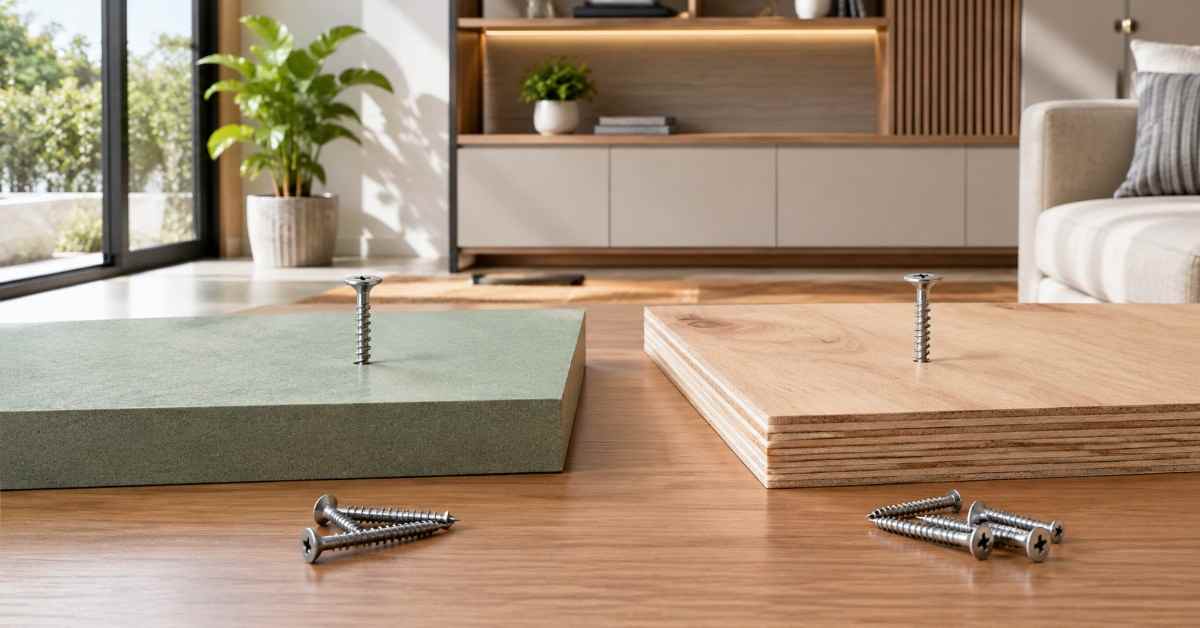
While HDHMR board benefits include high density, smooth surfaces, and moisture resistance, plywood has long been known for exceptional fastening performance because of its cross-laminated veneer construction. Industry comparisons consistently show plywood providing superior edge screwing performance and structural holding capacity, while HDHMR offers good face screw holding due to its dense, uniform composition.
For furniture manufacturers, carpenters, architects, and homeowners, understanding the difference between nail holding strength of HDHMR and nail holding strength of plywood is critical before choosing a material.
In this guide, we compare HDHMR board vs plywood, examine plywood screw holding strength, explore why fastening performance matters in furniture, and explain how premium plywood solutions from WigwamPly deliver reliable long-term structural performance for demanding furniture applications.
Top 10 Best Plywood Brands in India: Best Plywood Companies Compared
What Is Nail Holding Strength & Why It Matters in Furniture — HDHMR vs Plywood Explained
When comparing HDHMR vs plywood, most buyers focus on moisture resistance, finish quality, or price. However, one factor has a far greater impact on furniture longevity: nail and screw holding strength.
Every piece of furniture relies on mechanical fasteners to stay structurally sound. Hinges, drawer channels, handles, shelf supports, cabinet connectors, and mounting brackets all depend on the board’s ability to securely grip nails and screws throughout years of use.
This is exactly why nail holding strength matters in furniture.
Why Nail Holding Strength Matters in Furniture
Modern furniture experiences constant movement and load cycles.
Kitchen shutters are opened and closed multiple times every day. Drawer runners support repeated weight. Wardrobe hinges endure thousands of opening cycles during their lifespan.
If the board cannot retain fasteners securely, problems begin to appear.
| Furniture Component | Impact of Poor Fastener Holding |
| Cabinet hinges | Loose or misaligned shutters |
| Drawer runners | Sagging drawers and channel failure |
| Shelf supports | Reduced load-bearing reliability |
| Handles and knobs | Fastener loosening over time |
| Wardrobe fittings | Structural instability |
| Modular furniture joints | Joint separation and wobbling |
In most furniture failures, the problem is not the hardware itself. The issue is often the board losing its grip on the fastener.
How Nail Holding Strength Works at a Material Level
The ability of a panel to hold nails and screws depends on its internal structure.
Plywood and HDHMR achieve this in fundamentally different ways.
Plywood Construction
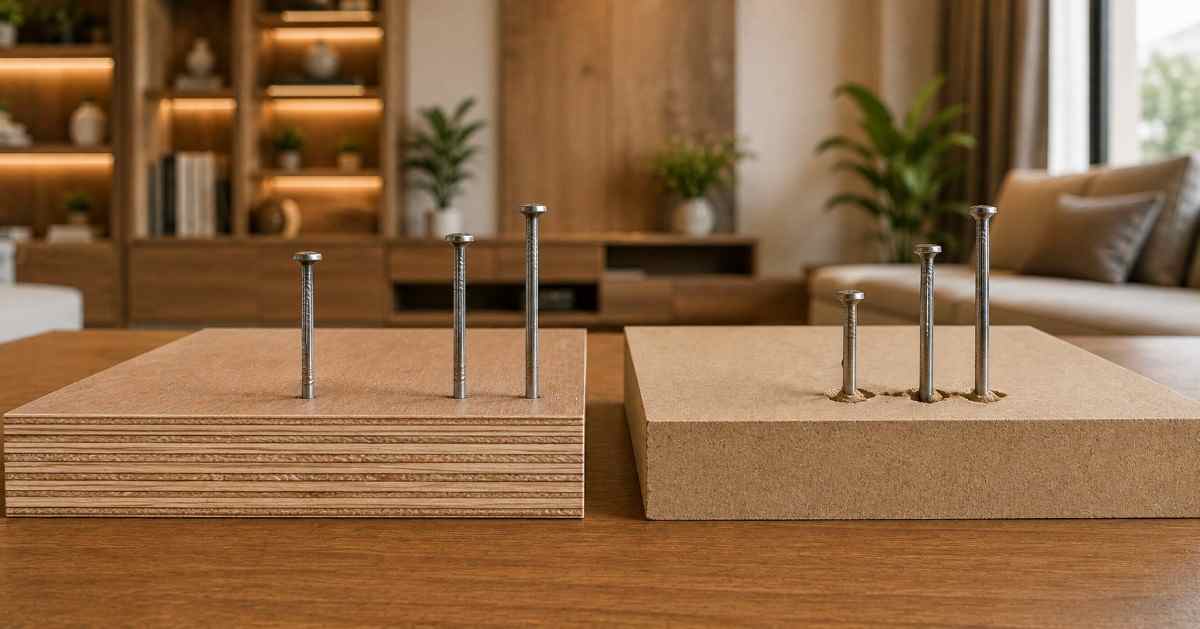
Plywood consists of multiple cross-laminated veneer layers bonded together. Each veneer layer is positioned at a different grain orientation.
When a screw or nail enters the panel, it passes through multiple alternating grain directions.
This creates mechanical resistance throughout the thickness of the board.
The fastener effectively locks into multiple wood fiber orientations simultaneously.
HDHMR Construction
HDHMR (High Density High Moisture Resistant Board) is manufactured from compressed wood fibers bonded together under high pressure.
Because the structure is homogeneous rather than layered, fastener retention relies primarily on density.
While the board can provide reasonable holding strength on its face surface, it lacks the multidirectional grain structure that gives plywood its superior grip.
Nail Holding Strength of Plywood vs Nail Holding Strength of HDHMR
The difference becomes particularly important in real furniture applications.
Most hinges, connectors, and assembly fasteners are fixed near panel edges rather than the centre of the board.
This is where plywood’s layered construction provides a significant advantage.
| Performance Parameter | Plywood | HDHMR |
| Face nail holding | Excellent | Good |
| Face screw holding | Excellent | Good |
| Edge nail holding | Excellent | Moderate |
| Edge screw holding | Excellent | Moderate to Fair |
| Screw withdrawal resistance | Very High | Moderate |
| Hinge fixing reliability | Excellent | Moderate |
| Joint strength | Excellent | Moderate |
| Resistance to fastener loosening | High | Medium |
| Long-term structural performance | Excellent | Good |
| Risk of edge crumbling | Very Low | Higher |
Why Plywood Performs Better at Edges
Furniture hardware is rarely installed in the centre of a panel.
Examples include:
- Kitchen cabinet hinges
- Wardrobe shutter hinges
- Drawer runner screws
- Shelf support fixings
- Connector fittings
- Modular cabinet joints
These applications place significant stress on board edges.
In plywood, alternating veneer layers distribute these stresses across multiple grain directions.
In HDHMR, the stress is concentrated within compressed fibers that can gradually weaken around the fastener under repeated loading.
This is why furniture manufacturers often prefer plywood for hinge-heavy and hardware-intensive applications.
HDHMR vs Plywood for Furniture Hardware
HDHMR certainly offers benefits.
Its high density, smooth surface, and machining characteristics make it popular for decorative furniture applications.
However, when the evaluation focuses specifically on nail holding strength of HDHMR versus nail holding strength of plywood, plywood maintains a clear structural advantage.
The reason is simple:
- Plywood combines density with cross-grain reinforcement.
- HDHMR relies primarily on density alone.
The cross-laminated construction creates stronger mechanical locking around fasteners, especially at edges and joints where furniture experiences the highest stresses.
Which Material Offers Better Fastener Grip?
For applications where hinges, drawer channels, connectors, shelf supports, and hardware reliability are important, the answer is straightforward.
| Application Requirement | Recommended Material |
| Heavy-duty modular furniture | Plywood |
| Kitchen cabinet hinges | Plywood |
| Wardrobe shutters | Plywood |
| High-load shelving | Plywood |
| Furniture joints and connectors | Plywood |
| Decorative panels with minimal hardware | HDHMR can be considered |
Verdict: HDHMR vs Plywood for Nail Holding Strength
If the primary criterion is fastener retention, plywood outperforms HDHMR.
Its cross-laminated veneer construction provides superior face and edge holding strength, higher screw withdrawal resistance, stronger hinge performance, and better long-term reliability in modular furniture applications.
For furniture where structural durability matters as much as appearance, plywood remains the benchmark material for dependable nail and screw holding performance.
WigwamPly Plywood vs HDHMR — Screw Holding Capacity, Board Benefits & Which to Choose for Furniture
While plywood often leads the conversation on structural performance, it is important to acknowledge that HDHMR board has several genuine advantages that make it suitable for specific furniture applications.
The key is understanding where HDHMR board vs plywood excels and where each material should be used.
HDHMR Board Benefits
HDHMR (High Density High Moisture Resistant Board) is engineered to deliver a dense, uniform surface with good machinability and moisture resistance.
Its benefits include:
| HDHMR Board Benefit | Practical Advantage |
| High surface density | Good face screw and nail holding |
| Smooth, uniform surface | Excellent for laminates and decorative finishes |
| CNC routing compatibility | Suitable for decorative profiling and machining |
| Moisture resistance | Better moisture performance than standard MDF |
| Consistent composition | Predictable machining results |
| Paint and laminate compatibility | Ideal for decorative furniture components |
These characteristics make HDHMR a practical choice for cabinet shutters, decorative wall panels, routed furniture fronts, and applications where most fasteners are installed through the face rather than the edge.
Why Wigwam Ply Plywood Delivers Superior Screw Holding Strength
When furniture performance depends on fasteners, plywood screw holding strength becomes one of the most important material selection criteria.
Unlike HDHMR, plywood derives its strength from multiple cross-laminated veneer layers bonded together under pressure.
This construction creates numerous grain interfaces that mechanically lock around screws and nails, resulting in stronger withdrawal resistance and better long-term holding performance.
Premium plywood products from Wigwam Ply further strengthen this advantage through advanced manufacturing practices.
| Wigwam Ply Feature | Fastener Holding Benefit |
| Cross-laminated veneer construction | Superior screw withdrawal strength |
| Full-core construction | Consistent holding performance throughout the sheet |
| Reduced internal voids | Reliable grip without weak spots |
| Both-side calibration | Uniform density and fastening consistency |
| IS-certified manufacturing standards | Predictable structural performance |
| Premium hardwood veneers | Enhanced mechanical strength |
The result is stronger and more reliable plywood screw holding capacity, especially in demanding furniture applications.
Where Plywood’s Fastener Advantage Becomes Critical
The difference between HDHMR and plywood becomes most noticeable in furniture that experiences repeated movement, load, and hardware stress.
Modular Kitchen Carcasses
Kitchen cabinets contain:
- Hinges
- Drawer runners
- Pull-out systems
- Tandem channels
- Basket mechanisms
Most of these components are fixed near edges.
Plywood’s superior edge holding helps maintain hardware alignment and reduce loosening over years of daily use.
Products such as Wigwam Visor (IS 710 Marine Grade) and Wigwam Fabricate are particularly suitable for kitchen environments where both moisture resistance and screw holding strength matter.
Floor-to-Ceiling Wardrobes
Large wardrobes place substantial loads on:
- Shelf supports
- Hanging rail brackets
- Hinge systems
- Connector fittings
These loads are transferred directly through fasteners.
Plywood’s cross-laminated structure provides stronger retention and greater resistance to long-term loosening.
Office Furniture
Office furniture experiences continuous operational stress.
Drawer units, filing cabinets, workstations, and storage systems often undergo thousands of opening and closing cycles annually.
Reliable fastener retention helps maintain alignment and structural integrity over time.
Plywood vs HDHMR: Furniture Performance Comparison
| Performance Factor | Wigwam Ply Plywood | HDHMR |
| Face screw holding | Excellent | Good |
| Edge screw holding | Excellent | Moderate |
| Screw withdrawal strength | Excellent | Moderate |
| Hinge fixing reliability | Excellent | Moderate |
| Drawer runner performance | Excellent | Good |
| Heavy-load furniture suitability | Excellent | Moderate |
| Decorative routed panels | Good | Excellent |
| Structural furniture performance | Excellent | Moderate |
| Long-term hardware retention | Excellent | Good |
Understanding the Value Perspective
The comparison between HDHMR and plywood should not focus solely on initial material cost.
Instead, buyers should consider long-term furniture performance.
| Consideration | Wigwam Ply Plywood | HDHMR |
| Initial material investment | Moderate to Premium | Moderate |
| Hardware retention lifespan | Longer | Moderate |
| Risk of hinge loosening | Lower | Higher |
| Structural reliability | Higher | Moderate |
| Furniture maintenance requirement | Lower | Moderate |
| Long-term value | Excellent | Good |
Actual market prices vary by thickness, grade, location, and finish specification. Prices are subject to change.
Quick Decision Guide
| Furniture Requirement | Recommended Material |
| Modular kitchen carcasses | Wigwam Ply Plywood |
| Floor-to-ceiling wardrobes | Wigwam Ply Plywood |
| Office storage systems | Wigwam Ply Plywood |
| Heavy-load shelving | Wigwam Ply Plywood |
| Hinge-heavy furniture | Wigwam Ply Plywood |
| Decorative routed shutters | HDHMR Acceptable |
| CNC-profiled decorative panels | HDHMR Acceptable |
| Low-fastener furniture fronts | HDHMR Acceptable |
Which Should You Choose?
If the project involves structural furniture, frequent hardware usage, heavy loads, or long-term durability requirements, WigwamPly plywood remains the stronger choice.
Its superior plywood screw holding strength, reliable plywood screw holding capacity, premium veneer construction, and calibrated manufacturing provide advantages that become increasingly important as furniture ages.
HDHMR remains a useful material for decorative and surface-focused applications. However, when the priority is dependable fastener retention, hinge reliability, and structural performance, plywood continues to set the benchmark for furniture-grade construction.
Build Furniture That Stays Strong for Years with Wigwam Ply
Furniture performance is not determined by appearance alone. The true test lies in how well it withstands daily use, repeated loading, and constant hardware movement over time.
That’s where WigwamPly makes the difference.
Engineered with premium hardwood veneers, precision manufacturing, and both-side calibration, Wigwam Ply delivers exceptional screw-holding strength, reliable edge fastening, and long-term structural stability for demanding furniture applications. Whether you’re building modular kitchens, wardrobes, office furniture, shelving systems, or custom interiors, Wigwam Ply provides the strength needed to keep hinges, runners, connectors, and fittings secure for years.
From moisture-resistant solutions to premium furniture-grade plywood, Wigwam Ply combines durability, precision, and performance in every sheet.
Choose WigwamPly for stronger joints, better hardware retention, and furniture built to last.
Explore the complete range of Wigwam Ply products and discover why architects, designers, carpenters, and homeowners trust Wigwam Ply for premium furniture and interior projects across India.
Frequently Asked Questions
Does plywood hold nails better than HDHMR?
In most furniture applications, yes.
Plywood generally offers better nail and screw holding strength than HDHMR, particularly at edges and joints. Its cross-laminated veneer construction creates multiple grain directions that mechanically grip fasteners, resulting in stronger withdrawal resistance and long-term holding performance. HDHMR provides good face holding due to its density but is typically less reliable at edges where many furniture fittings are installed.
Why does edge nail holding matter in modular furniture?
Most furniture hardware is installed near panel edges rather than in the centre.
Examples include:
- Cabinet hinges
- Drawer runners
- Shelf supports
- Connector fittings
- Hanging rail brackets
Poor edge holding can lead to loose hinges, sagging drawers, misaligned shutters, and weakened furniture joints over time. This is why edge screw-holding performance is often considered one of the most important indicators of furniture durability.
Is HDHMR good for kitchen cabinet carcasses?
HDHMR can be used for kitchen furniture, particularly for shutters and decorative components where smooth surfaces and moisture resistance are priorities.
However, for kitchen carcasses that carry hinges, pull-outs, drawer systems, and heavy hardware loads, many furniture manufacturers prefer plywood because of its superior edge screw-holding strength and long-term structural reliability. The choice ultimately depends on design requirements, load conditions, and expected usage.
What plywood is best for screw holding in modular furniture?
Premium hardwood plywood with high-quality core construction generally provides the best screw-holding performance.
For demanding modular furniture applications, look for:
| Feature | Why It Matters |
| Full-core construction | Consistent fastener grip |
| Minimal internal voids | Reduces weak spots |
| Cross-laminated veneers | Improves screw withdrawal resistance |
| Both-side calibration | Uniform density and performance |
| IS-certified manufacturing | Reliable quality standards |
Products such as Wigwam Fabricate, Wigwam Visor, and other premium Wigwam Ply ranges are designed for furniture applications where hardware retention and structural durability are critical.
How does Wigwam Ply plywood perform on nail holding strength?
Wigwam Ply plywood is engineered to provide strong and consistent fastener retention through:
- Cross-laminated veneer construction
- Premium hardwood core veneers
- Reduced internal voids
- Precision manufacturing
- Both-side calibration
These characteristics help deliver reliable nail and screw holding across both faces and edges, making Wigwam Ply suitable for hinge-heavy modular kitchens, wardrobes, office furniture, shelving systems, and other hardware-intensive furniture applications.
Is plywood screw holding strength better at the face or edge?
Plywood performs well in both areas, but face screw holding is typically the strongest because screws engage multiple veneer layers across a larger surface area. Unlike many fibre-based boards, plywood also maintains excellent edge holding performance, which is one reason it is widely used in modular furniture construction.
Can screws loosen in HDHMR over time?
Like any engineered board, HDHMR can experience reduced holding performance if screws are repeatedly removed and reinstalled or subjected to heavy cyclic loading. Face fastener performance is generally good, but edge fixing points may be more vulnerable to wear compared with plywood over long periods of intensive use.
Which material is better for wardrobes: HDHMR or plywood?
For structural wardrobe components such as carcasses, shelves, hinge supports, and hanging rail fixings, plywood is generally preferred because of its superior screw-holding capacity and long-term load-bearing reliability.
HDHMR remains a good option for decorative shutters and routed panels where surface finish quality is the primary consideration.
Does higher density automatically mean better screw holding?
Not always.
Density contributes to fastener grip, which is why HDHMR performs better than standard MDF. However, plywood benefits from both density and cross-grain reinforcement. This combination often gives plywood an advantage in edge holding, screw withdrawal resistance, and long-term hardware performance.
What should homeowners choose for long-lasting modular furniture?
For furniture expected to carry heavy loads, support frequent hardware movement, and maintain structural stability over many years, premium plywood remains the safest choice.
If the priority is decorative machining, routed designs, or smooth painted surfaces with limited structural demands, HDHMR can also be a suitable option. The best results often come from selecting the material based on the function of each furniture component rather than using a single board type everywhere.