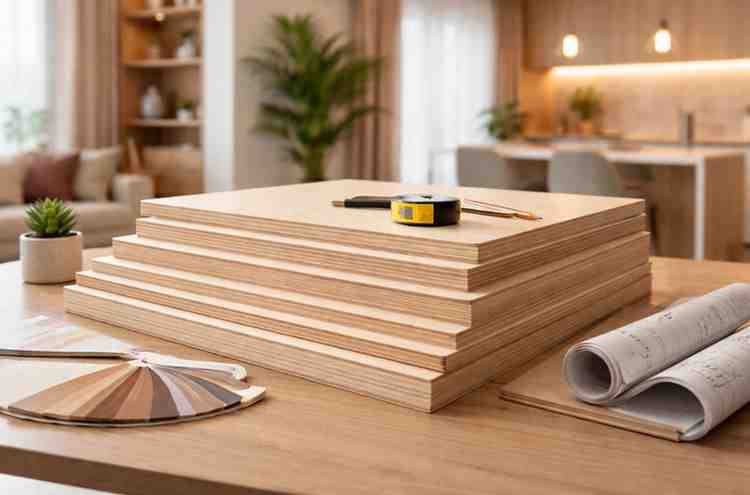
Many individuals select plywood without thoroughly checking its thickness. They either follow the carpenter’s advice or believe that this particular thickness is always preferable.
However, that isn’t always the case.
Standard plywood thickness is important because it influences strength, cost, and long-term durability. Choosing the wrong thickness might either weaken the furniture or waste money.
In this plywood thickness guide for India, we’ll discuss common sheet sizes ranging from 5mm to 30mm, along with where each thickness is appropriate.
What Are Standard Plywood Thicknesses in India?
If you’re wondering what popular plywood thicknesses range from 5 to 30 mm, the following are popular choices: 5, 6, 9, 12, 16, 18, 25, and 30 mm.
Not all projects require 18mm plywood. That’s a common presumption.
Thickness determines how much weight the board can support and how solid it feels. In general, thicker plywood is stronger—but only in certain situations.
Using 18mm everywhere only raises expenses without improving quality.
Standard Plywood Sheet Dimensions in mm Explained
Most plywood sheets in India are 2440mm x 1220mm (8 ft x 4 ft). This dimension is ideal for regular furniture construction, cabinets, and wardrobes.
When comparing plywood sheet dimensions in mm, keep in mind that the thickness might vary from 5mm to 30mm, but sheet length and breadth often remain constant.
Cutting the sheet reduces its size, but good support below is what preserves strength, not just thickness.
Plywood Thickness Uses: Where Each Size Works Best
Understanding the potential uses for plywood thickness helps decision-making. 5 mm to 6 mm is the ideal thickness for cabinet backs and backing panels. It isn’t meant for load-bearing parts.
Light furniture and drawer bottoms work well with 9mm to 12mm. Common uses of 16mm–18mm include shelving, cabinet shutters, and wardrobes.
When significant load-bearing strength is needed, such as for sturdy tabletops or structural components, 25–30 mm is used. Every thickness serves a purpose. Right matching prevents overspending and weakness.
How to Choose Plywood Thickness for Different Applications
When selecting plywood thickness for various uses, consider a few basic factors, such as:
- How much weight will it be able to support?
- What is the duration of the unsupported span?
- Will it come into contact with moisture?
- How much do you have to spend?
How to Choose Plywood Thickness for Wardrobe and Kitchen
Kitchens require slightly different thinking than wardrobes. 16mm or 18mm are typically suitable for shelving and wardrobe shutters. It is possible to create a narrow back panel.
Kitchen cabinet bases and shutters should be sturdy enough to resist weight and daily use. Back panels do not have the same thickness. Plywood that can endure moisture is crucial for kitchens. Thickness alone won’t protect against humidity.
Additionally, avoid using extremely thick plywood if not necessary. It simply adds weight and increases costs.
Best Plywood Thickness Options for Residential Furniture
For most residential furniture:
- Normally, beds need 18mm or more for support and structure.
- 16mm to 18mm are frequently used in TV units.
- Shelves in storage cabinets are typically 16–18 mm.
- For durability, the top surface of study tables might be 18 mm.
The ideal plywood thickness for home furnishings depends on daily use and load.
Plywood Sheet Size for Furniture Projects
When planning a furniture project, keep the following points in mind.
- Plan your cutting structure to reduce waste.
- Make sure the hardware you’re using is the right thickness.
- Avoid using different thicknesses in the same construction unless it is properly designed.
Standard mm plywood sheet size performs best when meticulously prepared before cutting.
Common Mistakes When Selecting Plywood Thickness
When selecting plywood thickness, avoid making these common mistakes:
- Using 12mm when heavier shelves require 18mm.
- Ignoring the presence of moisture in kitchens.
- Making a thickness decision without considering the support structure.
- Spending more on excessive thickness on a false assumption that it will result in higher quality.
The objective determines the ideal thickness, not merely personal taste.
Conclusion
Plywood thickness should always be right for the purpose for which it is planned. If the framework is weak, thicker plywood isn’t necessarily stronger. Proper support is also important. Selecting the right thickness increases durability and reduces costs.
When choosing plywood for your next project, check out Wigwam Ply’s reliable collection and pick the right thickness for durable results.
FAQs
1. When should I use thicker plywood over thinner sheets?
Use thicker plywood when the board’s weight or stability lasts over a longer span. Shelves, bed frames, table-tops, and wardrobe shutters usually require more thickness than back panels.
2. Does plywood thickness affect strength and durability?
Yes, thickness does affect strength. Thicker plywood can handle more load and bending. But strength also depends on support structure — not thickness alone.
3. What plywood thickness is suitable for wardrobes and cabinets?
For wardrobes and cabinets, 16mm or 18mm usually works well for shelves and shutters. Back panels can be thinner, like 6mm or 9mm.
4. Can I use thin plywood for decorative applications?
Yes. Thin plywood, like 5mm or 6mm, is often used for back panels, wall cladding, and decorative surfaces. It’s not meant for heavy load-bearing use.
5. What are the common applications for 25mm plywood?
25mm plywood is used where extra strength is needed — heavy table tops, strong shelving, or structural furniture parts that carry more weight.
6. Are standard sheet dimensions the same for all thicknesses?
Usually yes. The length and width remain the same, but the thickness changes. Most sheets come in standard sizes regardless of thickness.
7. Why is 2440 x 1220 mm a common plywood sheet size?
2440 x 1220 mm (8 ft x 4 ft) is a practical size for furniture making. It fits well with common wardrobe heights and cabinet dimensions, and reduces cutting waste.
8. What are the standard plywood thickness options available in mm?
Common options include 5mm, 6mm, 9mm, 12mm, 16mm, 18mm, 25mm, and 30mm. Not every project needs the thickest option; choose based on use.
9. What is the standard plywood sheet size in mm?
The most common plywood sheet size is 2440mm x 1220mm. Some variations exist, but this is the standard size used in most carpentry projects.
10. How do I choose the right plywood thickness for my project?
Think about how much weight it will carry, how long the span is, and whether moisture is involved. Match thickness to usage, not just cost or assumption.